Pearson Edexcel · A-Level · History
Course version: 9HI0 · Version from Sept 2015
Britain: losing and gaining an empire, 1763–1914 - 3 Learning from past…
Full specification wording
Paper 3, Option 35.1: Britain: losing and gaining an empire, 1763–1914 - 3 Learning from past mistakes: Canada and the Durham Report, 1837–40: The political nature and governmental system of Upper and Lower Canada and the perceived threat from the USA.
After 1791 the Constitutional Act split Quebec into two colonies: Lower Canada, mainly French-speaking and Catholic, and Upper Canada, mainly English-speaking and Protestant.
Checked against the Pearson Edexcel 9HI0 specification (opens in a new tab) on .
- Point 1 of 3
- 3 key terms
Study notes
From the checked teaching notes for this specification point.
The idea
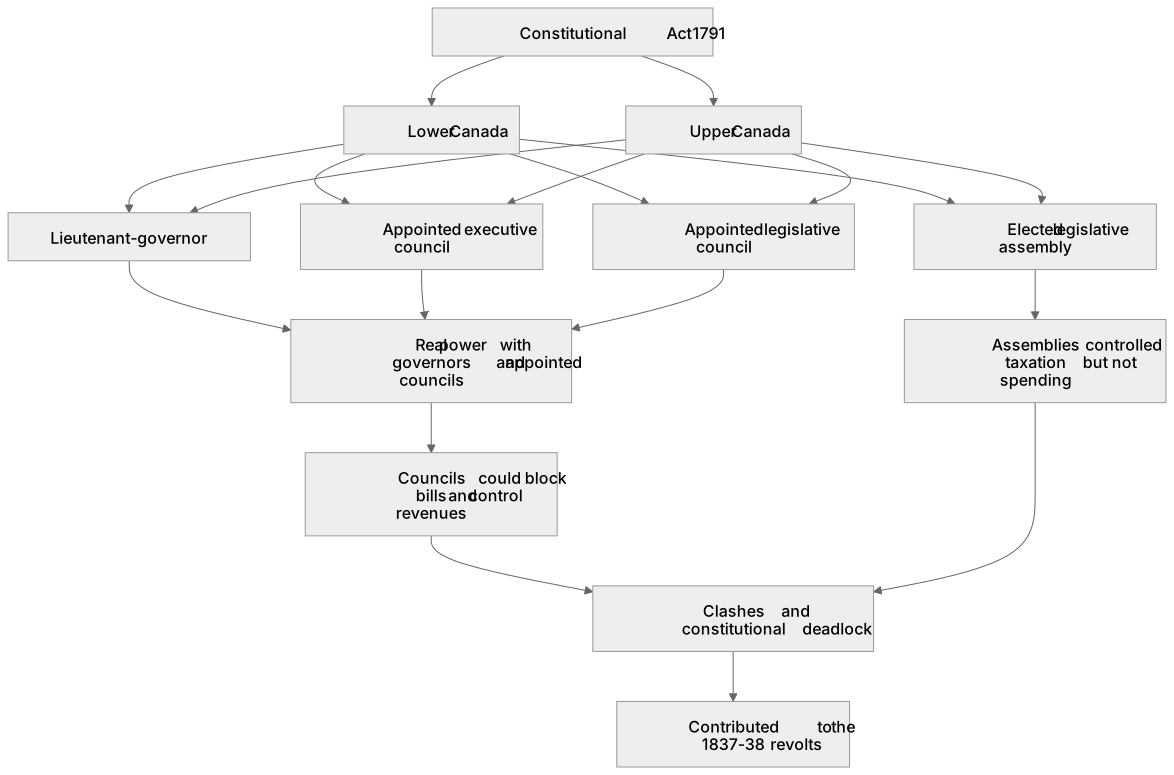
After 1791 the Constitutional Act split Quebec into two colonies: Lower Canada, mainly French-speaking and Catholic, and Upper Canada, mainly English-speaking and Protestant. Each had a lieutenant-governor, an appointed executive council, an appointed legislative council and an elected legislative assembly. Real power lay with the governors and appointed councils, who could block bills and control revenues, so the assemblies often clashed with them. The USA was seen as a threat: after the American Revolution many Loyalists settled in Canada, and the War of 1812 confirmed fears of invasion. The USA's rapid westward expansion and democratic republicanism seemed to menace British rule, especially as many Canadians wanted more control over taxation and spending. This tension shaped the political system and helped cause the 1837–38 revolts.
What earns the marks
- Describes the key features of the 1791 Constitutional Act: division into Upper and Lower Canada, each with a governor, executive council, legislative council and elected assembly.
- Explains that executive and legislative councils were appointed, not elected, and could veto or block assembly decisions, creating a constitutional deadlock.
- Explains that the assemblies controlled taxation but not spending, leading to disputes over revenues and responsible government.
- Explains the perceived threat from the USA: Loyalist settlement after 1783, the War of 1812, and fears of American expansion and republican ideas.
- Analyses how the political system and the American threat together created tensions that contributed to the 1837–38 revolts.
Common mistakes and how to put them right
Stating that Upper and Lower Canada were created in 1840 by the Durham Report.
Put it right: They were created in 1791 by the Constitutional Act; the Durham Report led to the 1840 Act of Union.
Claiming that the legislative councils were elected.
Put it right: They were appointed by the governor, while only the assemblies were elected.
Saying the USA posed no threat after 1815.
Put it right: American expansion and republican ideas continued to be seen as a threat, influencing Canadian politics into the 1830s.
Exam tips
- Use specific terms such as 'Château Clique' and 'Family Compact' to show knowledge of the appointed elites.
- Link the structure of government to the revolts: explain how blocked reforms caused frustration.
- When discussing the American threat, refer to both military fears and ideological influence.
Try the lesson
The start of the Paper 3, Option 35.1: Britain: losing and gaining an empire, 1763–1914 - 3 Learning from past mistakes: Canada and the Durham Report, 1837–40: The political nature and governmental system of Upper and Lower Canada and the perceived threat from the USA. lesson, made from checked teaching notes for this specification point.
Have a go first
Under the Constitutional Act of 1791, which body held the real executive power in Upper and Lower Canada?
Listen
After 1791 the Constitutional Act split Quebec into two colonies: Lower Canada, mainly French-speaking and Catholic, and Upper Canada, mainly English-speaking and Protestant. Each had a lieutenant-governor, an appointed executive council, an appointed legislative council and an elected legislative assembly. Real power lay with the governors and appointed councils, who could block bills and control revenues, so the assemblies often clashed with them. The USA was seen as a threat: after the American Revolution many Loyalists settled in Canada, and the War of 1812 confirmed fears of invasion. The USA's rapid westward expansion and democratic republicanism seemed to menace British rule, especially as many Canadians wanted more control over taxation and spending. This tension shaped the political system and helped cause the 1837–38 revolts. A strong answer earns marks for these points. Describes the key features of the 1791 Constitutional Act: division into Upper and Lower Canada, each with a governor, executive council, legislative council and elected assembly. Explains that executive and legislative councils were appointed, not elected, and could veto or block assembly decisions, creating a constitutional deadlock. Explains that the assemblies controlled taxation but not spending, leading to disputes over revenues and responsible government. Explains the perceived threat from the USA: Loyalist settlement after 1783, the War of 1812, and fears of American expansion and republican ideas. A common slip: stating that Upper and Lower Canada were created in 1840 by the Durham Report. Instead, they were created in 1791 by the Constitutional Act; the Durham Report led to the 1840 Act of Union. Exam tip: Use specific terms such as 'Château Clique' and 'Family Compact' to show knowledge of the appointed elites.
See it
Key words
Say what each word means before you turn the card.
Constitutional structures and power
Try answering aloud or in your head before turning the card.
Colonial governance and representation
Try answering aloud or in your head before turning the card.
American expansionism and republicanism
Try answering aloud or in your head before turning the card.
See every definition
- Constitutional structures and power
- After 1791 each colony had a lieutenant-governor, appointed executive and legislative councils and an elected legislative assembly, but real power lay with the governors and appointed councils.
- Colonial governance and representation
- The appointed councils could block bills and control revenues, so the elected assemblies often clashed with them, and many Canadians wanted more control over taxation and spending.
- American expansionism and republicanism
- The USA's rapid westward expansion and democratic republicanism seemed to menace British rule, and the War of 1812 confirmed fears of invasion.
Label the diagram
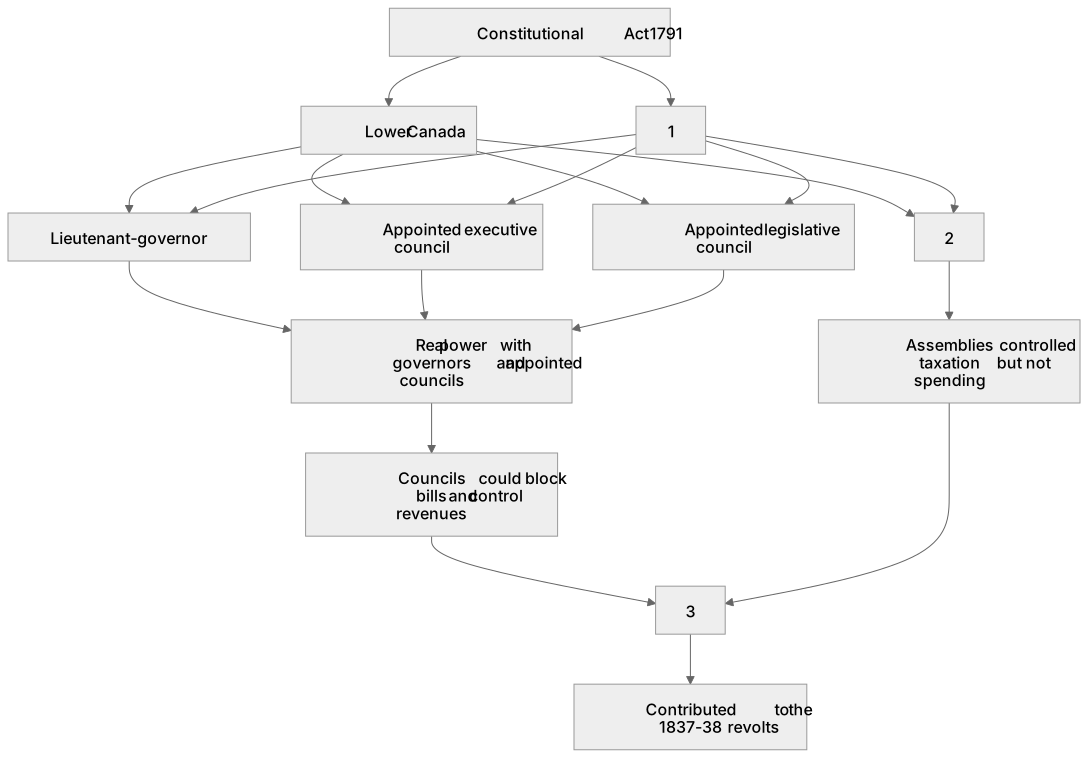
Some boxes have lost their names. Pick the right name for each number.
1Box 1
2Box 2
3Box 3
There is more to this lesson
The full lesson goes on to check your understanding and help you earn the marks. Create a free account to carry on, with your progress saved.
A week of Premium from your first lesson · Then the free plan continues · No card, no charge
Test your understanding of Paper 3, Option 35.1: Britain: losing and gaining an empire, 1763–1914 - 3 Learning from past mistakes: Canada and the Durham Report, 1837–40: The political nature and governmental system of Upper and Lower Canada and the perceived threat from the USA.
Active recall beats re-reading. Take an instant quiz now to test what you’ve learned and lock it into long-term memory.
A week of Premium from your first lesson · Then the free plan continues · No card, no charge