Pearson Edexcel · A-Level · History
Course version: 9HI0 · Version from Sept 2015
Britain: losing and gaining an empire, 1763–1914 - 4 Nearly losing an…
Full specification wording
Paper 3, Option 35.1: Britain: losing and gaining an empire, 1763–1914 - 4 Nearly losing an empire: the British in India, 1829–58: The role of the East India Company and the Governor General; the importance of Bengal and the Company Army.
In India, the East India Company transitioned from a trading body to a territorial ruler.
Checked against the Pearson Edexcel 9HI0 specification (opens in a new tab) on .
- Point 1 of 3
- 2 key terms
Study notes
From the checked teaching notes for this specification point.
The idea
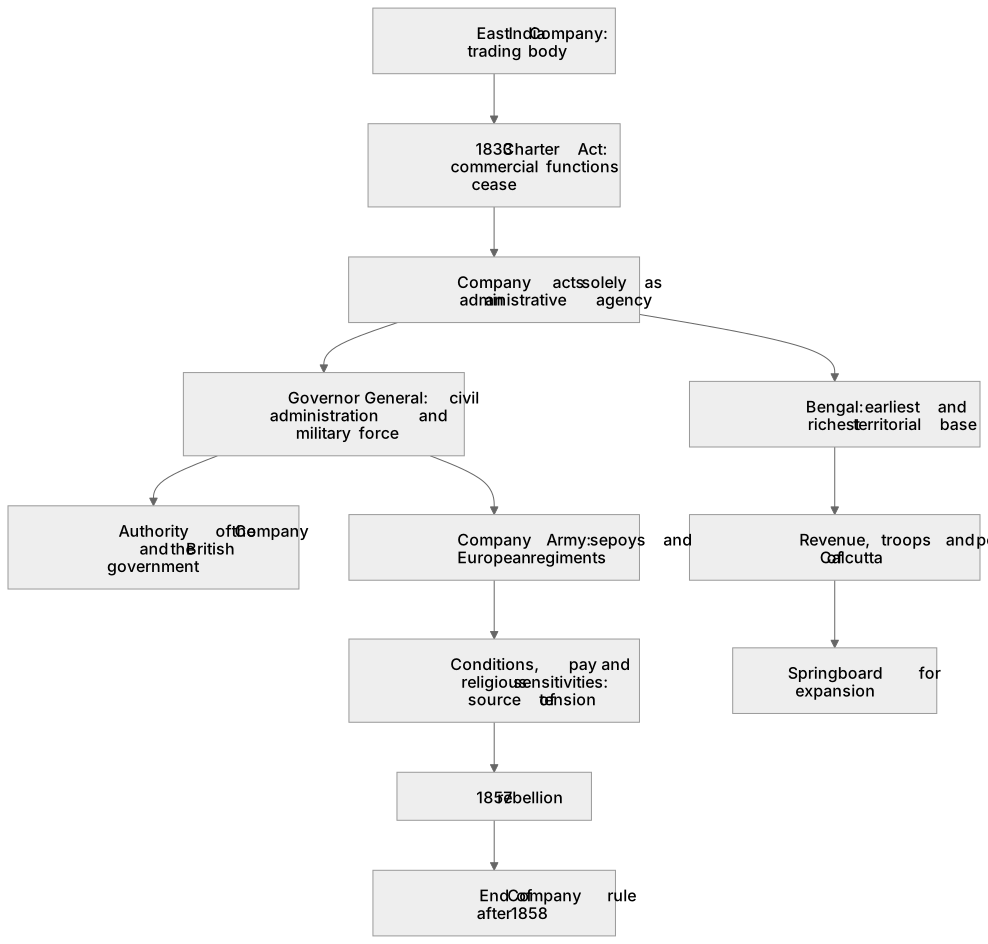
In India, the East India Company transitioned from a trading body to a territorial ruler. By the 1833 Charter Act, its commercial functions ceased, acting solely as an administrative agency. It ruled through a Governor General, who commanded civil administration and military force under the authority of the Company and the British government. Bengal mattered as the Company's earliest and richest territorial base, supplying revenue, troops and the port of Calcutta, becoming the springboard for expansion. The Company Army was central to that power: Indian sepoys and the Company's own European regiments enforced authority, but their conditions, pay and religious sensitivities made them a source of tension, culminating in the 1857 rebellion.
What earns the marks
- Explains the East India Company's transition from a trading corporation to a territorial ruler, noting the end of its commercial functions in 1833.
- Explains the Governor General's role as head of civil and military administration, acting under the authority of the Company and the British government.
- Shows why Bengal was important: revenue, resources, the Calcutta base and a starting point for further expansion.
- Shows the importance of the Company Army: sepoys and Company European troops upheld rule, and their grievances contributed to the 1857 crisis.
- Links these roles to the wider theme of nearly losing an empire, leading to the end of Company rule after 1858.
Common mistakes and how to put them right
Treating the Company as a trading body throughout the period.
Put it right by noting its commercial functions ended in 1833, after which it acted solely as an administrative agency.
Assuming the Governor General was the Crown's direct representative.
Put it right by noting this title (Viceroy) was only adopted after 1858; before then, he represented the Company.
Confusing the Company Army with the regular British Army.
Put it right by distinguishing the EIC's own sepoy and European regiments from Crown regiments stationed in India.
Exam tips
- Distinguish the Company's administrative and military functions, using Bengal as a concrete example of its territorial power.
- Connect the Company Army to the causes of 1857, showing how military grievance became a political crisis.
Try the lesson
The start of the Paper 3, Option 35.1: Britain: losing and gaining an empire, 1763–1914 - 4 Nearly losing an empire: the British in India, 1829–58: The role of the East India Company and the Governor General; the importance of Bengal and the Company Army. lesson, made from checked teaching notes for this specification point.
Have a go first
In the period 1829–58, what was the main role of the East India Company in British India?
Listen
In India, the East India Company transitioned from a trading body to a territorial ruler. By the 1833 Charter Act, its commercial functions ceased, acting solely as an administrative agency. It ruled through a Governor General, who commanded civil administration and military force under the authority of the Company and the British government. Bengal mattered as the Company's earliest and richest territorial base, supplying revenue, troops and the port of Calcutta, becoming the springboard for expansion. The Company Army was central to that power: Indian sepoys and the Company's own European regiments enforced authority, but their conditions, pay and religious sensitivities made them a source of tension, culminating in the 1857 rebellion. A strong answer earns marks for these points. Explains the East India Company's transition from a trading corporation to a territorial ruler, noting the end of its commercial functions in 1833. Explains the Governor General's role as head of civil and military administration, acting under the authority of the Company and the British government. Shows why Bengal was important: revenue, resources, the Calcutta base and a starting point for further expansion. Shows the importance of the Company Army: sepoys and Company European troops upheld rule, and their grievances contributed to the 1857 crisis. A common slip: Treating the Company as a trading body throughout the period. Instead, noting its commercial functions ended in 1833, after which it acted solely as an administrative agency. Exam tip: Distinguish the Company's administrative and military functions, using Bengal as a concrete example of its territorial power.
See it
Key words
Say what each word means before you turn the card.
Revenue, trade and the economy of Bengal
Try answering aloud or in your head before turning the card.
Military power and the sepoy army
Try answering aloud or in your head before turning the card.
See every definition
- Revenue, trade and the economy of Bengal
- Bengal was the Company's earliest and richest territorial base, supplying revenue, troops and the port of Calcutta, and becoming the springboard for expansion.
- Military power and the sepoy army
- Indian sepoys and the Company's own European regiments enforced authority, but their conditions, pay and religious sensitivities made them a source of tension, culminating in the 1857 rebellion.
Label the diagram
Some boxes have lost their names. Pick the right name for each number.
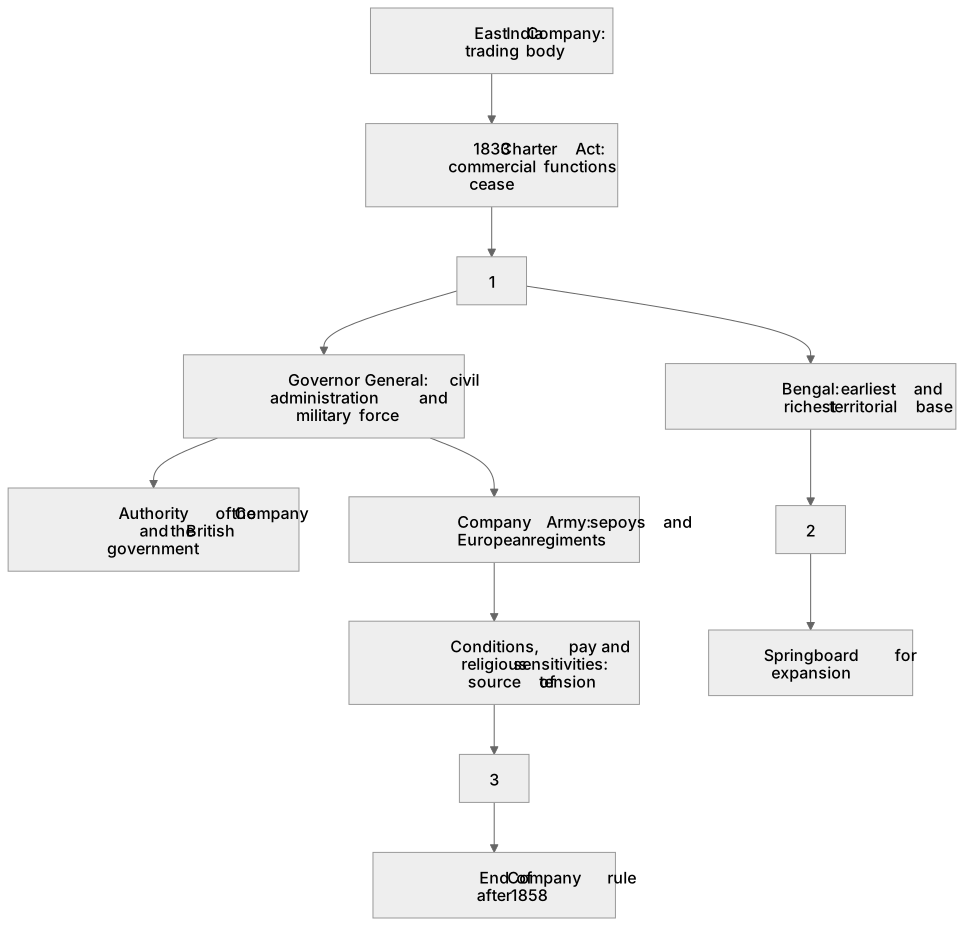
1Box 1
2Box 2
3Box 3
There is more to this lesson
The full lesson goes on to check your understanding and help you earn the marks. Create a free account to carry on, with your progress saved.
A week of Premium from your first lesson · Then the free plan continues · No card, no charge
Test your understanding of Paper 3, Option 35.1: Britain: losing and gaining an empire, 1763–1914 - 4 Nearly losing an empire: the British in India, 1829–58: The role of the East India Company and the Governor General; the importance of Bengal and the Company Army.
Active recall beats re-reading. Take an instant quiz now to test what you’ve learned and lock it into long-term memory.
A week of Premium from your first lesson · Then the free plan continues · No card, no charge