Pearson Edexcel · A-Level · History
Course version: 9HI0 · Version from Sept 2015
Britain: losing and gaining an empire, 1763–1914 - 5 The Nile valley,…
Full specification wording
Paper 3, Option 35.1: Britain: losing and gaining an empire, 1763–1914 - 5 The Nile valley, 1882–98: Reasons for intervention in Egypt 1882: Arabi Pasha and Arab nationalism; protecting European loans and people. French withdrawal; the British military campaign.
By 1882 Egypt was nominally Ottoman but financially controlled by European bondholders.
Checked against the Pearson Edexcel 9HI0 specification (opens in a new tab) on .
- Point 1 of 3
- 4 key terms
Study notes
From the checked teaching notes for this specification point.
The idea
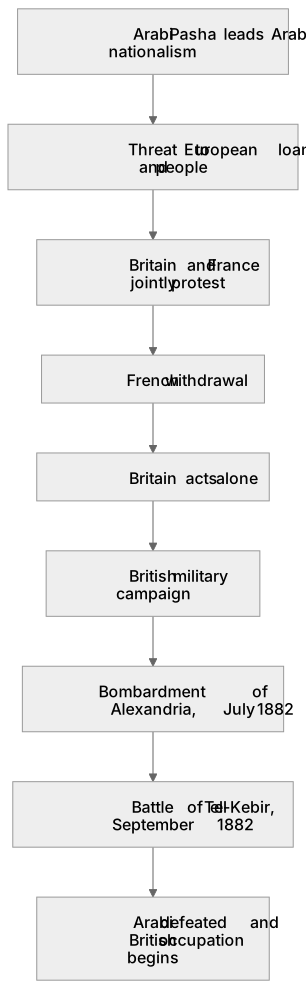
By 1882 Egypt was nominally Ottoman but financially controlled by European bondholders. Colonel Arabi Pasha led a nationalist movement against foreign influence and the Khedive, threatening the Suez Canal and European residents. Britain and France jointly protested, but France withdrew, leaving Britain to act alone. Britain intervened to protect European loans and people, and to secure the canal. The military campaign began with the bombardment of Alexandria in July 1882 and ended with the Battle of Tel el-Kebir in September, after which Arabi was defeated and British occupation began. This established a pattern of informal control that lasted decades.
What earns the marks
- Explains Arabi Pasha's role as leader of Egyptian nationalism and his opposition to foreign financial control.
- Analyses how the need to protect European loans and the safety of European people provided a justification for intervention.
- Assesses the significance of French withdrawal in enabling unilateral British action.
- Describes the British military campaign, including key events such as the bombardment of Alexandria and the Battle of Tel el-Kebir.
- Evaluates the relative importance of economic, strategic and nationalist factors in the decision to intervene.
Common mistakes and how to put them right
Confusing Arabi Pasha with the Khedive.
Put it right: Arabi was a nationalist army officer, not the ruler; the Khedive was Tewfik.
Assuming France participated in the military campaign.
Put it right: France withdrew, leaving Britain to act alone.
Treating the intervention as solely about the Suez Canal.
Put it right: Loans and protection of people were also key, and the canal was part of strategic and financial concerns.
Exam tips
- Use precise dates and names to support your argument, such as July 1882 for Alexandria and September 1882 for Tel el-Kebir.
- Link each reason for intervention to the broader context of European imperialism and financial control.
- When discussing the military campaign, focus on how it achieved the aims of protecting loans and people, and securing the canal.
Try the lesson
The start of the Paper 3, Option 35.1: Britain: losing and gaining an empire, 1763–1914 - 5 The Nile valley, 1882–98: Reasons for intervention in Egypt 1882: Arabi Pasha and Arab nationalism; protecting European loans and people. French withdrawal; the British military campaign. lesson, made from checked teaching notes for this specification point.
Have a go first
Which Egyptian military figure led the nationalist movement that prompted British intervention in Egypt in 1882?
Listen
By 1882 Egypt was nominally Ottoman but financially controlled by European bondholders. Colonel Arabi Pasha led a nationalist movement against foreign influence and the Khedive, threatening the Suez Canal and European residents. Britain and France jointly protested, but France withdrew, leaving Britain to act alone. Britain intervened to protect European loans and people, and to secure the canal. The military campaign began with the bombardment of Alexandria in July 1882 and ended with the Battle of Tel el-Kebir in September, after which Arabi was defeated and British occupation began. This established a pattern of informal control that lasted decades. A strong answer earns marks for these points. Explains Arabi Pasha's role as leader of Egyptian nationalism and his opposition to foreign financial control. Analyses how the need to protect European loans and the safety of European people provided a justification for intervention. Assesses the significance of French withdrawal in enabling unilateral British action. Describes the British military campaign, including key events such as the bombardment of Alexandria and the Battle of Tel el-Kebir. Exam tip: Use precise dates and names to support your argument, such as July 1882 for Alexandria and September 1882 for Tel el-Kebir.
See it
Key words
Say what each word means before you turn the card.
Arabi Pasha
Try answering aloud or in your head before turning the card.
Nationalism and resistance
Try answering aloud or in your head before turning the card.
Economic control and debt
Try answering aloud or in your head before turning the card.
Great power rivalry and unilateral action
Try answering aloud or in your head before turning the card.
See every definition
- Arabi Pasha
- Colonel who led a nationalist movement against foreign influence and the Khedive, threatening the Suez Canal and European residents.
- Nationalism and resistance
- Egyptian opposition to foreign influence, led by Arabi Pasha against the Khedive and European bondholders' financial control.
- Economic control and debt
- Financial control of nominally Ottoman Egypt by European bondholders, with protection of European loans a reason for intervention.
- Great power rivalry and unilateral action
- Britain and France jointly protested, but French withdrawal left Britain to act alone in intervening in Egypt.
Label the diagram
Some boxes have lost their names. Pick the right name for each number.
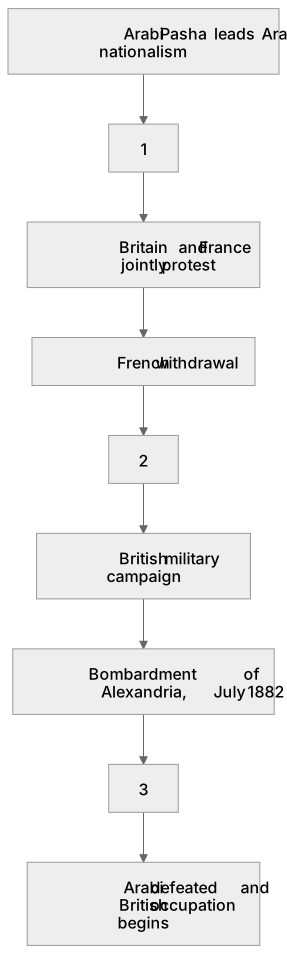
1Box 1
2Box 2
3Box 3
There is more to this lesson
The full lesson goes on to check your understanding and help you earn the marks. Create a free account to carry on, with your progress saved.
A week of Premium from your first lesson · Then the free plan continues · No card, no charge
Test your understanding of Paper 3, Option 35.1: Britain: losing and gaining an empire, 1763–1914 - 5 The Nile valley, 1882–98: Reasons for intervention in Egypt 1882: Arabi Pasha and Arab nationalism; protecting European loans and people. French withdrawal; the British military campaign.
Active recall beats re-reading. Take an instant quiz now to test what you’ve learned and lock it into long-term memory.
A week of Premium from your first lesson · Then the free plan continues · No card, no charge