Pearson Edexcel · A-Level · History
Course version: 9HI0 · Version from Sept 2015
The British experience of warfare, c1790–1918 - 1 Britain and the French…
Full specification wording
Paper 3, Option 35.2: The British experience of warfare, c1790–1918 - 1 Britain and the French Wars, 1793–1815: The impact on the British economy, industry, commerce and agriculture of the length of the conflict.
This topic examines how the prolonged French Wars (1793–1815) affected the British economy, industry, commerce and agriculture.
Checked against the Pearson Edexcel 9HI0 specification (opens in a new tab) on .
- Point 3 of 3
Study notes
From the checked teaching notes for this specification point.
The idea
This topic examines how the prolonged French Wars (1793–1815) affected the British economy, industry, commerce and agriculture. You must understand that the length of the conflict, with only brief pauses, placed sustained pressure on resources and prompted change. The economy faced inflation, higher taxes and national debt, but also saw growth in certain sectors. Industry benefited from increased demand for war materials, such as iron and textiles, and from disruption to continental competitors. Commerce was affected by blockades, privateering and loss of markets, but also by expansion into new markets and the growth of smuggling. Agriculture experienced rising prices and increased cultivation, but also hardship for labourers. Assess how far these changes were caused by the length of the war, and evaluate the overall impact on different groups.
What earns the marks
- Explains the economic pressures of prolonged war: inflation, taxation and national debt.
- Describes the impact on industry: increased demand for war goods, technological developments and regional growth.
- Analyses changes in commerce: blockades, loss of European markets, expansion into new markets and the role of smuggling.
- Assesses the effects on agriculture: rising prices, enclosure, increased production and the plight of agricultural labourers.
- Evaluates the extent to which the length of the conflict was responsible for these changes, considering other factors.
Common mistakes and how to put them right
Assuming the war only had negative effects.
Put it right: Recognise that some sectors, like industry, benefited from increased demand.
Overlooking the role of other factors, such as the Industrial Revolution, in economic change.
Put it right: Distinguish between wartime impacts and longer-term trends.
Treating the economy as a single entity.
Put it right: Differentiate between the experiences of different sectors and social groups.
Exam tips
- Structure your answer around the four areas: economy, industry, commerce and agriculture, ensuring each is addressed.
- Use specific examples, such as the Orders in Council or the Corn Laws, to illustrate your points.
- When evaluating impact, consider short-term versus long-term effects and the experiences of different groups.
Try the lesson
The start of the Paper 3, Option 35.2: The British experience of warfare, c1790–1918 - 1 Britain and the French Wars, 1793–1815: The impact on the British economy, industry, commerce and agriculture of the length of the conflict. lesson, made from checked teaching notes for this specification point.
Have a go first
How did the prolonged length of the French Wars (1793–1815) specifically impact the British textile industry?
Listen
This topic examines how the prolonged French Wars (1793–1815) affected the British economy, industry, commerce and agriculture. You must understand that the length of the conflict, with only brief pauses, placed sustained pressure on resources and prompted change. The economy faced inflation, higher taxes and national debt, but also saw growth in certain sectors. Industry benefited from increased demand for war materials, such as iron and textiles, and from disruption to continental competitors. Commerce was affected by blockades, privateering and loss of markets, but also by expansion into new markets and the growth of smuggling. Agriculture experienced rising prices and increased cultivation, but also hardship for labourers. Assess how far these changes were caused by the length of the war, and evaluate the overall impact on different groups. A strong answer earns marks for these points. Explains the economic pressures of prolonged war: inflation, taxation and national debt. Describes the impact on industry: increased demand for war goods, technological developments and regional growth. Analyses changes in commerce: blockades, loss of European markets, expansion into new markets and the role of smuggling. Assesses the effects on agriculture: rising prices, enclosure, increased production and the plight of agricultural labourers. A common slip: assuming the war only had negative effects. Instead, recognise that some sectors, like industry, benefited from increased demand. Exam tip: Structure your answer around the four areas: economy, industry, commerce and agriculture, ensuring each is addressed.
See it
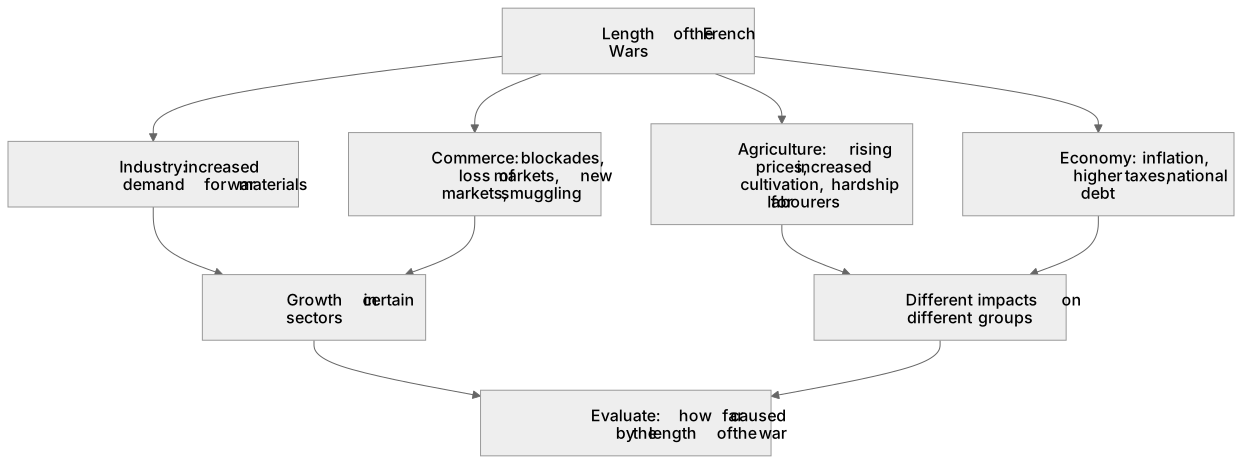
Label the diagram
Some boxes have lost their names. Pick the right name for each number.
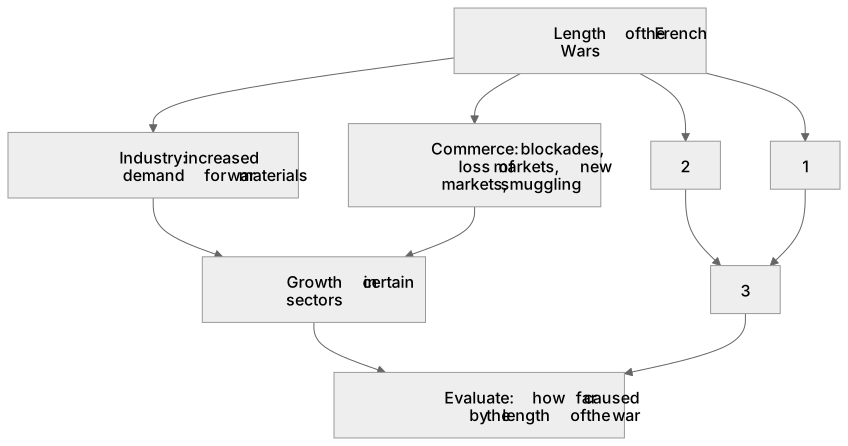
1Box 1
2Box 2
3Box 3
There is more to this lesson
The full lesson goes on to check your understanding and help you earn the marks. Create a free account to carry on, with your progress saved.
A week of Premium from your first lesson · Then the free plan continues · No card, no charge
Test your understanding of Paper 3, Option 35.2: The British experience of warfare, c1790–1918 - 1 Britain and the French Wars, 1793–1815: The impact on the British economy, industry, commerce and agriculture of the length of the conflict.
Active recall beats re-reading. Take an instant quiz now to test what you’ve learned and lock it into long-term memory.
A week of Premium from your first lesson · Then the free plan continues · No card, no charge