Pearson Edexcel · A-Level · History
Course version: 9HI0 · Version from Sept 2015
The British experience of warfare, c1790–1918 - 3 The second Boer War,…
Full specification wording
Paper 3, Option 35.2: The British experience of warfare, c1790–1918 - 3 The second Boer War, 1899–1902: The importance of the roles of Field Marshalls Roberts and Kitchener, and General Sir Redvers Buller in achieving victory.
Victory in the second Boer War depended on three commanders whose methods differed sharply.
Checked against the Pearson Edexcel 9HI0 specification (opens in a new tab) on .
- Point 2 of 3
- 3 key terms
Study notes
From the checked teaching notes for this specification point.
The idea
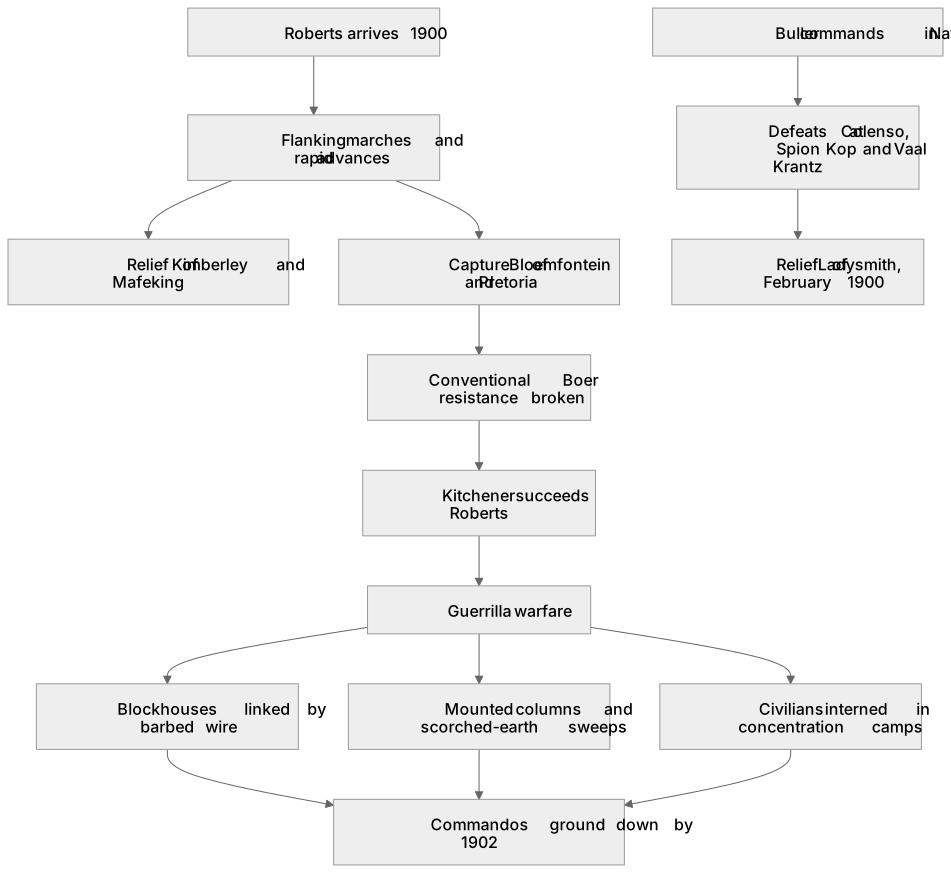
Victory in the second Boer War depended on three commanders whose methods differed sharply. Roberts, arriving in 1900, used flanking marches and rapid advances to relieve Kimberley and Mafeking and to take Bloemfontein and Pretoria, breaking conventional Boer resistance. Kitchener, succeeding him, faced guerrilla warfare; he built blockhouses linked by barbed wire, used mounted columns and scorched-earth sweeps, and interned civilians in concentration camps, grinding the commandos down by 1902. Buller, commanding in Natal, suffered early defeats at Colenso, Spion Kop and Vaal Krantz, yet recovered to relieve Ladysmith in February 1900. Assess each man's contribution to the eventual victory, weighing tactical skill, logistics, attrition and the cost in lives and civilian suffering.
What earns the marks
- Explains Roberts's strategy of flanking manoeuvres and rapid advance, including the relief of Kimberley and Mafeking and the capture of Bloemfontein and Pretoria, and how this broke organised Boer field resistance.
- Explains Kitchener's counter-guerrilla methods: blockhouse lines, armoured trains, mounted columns, farm burning and concentration camps, and how these progressively restricted commando movement.
- Explains Buller's mixed record: defeats at Colenso, Spion Kop and Vaal Krantz, followed by the successful relief of Ladysmith, showing resilience and the ability to learn from failure.
- Weighs the relative importance of each commander, for example arguing that Roberts won the conventional war while Kitchener's attritional system secured the peace, with Buller's role more limited.
- Uses specific evidence such as dates, battles and places accurately to support judgements about each commander's contribution to victory.
Common mistakes and how to put them right
Treating Buller as simply incompetent.
Put it right: Balance his early defeats against his eventual relief of Ladysmith and his careful logistical preparations.
Assuming Roberts alone won the war.
Put it right: Recognise that Boer guerrilla resistance continued after his departure and required Kitchener's blockhouse and column system.
Describing the concentration camps without context.
Put it right: Explain them as part of Kitchener's wider attritional strategy while acknowledging the high mortality from disease and poor administration.
Exam tips
- Plan by commander, then reach an overall judgement about whose role mattered most and why.
- Anchor each claim in a named battle, date or place to show precise knowledge rather than general assertion.
- Link military methods to the nature of the war, showing how guerrilla tactics forced a change from Roberts's approach to Kitchener's.
Try the lesson
The start of the Paper 3, Option 35.2: The British experience of warfare, c1790–1918 - 3 The second Boer War, 1899–1902: The importance of the roles of Field Marshalls Roberts and Kitchener, and General Sir Redvers Buller in achieving victory. lesson, made from checked teaching notes for this specification point.
Have a go first
What was the primary strategic change implemented by Field Marshal Roberts upon taking command in South Africa in early 1900?
Listen
Victory in the second Boer War depended on three commanders whose methods differed sharply. Roberts, arriving in 1900, used flanking marches and rapid advances to relieve Kimberley and Mafeking and to take Bloemfontein and Pretoria, breaking conventional Boer resistance. Kitchener, succeeding him, faced guerrilla warfare; he built blockhouses linked by barbed wire, used mounted columns and scorched-earth sweeps, and interned civilians in concentration camps, grinding the commandos down by 1902. Buller, commanding in Natal, suffered early defeats at Colenso, Spion Kop and Vaal Krantz, yet recovered to relieve Ladysmith in February 1900. Assess each man's contribution to the eventual victory, weighing tactical skill, logistics, attrition and the cost in lives and civilian suffering. A strong answer earns marks for these points. Explains Roberts's strategy of flanking manoeuvres and rapid advance, including the relief of Kimberley and Mafeking and the capture of Bloemfontein and Pretoria, and how this broke organised Boer field resistance. Explains Kitchener's counter-guerrilla methods: blockhouse lines, armoured trains, mounted columns, farm burning and concentration camps, and how these progressively restricted commando movement. Explains Buller's mixed record: defeats at Colenso, Spion Kop and Vaal Krantz, followed by the successful relief of Ladysmith, showing resilience and the ability to learn from failure. Weighs the relative importance of each commander, for example arguing that Roberts won the conventional war while Kitchener's attritional system secured the peace, with Buller's role more limited. A common slip: Treating Buller as simply incompetent. Instead, balance his early defeats against his eventual relief of Ladysmith and his careful logistical preparations. Exam tip: Plan by commander, then reach an overall judgement about whose role mattered most and why.
See it
Key words
Say what each word means before you turn the card.
Command and strategy
Try answering aloud or in your head before turning the card.
Counter-insurgency and attrition
Try answering aloud or in your head before turning the card.
Costs and controversy of total war
Try answering aloud or in your head before turning the card.
See every definition
- Command and strategy
- The methods used by Roberts, Kitchener and Buller, whose approaches differed sharply in achieving victory.
- Counter-insurgency and attrition
- Kitchener's response to guerrilla warfare, using blockhouses, mounted columns and scorched-earth sweeps to grind the commandos down by 1902.
- Costs and controversy of total war
- The cost in lives and civilian suffering, including the internment of civilians in concentration camps.
Label the diagram
Some boxes have lost their names. Pick the right name for each number.
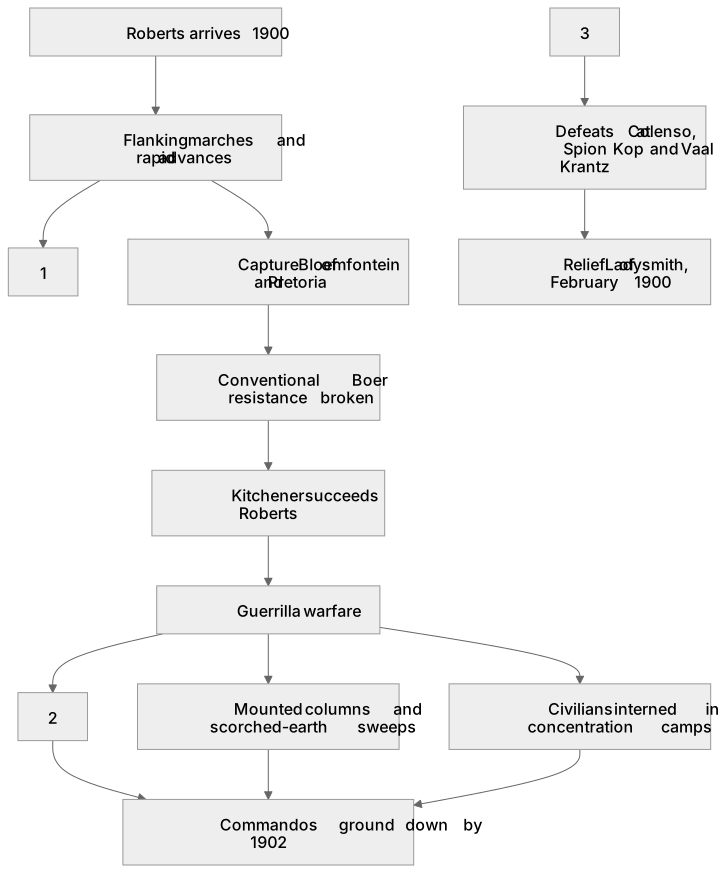
1Box 1
2Box 2
3Box 3
There is more to this lesson
The full lesson goes on to check your understanding and help you earn the marks. Create a free account to carry on, with your progress saved.
A week of Premium from your first lesson · Then the free plan continues · No card, no charge
Test your understanding of Paper 3, Option 35.2: The British experience of warfare, c1790–1918 - 3 The second Boer War, 1899–1902: The importance of the roles of Field Marshalls Roberts and Kitchener, and General Sir Redvers Buller in achieving victory.
Active recall beats re-reading. Take an instant quiz now to test what you’ve learned and lock it into long-term memory.
A week of Premium from your first lesson · Then the free plan continues · No card, no charge