Pearson Edexcel · A-Level · History
Course version: 9HI0 · Version from Sept 2015
The British experience of warfare, c1790–1918 - 4 Trench warfare on the…
Full specification wording
Paper 3, Option 35.2: The British experience of warfare, c1790–1918 - 4 Trench warfare on the Western Front, 1914–18: Reasons for change from a war of movement to attrition; entrenchment and the building of defensive systems; the need for military adjustment; the use of new fighting techniques and new technology – machine guns, chlorine gas, tanks, fuse 106 and the creeping barrage.
The opening campaigns of 1914 saw mobile warfare as armies sought decisive battles, but by late 1914 the Western Front had become a war of attrition.
Checked against the Pearson Edexcel 9HI0 specification (opens in a new tab) on .
- Point 1 of 3
- 4 key terms
Study notes
From the checked teaching notes for this specification point.
The idea
The opening campaigns of 1914 saw mobile warfare as armies sought decisive battles, but by late 1914 the Western Front had become a war of attrition. Several factors caused this change: the failure of the Schlieffen Plan, the Battle of the Marne, and the 'race to the sea' denied both sides a breakthrough. As frontal assaults proved costly, troops dug in, creating trench systems with barbed wire, machine-gun nests, and artillery. This stalemate forced military adjustment: commanders developed new tactics and technologies. Machine guns increased defensive firepower; chlorine gas was first used at Ypres in 1915; tanks appeared at the Somme in 1916; fuse 106 improved shell reliability; and the creeping barrage coordinated artillery and infantry. These innovations aimed to restore mobility but often fell short, shaping the character of trench warfare until 1918.
What earns the marks
- Explains how the failure of the Schlieffen Plan and the Battle of the Marne (September 1914) ended the war of movement and led to the 'race to the sea'.
- Describes the development of trench systems, including front-line, support, and communication trenches, and the use of barbed wire and machine-gun emplacements.
- Analyses the need for military adjustment, such as the shift from massed infantry charges to more sophisticated tactics like the creeping barrage.
Common mistakes and how to put them right
Stating that the war of movement ended immediately after the Battle of the Marne.
Put it right: It was a gradual process through late 1914, with the 'race to the sea' and trench-building continuing into 1915.
Claiming that chlorine gas was first used by the British.
Put it right: It was first used by the Germans at the Second Battle of Ypres in April 1915.
Describing tanks as a decisive breakthrough weapon in 1916.
Put it right: Early tanks were mechanically unreliable and used in small numbers, so they had limited impact at the Somme.
Exam tips
- When discussing the change to attrition, link it to specific battles and their outcomes to show causation.
- For technology, explain how each innovation was intended to overcome trench stalemate and assess its actual effectiveness.
- Use precise terminology such as 'creeping barrage' and 'fuse 106', and avoid vague references to 'new weapons'.
Try the lesson
The start of the Paper 3, Option 35.2: The British experience of warfare, c1790–1918 - 4 Trench warfare on the Western Front, 1914–18: Reasons for change from a war of movement to attrition; entrenchment and the building of defensive systems; the need for military adjustment; the use of new fighting techniques and new technology – machine guns, chlorine gas, tanks, fuse 106 and the creeping barrage. lesson, made from checked teaching notes for this specification point.
Have a go first
Which development most directly caused the Western Front to change from a war of movement into a war of attrition by late 1914?
Listen
The opening campaigns of 1914 saw mobile warfare as armies sought decisive battles, but by late 1914 the Western Front had become a war of attrition. Several factors caused this change: the failure of the Schlieffen Plan, the Battle of the Marne, and the 'race to the sea' denied both sides a breakthrough. As frontal assaults proved costly, troops dug in, creating trench systems with barbed wire, machine-gun nests, and artillery. This stalemate forced military adjustment: commanders developed new tactics and technologies. Machine guns increased defensive firepower; chlorine gas was first used at Ypres in 1915; tanks appeared at the Somme in 1916; fuse 106 improved shell reliability; and the creeping barrage coordinated artillery and infantry. These innovations aimed to restore mobility but often fell short, shaping the character of trench warfare until 1918. A strong answer earns marks for these points. Explains how the failure of the Schlieffen Plan and the Battle of the Marne (September 1914) ended the war of movement and led to the 'race to the sea'. Describes the development of trench systems, including front-line, support, and communication trenches, and the use of barbed wire and machine-gun emplacements. Analyses the need for military adjustment, such as the shift from massed infantry charges to more sophisticated tactics like the creeping barrage. Evaluates the impact of new technology: machine guns (defensive advantage), chlorine gas (first used at Ypres, 1915), tanks (first used at the Somme, 1916), fuse 106 (improved shell detonation), and the creeping barrage (coordinated artillery-infantry attack). A common slip: stating that the war of movement ended immediately after the Battle of the Marne. Instead, it was a gradual process through late 1914, with the 'race to the sea' and trench-building continuing into 1915. Exam tip: When discussing the change to attrition, link it to specific battles and their outcomes to show causation.
See it
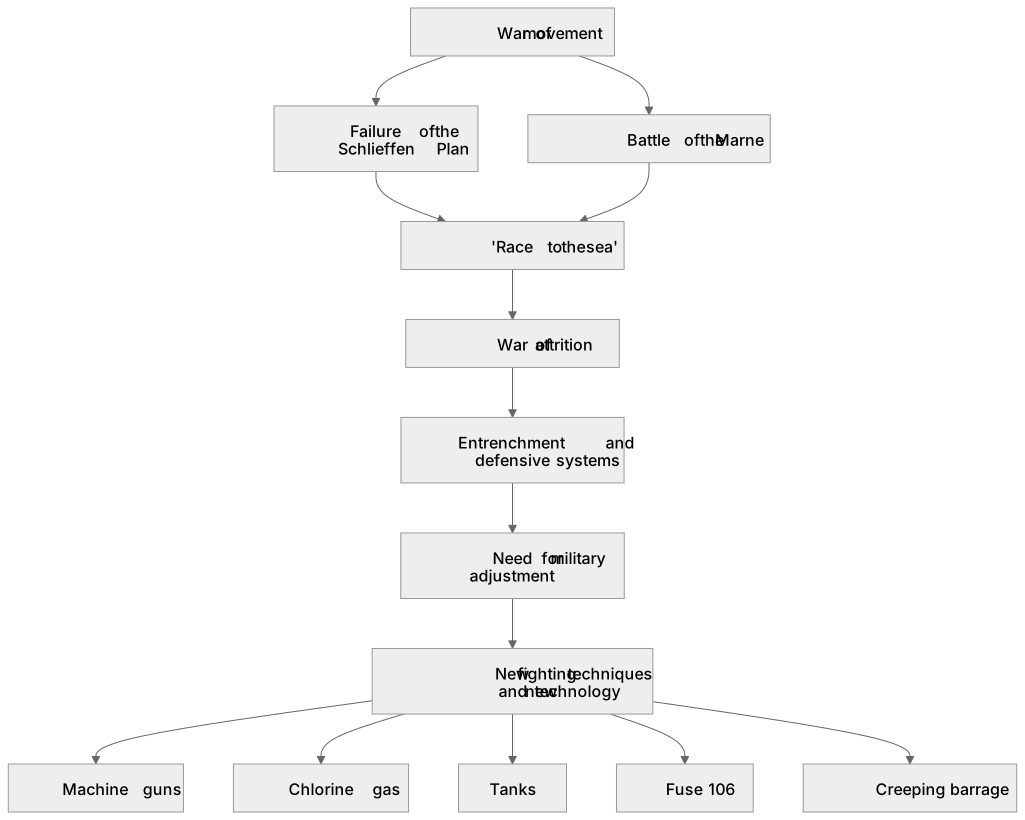
Key words
Say what each word means before you turn the card.
Causation of stalemate
Try answering aloud or in your head before turning the card.
Development of trench warfare
Try answering aloud or in your head before turning the card.
Military adaptation and innovation
Try answering aloud or in your head before turning the card.
Technological impact on tactics
Try answering aloud or in your head before turning the card.
See every definition
- Causation of stalemate
- The failure of the Schlieffen Plan, the Battle of the Marne and the 'race to the sea' denied both sides a breakthrough, so the Western Front became a war of attrition.
- Development of trench warfare
- As frontal assaults proved costly, troops dug in, creating trench systems with barbed wire, machine-gun nests and artillery.
- Military adaptation and innovation
- Stalemate forced military adjustment, with commanders developing new tactics and technologies aimed at restoring mobility.
- Technological impact on tactics
- Machine guns increased defensive firepower, chlorine gas was first used at Ypres in 1915, tanks appeared at the Somme in 1916, fuse 106 improved shell reliability and the creeping barrage coordinated artillery and infantry.
Label the diagram
Some boxes have lost their names. Pick the right name for each number.
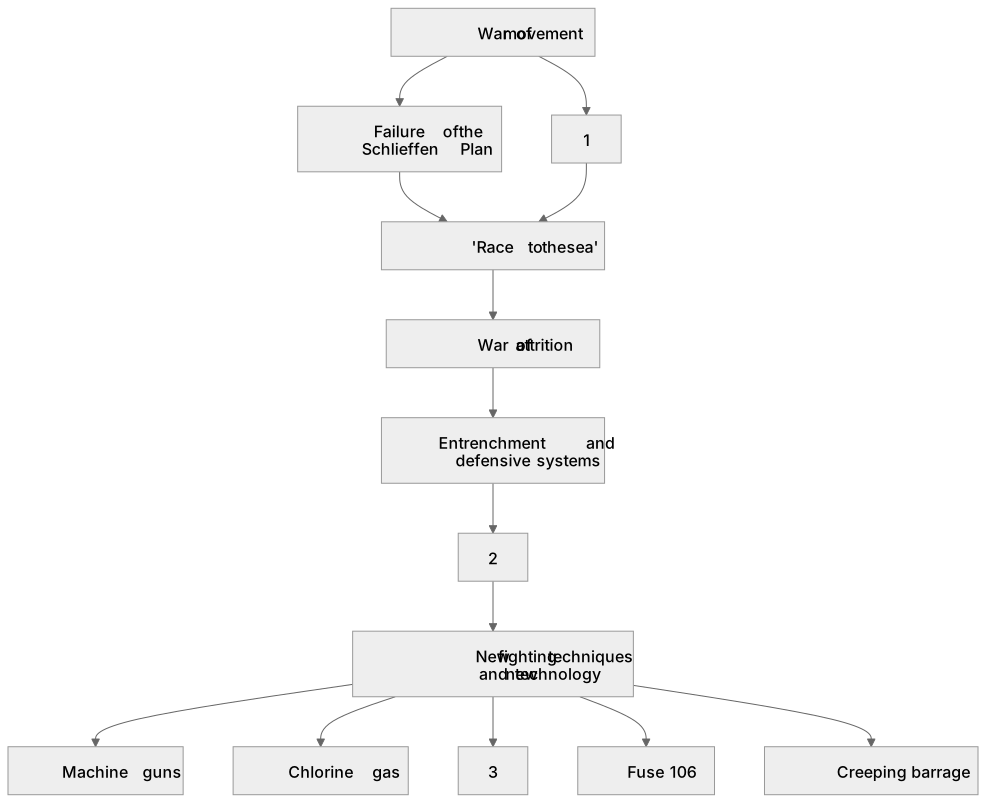
1Box 1
2Box 2
3Box 3
There is more to this lesson
The full lesson goes on to check your understanding and help you earn the marks. Create a free account to carry on, with your progress saved.
A week of Premium from your first lesson · Then the free plan continues · No card, no charge
Test your understanding of Paper 3, Option 35.2: The British experience of warfare, c1790–1918 - 4 Trench warfare on the Western Front, 1914–18: Reasons for change from a war of movement to attrition; entrenchment and the building of defensive systems; the need for military adjustment; the use of new fighting techniques and new technology – machine guns, chlorine gas, tanks, fuse 106 and the creeping barrage.
Active recall beats re-reading. Take an instant quiz now to test what you’ve learned and lock it into long-term memory.
A week of Premium from your first lesson · Then the free plan continues · No card, no charge