Pearson Edexcel · A-Level · History
Course version: 9HI0 · Version from Sept 2015
Protest, agitation and parliamentary reform in Britain, c1780–1928 - 1…
Full specification wording
Paper 3, Option 36.1: Protest, agitation and parliamentary reform in Britain, c1780–1928 - 1 Reform of parliament: Changes in the franchise, c1780–1928: the franchise c1780 and its significance for representation of the people; pressures for change and reasons for resistance (key developments: the Representation of the People Acts of 1832, 1867, 1884, 1918 and 1928).
In c1780 the franchise varied by borough and county, so representation was patchy: county votes often rested on freehold land worth 40 shillings a year, while borough qualifications ranged from…
Checked against the Pearson Edexcel 9HI0 specification (opens in a new tab) on .
- Point 1 of 2
- 4 key terms
Study notes
From the checked teaching notes for this specification point.
The idea
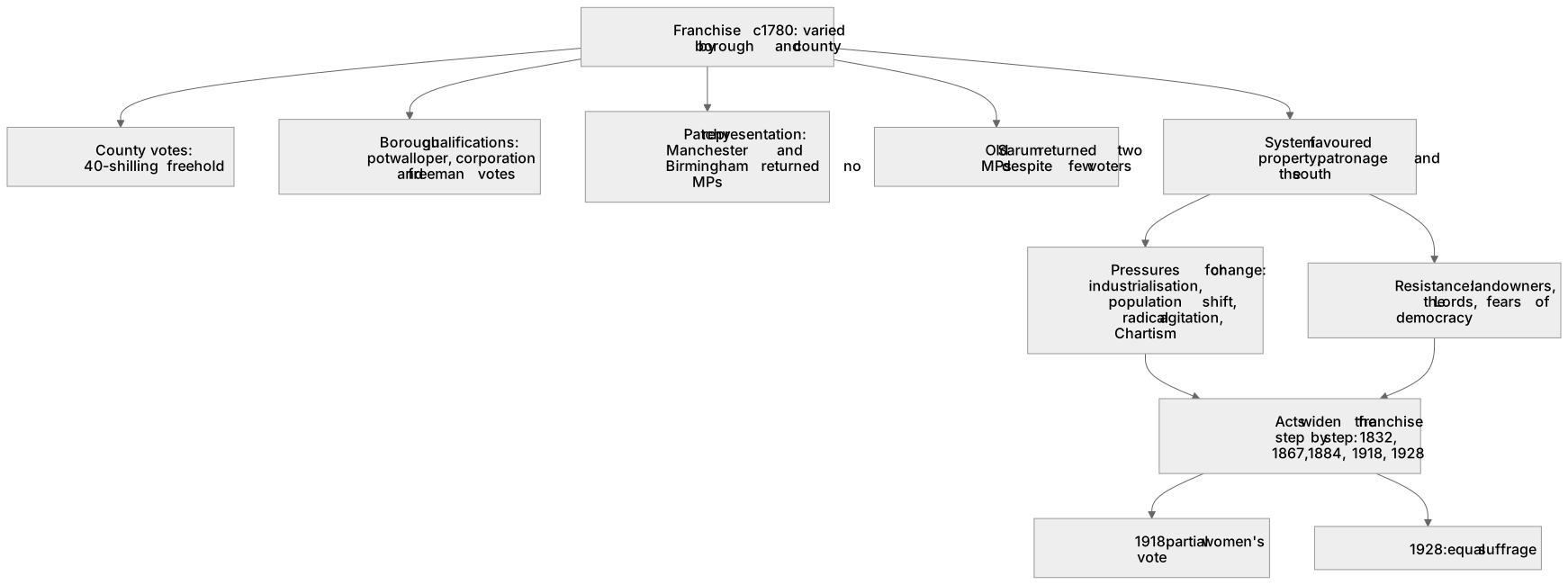
In c1780 the franchise varied by borough and county, so representation was patchy: county votes often rested on freehold land worth 40 shillings a year, while borough qualifications ranged from potwalloper households to corporation and freeman votes. Large towns such as Manchester and Birmingham returned no MPs, whereas Old Sarum returned two despite few voters, so the system favoured property, patronage and the south. Pressure came from industrialisation, population shift, radical agitation and later Chartism; resistance came from landowners, the Lords and fears of democracy. The Acts of 1832, 1867, 1884, 1918 and 1928 widened the franchise step by step, with 1918 adding a partial women's vote and 1928 equalising it.
What earns the marks
- Explains the c1780 franchise as varied and property-linked, using county 40-shilling freeholder qualification and contrasting borough qualifications.
- Links the c1780 franchise to representation by noting unrepresented industrial towns and rotten or pocket boroughs such as Old Sarum.
- Identifies pressures for change, including population growth, urbanisation, radical protest and organised campaigns.
- Explains resistance, including landed and aristocratic interests, Lords' obstruction and anxiety about property and democracy.
- Sequences the five named Acts and states the widening each produced, including 1918 partial women's suffrage and 1928 equal suffrage.
Common mistakes and how to put them right
Treating the c1780 franchise as one uniform national qualification.
Put it right by distinguishing county freeholder rules from varied borough rules.
Assuming 1832 introduced democracy.
Put it right by explaining it redistributed seats and modestly widened the vote while leaving many working men and all women excluded.
Confusing 1918 with 1928.
Put it right by stating 1918 gave some women the vote and 1928 equalised the franchise on the same terms as men.
Exam tips
- Anchor each Act to one precise change in who could vote or how seats were distributed.
- Use named places and groups to show significance rather than listing statutes.
- When assessing resistance, distinguish Commons, Lords and extra-parliamentary opposition.
Try the lesson
The start of the Paper 3, Option 36.1: Protest, agitation and parliamentary reform in Britain, c1780–1928 - 1 Reform of parliament: Changes in the franchise, c1780–1928: the franchise c1780 and its significance for representation of the people; pressures for change and reasons for resistance (key developments: the Representation of the People Acts of 1832, 1867, 1884, 1918 and 1928). lesson, made from checked teaching notes for this specification point.
Have a go first
Which of the following groups was entitled to vote in county constituencies in England at the start of the period, around 1780?
Listen
In c1780 the franchise varied by borough and county, so representation was patchy: county votes often rested on freehold land worth 40 shillings a year, while borough qualifications ranged from potwalloper households to corporation and freeman votes. Large towns such as Manchester and Birmingham returned no MPs, whereas Old Sarum returned two despite few voters, so the system favoured property, patronage and the south. Pressure came from industrialisation, population shift, radical agitation and later Chartism; resistance came from landowners, the Lords and fears of democracy. The Acts of 1832, 1867, 1884, 1918 and 1928 widened the franchise step by step, with 1918 adding a partial women's vote and 1928 equalising it. A strong answer earns marks for these points. Explains the c1780 franchise as varied and property-linked, using county 40-shilling freeholder qualification and contrasting borough qualifications. Links the c1780 franchise to representation by noting unrepresented industrial towns and rotten or pocket boroughs such as Old Sarum. Identifies pressures for change, including population growth, urbanisation, radical protest and organised campaigns. Explains resistance, including landed and aristocratic interests, Lords' obstruction and anxiety about property and democracy. A common slip: Treating the c1780 franchise as one uniform national qualification. Instead, distinguishing county freeholder rules from varied borough rules. Exam tip: Anchor each Act to one precise change in who could vote or how seats were distributed.
See it
Key words
Say what each word means before you turn the card.
Franchise and representation
Try answering aloud or in your head before turning the card.
Pressure and resistance
Try answering aloud or in your head before turning the card.
Parliamentary reform legislation
Try answering aloud or in your head before turning the card.
Democratisation and its limits
Try answering aloud or in your head before turning the card.
See every definition
- Franchise and representation
- The right to vote varied by borough and county in c1780, so representation of the people was patchy.
- Pressure and resistance
- Pressure came from industrialisation, population shift, radical agitation and later Chartism, while resistance came from landowners, the Lords and fears of democracy.
- Parliamentary reform legislation
- The Representation of the People Acts of 1832, 1867, 1884, 1918 and 1928 widened the franchise step by step.
- Democratisation and its limits
- The Acts widened the franchise step by step, with 1918 adding a partial women's vote and 1928 equalising it.
Label the diagram
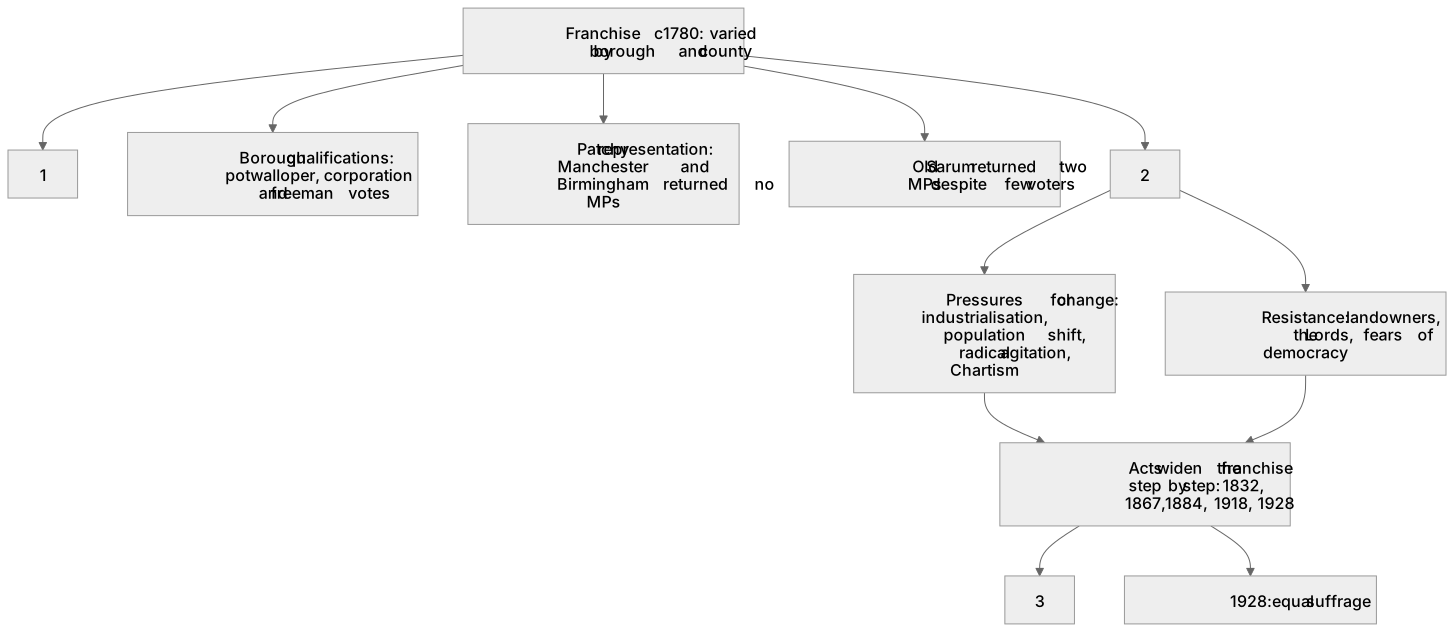
Some boxes have lost their names. Pick the right name for each number.
1Box 1
2Box 2
3Box 3
There is more to this lesson
The full lesson goes on to check your understanding and help you earn the marks. Create a free account to carry on, with your progress saved.
A week of Premium from your first lesson · Then the free plan continues · No card, no charge
Test your understanding of Paper 3, Option 36.1: Protest, agitation and parliamentary reform in Britain, c1780–1928 - 1 Reform of parliament: Changes in the franchise, c1780–1928: the franchise c1780 and its significance for representation of the people; pressures for change and reasons for resistance (key developments: the Representation of the People Acts of 1832, 1867, 1884, 1918 and 1928).
Active recall beats re-reading. Take an instant quiz now to test what you’ve learned and lock it into long-term memory.
A week of Premium from your first lesson · Then the free plan continues · No card, no charge