Pearson Edexcel · A-Level · History
Course version: 9HI0 · Version from Sept 2015
Protest, agitation and parliamentary reform in Britain, c1780–1928 - 2…
Full specification wording
Paper 3, Option 36.1: Protest, agitation and parliamentary reform in Britain, c1780–1928 - 2 Chartism, c1838–c1850: Fluctuations in support among different sections of society, and reasons for this.
Chartism's support fluctuated across classes, regions and time.
Checked against the Pearson Edexcel 9HI0 specification (opens in a new tab) on .
- Point 2 of 3
Study notes
From the checked teaching notes for this specification point.
The idea
Chartism's support fluctuated across classes, regions and time. In 1839, mass meetings and the petition attracted wide backing, but after rejection and arrests, support fell. In 1842, the Plug Plot strikes revived it, linking political and economic grievances. By 1848, the third petition drew huge crowds, yet fizzled out. Support varied by class: skilled artisans and handloom weavers were core, while middle-class reformers often withdrew, fearing revolution. Regionally, industrial north and Midlands were strongholds, but rural south was quieter. Reasons include economic depression, government repression, leadership divisions, and the rise of rival movements like the Anti-Corn Law League. Understanding these fluctuations requires analysing local and national factors.
What earns the marks
- Explains how economic conditions (e.g., 1837-42 depression, 1842 Plug Plot) increased or decreased support.
- Analyses the role of government repression (arrests, transportation) in reducing active support.
- Compares support among different classes: skilled workers, handloom weavers, middle-class radicals, and rural labourers.
- Assesses the impact of leadership divisions and tactical disagreements (e.g., moral force vs physical force) on support.
- Evaluates regional variations, such as strong support in Lancashire and Yorkshire versus weaker support in agricultural areas.
- Considers the influence of rival movements (e.g., Anti-Corn Law League, trade unions) in drawing away support.
Common mistakes and how to put them right
Treating Chartist support as constant throughout 1838-1850.
Put it right: Recognise peaks (1839, 1842, 1848) and troughs (1840-41, 1843-47) and explain causes.
Assuming all working-class people supported Chartism.
Put it right: Note that some workers prioritised trade unionism or were intimidated by employers.
Ignoring the role of women in Chartism.
Put it right: Include female Chartist associations and their fluctuating involvement.
Error: Overstating middle-class support. Correction: Explain that many middle-class reformers withdrew after 1839 due to fear of revolution.
Exam tips
- Use specific evidence (e.g., number of signatures on petitions, names of leaders, locations of meetings) to illustrate fluctuations.
- Structure your answer thematically (class, region, time) to show clear analysis of reasons.
- Link fluctuations to broader context (e.g., economic cycles, government policy) to demonstrate understanding.
Try the lesson
The start of the Paper 3, Option 36.1: Protest, agitation and parliamentary reform in Britain, c1780–1928 - 2 Chartism, c1838–c1850: Fluctuations in support among different sections of society, and reasons for this. lesson, made from checked teaching notes for this specification point.
Have a go first
Which section of society provided the overwhelming majority of Chartism's active supporters in the years 1838–1848?
Listen
Chartism's support fluctuated across classes, regions and time. In 1839, mass meetings and the petition attracted wide backing, but after rejection and arrests, support fell. In 1842, the Plug Plot strikes revived it, linking political and economic grievances. By 1848, the third petition drew huge crowds, yet fizzled out. Support varied by class: skilled artisans and handloom weavers were core, while middle-class reformers often withdrew, fearing revolution. Regionally, industrial north and Midlands were strongholds, but rural south was quieter. Reasons include economic depression, government repression, leadership divisions, and the rise of rival movements like the Anti-Corn Law League. Understanding these fluctuations requires analysing local and national factors. A strong answer earns marks for these points. Explains how economic conditions (e.g., 1837-42 depression, 1842 Plug Plot) increased or decreased support. Analyses the role of government repression (arrests, transportation) in reducing active support. Compares support among different classes: skilled workers, handloom weavers, middle-class radicals, and rural labourers. Assesses the impact of leadership divisions and tactical disagreements (e.g., moral force vs physical force) on support. A common slip: Treating Chartist support as constant throughout 1838-1850. Instead, Recognise peaks (1839, 1842, 1848) and troughs (1840-41, 1843-47) and explain causes. Exam tip: Use specific evidence (e.g., number of signatures on petitions, names of leaders, locations of meetings) to illustrate fluctuations.
See it
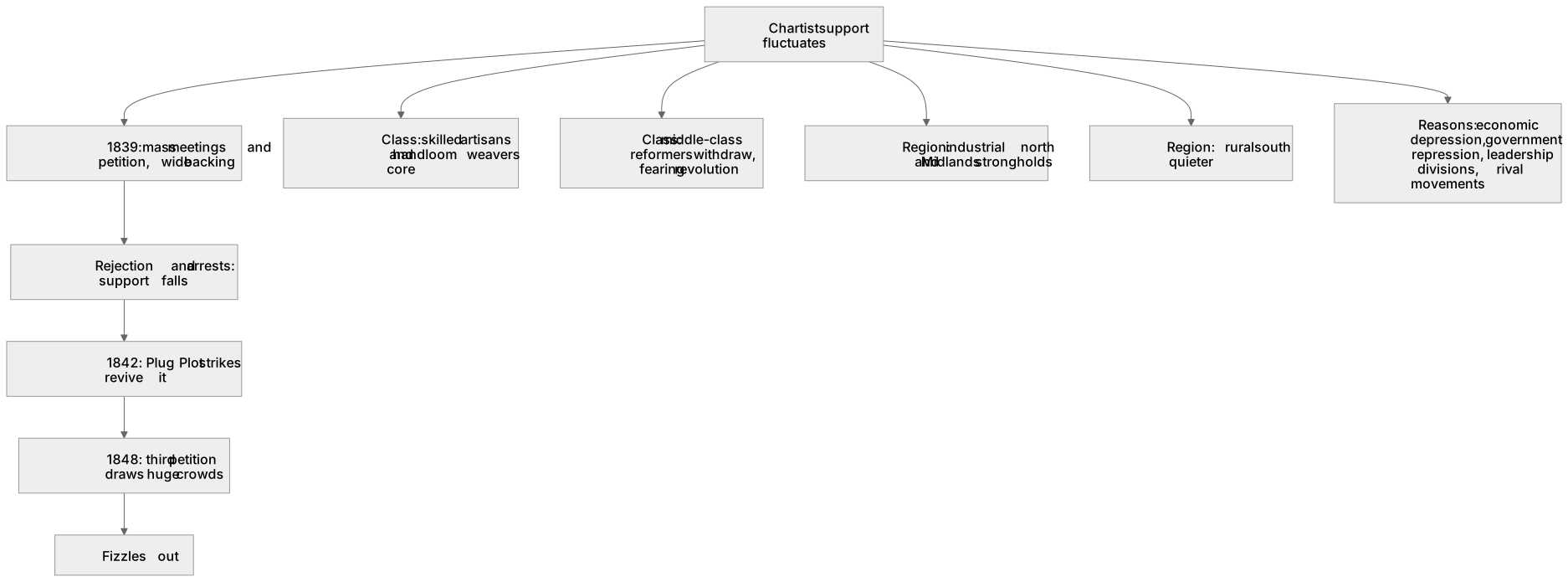
Put the events in order
Put these events in the order they happened, earliest first.
- 1. Mass meetings and the petition attracted wide backing
- 2. The third petition drew huge crowds, yet fizzled out
- 3. Plug Plot strikes revived Chartism, linking political and economic grievances
Label the diagram
Some boxes have lost their names. Pick the right name for each number.
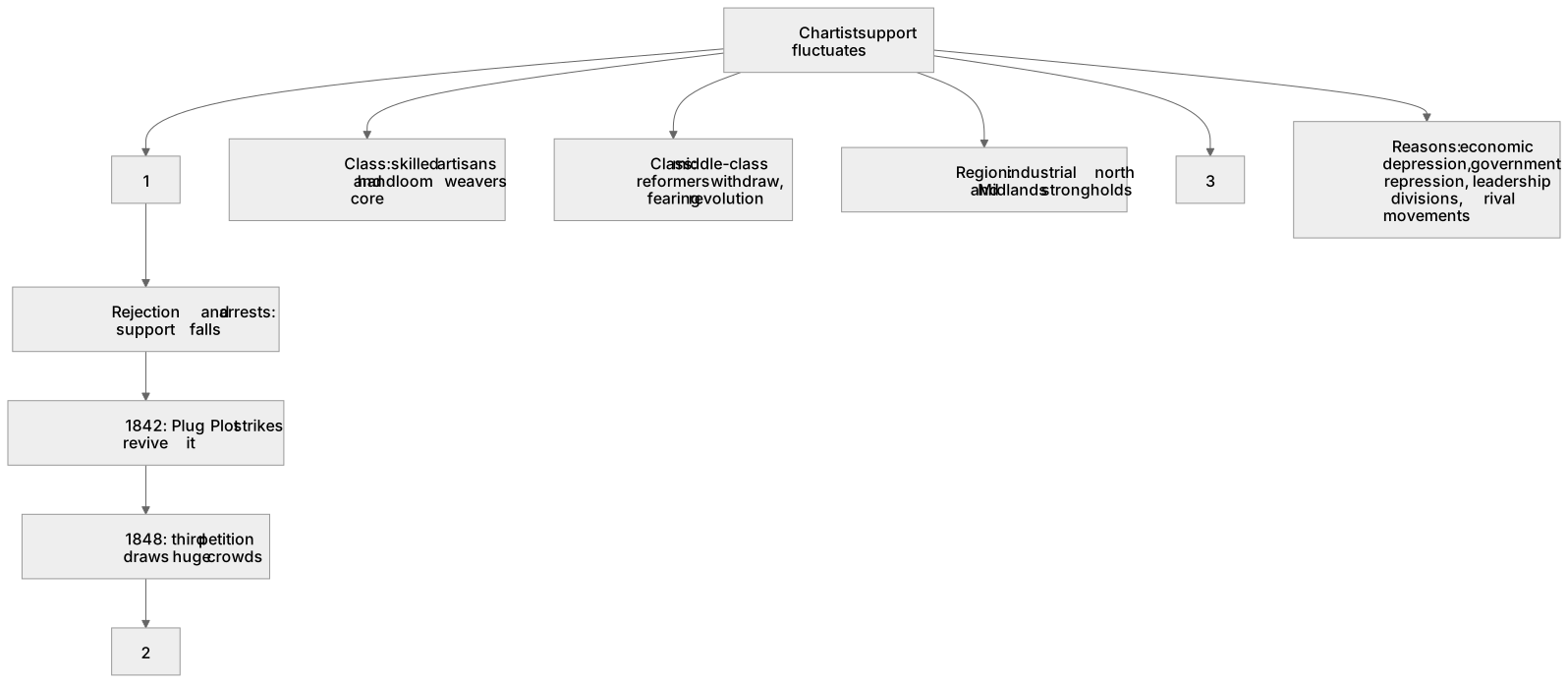
1Box 1
2Box 2
3Box 3
There is more to this lesson
The full lesson goes on to check your understanding and help you earn the marks. Create a free account to carry on, with your progress saved.
A week of Premium from your first lesson · Then the free plan continues · No card, no charge
Test your understanding of Paper 3, Option 36.1: Protest, agitation and parliamentary reform in Britain, c1780–1928 - 2 Chartism, c1838–c1850: Fluctuations in support among different sections of society, and reasons for this.
Active recall beats re-reading. Take an instant quiz now to test what you’ve learned and lock it into long-term memory.
A week of Premium from your first lesson · Then the free plan continues · No card, no charge