Pearson Edexcel · A-Level · History
Course version: 9HI0 · Version from Sept 2015
Protest, agitation and parliamentary reform in Britain, c1780–1928 - 4 The…
Full specification wording
Paper 3, Option 36.1: Protest, agitation and parliamentary reform in Britain, c1780–1928 - 4 The Women’s Social and Political Union, 1903–14: Government attitudes to female suffrage and WSPU; reasons for the failure of the Women’s Suffrage bill 1909, the Conciliation Committee and the Conciliation bills 1910 and 1911, and the Government Franchise bill 1913.
This topic examines government attitudes to female suffrage and WSPU militancy, and reasons for the failure of successive bills before 1914.
Checked against the Pearson Edexcel 9HI0 specification (opens in a new tab) on .
- Point 3 of 3
- 3 key terms
Study notes
From the checked teaching notes for this specification point.
The idea
This topic examines government attitudes to female suffrage and WSPU militancy, and reasons for the failure of successive bills before 1914. Government attitudes ranged from outright opposition by Asquith to cautious support. The Women’s Suffrage bill 1909 was talked out. The Conciliation Committee drafted cross-party bills, but the Conciliation bills 1910 and 1911 failed: the 1910 bill was derailed by a general election, and the 1911 bill was killed when Asquith announced a separate Manhood Suffrage Bill. The Government Franchise bill 1913 was withdrawn after the Speaker ruled that a women's suffrage amendment would so alter the bill that it could not proceed.
What earns the marks
- Explains government attitudes to female suffrage and the WSPU, noting Asquith's personal opposition and use of procedural tactics to avoid granting the vote.
- Analyses the reasons for the failure of the Women’s Suffrage bill 1909, a private member's bill that failed because it was talked out and lacked government support.
- Explains the failure of the Government Franchise bill 1913, which was withdrawn after the Speaker ruled that adding women's suffrage would change the bill so fundamentally that it would need to be reintroduced.
Common mistakes and how to put them right
Believing that the Conciliation bills 1910 and 1911 were the same bill.
Put it right by noting that they were separate attempts, with the 1910 bill lost due to the general election and the 1911 bill defeated after Asquith announced a separate Manhood Suffrage Bill.
Assuming that the Government Franchise bill 1913 was defeated by a vote.
Put it right by explaining that it was withdrawn after the Speaker's ruling on the scope of amendments.
Attributing all failure to WSPU militancy alone.
Put it right: Also considering government attitudes, Asquith's opposition, and the procedural complexities of private members' bills.
Exam tips
- Learn the sequence of bills and their specific reasons for failure, as questions often ask for causation.
- Distinguish between private members' bills and government bills, and explain why this mattered for the suffrage campaign.
Try the lesson
The start of the Paper 3, Option 36.1: Protest, agitation and parliamentary reform in Britain, c1780–1928 - 4 The Women’s Social and Political Union, 1903–14: Government attitudes to female suffrage and WSPU; reasons for the failure of the Women’s Suffrage bill 1909, the Conciliation Committee and the Conciliation bills 1910 and 1911, and the Government Franchise bill 1913. lesson, made from checked teaching notes for this specification point.
Have a go first
Which body was formed in 1910 to try to build cross-party support for a women’s suffrage bill?
Listen
This topic examines government attitudes to female suffrage and WSPU militancy, and reasons for the failure of successive bills before 1914. Government attitudes ranged from outright opposition by Asquith to cautious support. The Women’s Suffrage bill 1909 was talked out. The Conciliation Committee drafted cross-party bills, but the Conciliation bills 1910 and 1911 failed: the 1910 bill was derailed by a general election, and the 1911 bill was killed when Asquith announced a separate Manhood Suffrage Bill. The Government Franchise bill 1913 was withdrawn after the Speaker ruled that a women's suffrage amendment would so alter the bill that it could not proceed. A strong answer earns marks for these points. Explains government attitudes to female suffrage and the WSPU, noting Asquith's personal opposition and use of procedural tactics to avoid granting the vote. Analyses the reasons for the failure of the Women’s Suffrage bill 1909, a private member's bill that failed because it was talked out and lacked government support. Assesses the role of the Conciliation Committee and the failure of the Conciliation bills 1910 and 1911: the 1910 bill was overtaken by the general election, and the 1911 bill was undermined by Asquith's announcement of a separate Manhood Suffrage Bill. Explains the failure of the Government Franchise bill 1913, which was withdrawn after the Speaker ruled that adding women's suffrage would change the bill so fundamentally that it would need to be reintroduced. A common slip: Believing that the Conciliation bills 1910 and 1911 were the same bill. Instead, noting that they were separate attempts, with the 1910 bill lost due to the general election and the 1911 bill defeated after Asquith announced a separate Manhood Suffrage Bill. Exam tip: Learn the sequence of bills and their specific reasons for failure, as questions often ask for causation.
See it
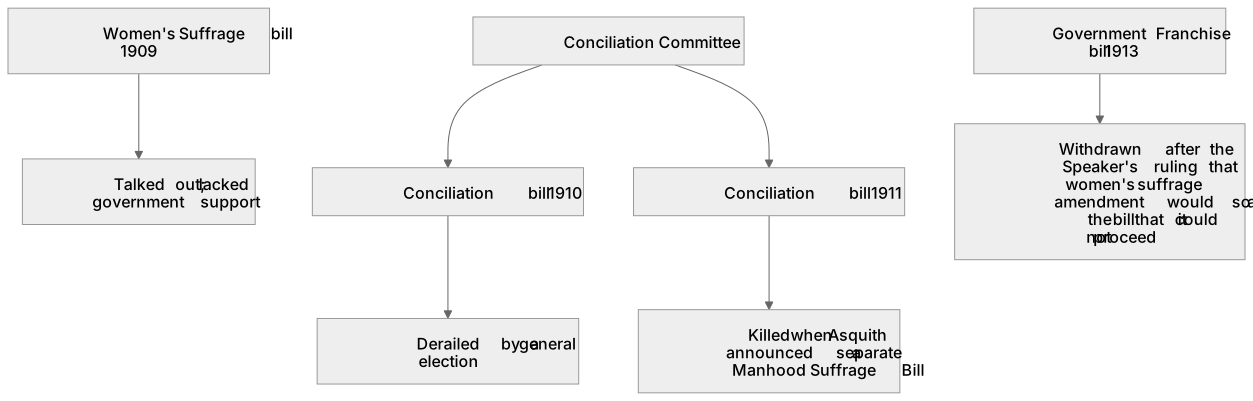
Put the events in order
Put these events in the order they happened, earliest first.
- 1. Government Franchise bill withdrawn after Speaker's ruling on amendments
- 2. Women's Suffrage bill talked out and lacking government support
- 3. Conciliation bill killed by announcement of separate Manhood Suffrage Bill
- 4. Conciliation bill derailed by a general election
Key words
Say what each word means before you turn the card.
Parliamentary procedure and obstruction
Try answering aloud or in your head before turning the card.
Government opposition and support
Try answering aloud or in your head before turning the card.
The impact of militancy on political negotiation
Try answering aloud or in your head before turning the card.
See every definition
- Parliamentary procedure and obstruction
- Procedural tactics, such as talking out a private member's bill, were used to avoid granting the vote.
- Government opposition and support
- Attitudes ranged from outright opposition by Asquith to cautious support.
- The impact of militancy on political negotiation
- Failures of the bills should be linked to government tactics and WSPU actions.
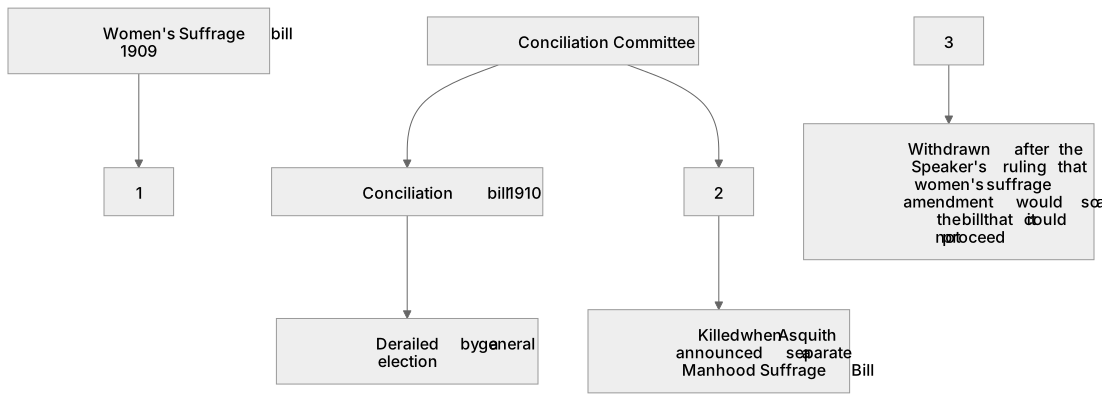
Label the diagram
Some boxes have lost their names. Pick the right name for each number.
1Box 1
2Box 2
3Box 3
There is more to this lesson
The full lesson goes on to check your understanding and help you earn the marks. Create a free account to carry on, with your progress saved.
A week of Premium from your first lesson · Then the free plan continues · No card, no charge
Test your understanding of Paper 3, Option 36.1: Protest, agitation and parliamentary reform in Britain, c1780–1928 - 4 The Women’s Social and Political Union, 1903–14: Government attitudes to female suffrage and WSPU; reasons for the failure of the Women’s Suffrage bill 1909, the Conciliation Committee and the Conciliation bills 1910 and 1911, and the Government Franchise bill 1913.
Active recall beats re-reading. Take an instant quiz now to test what you’ve learned and lock it into long-term memory.
A week of Premium from your first lesson · Then the free plan continues · No card, no charge