Pearson Edexcel · A-Level · History
Course version: 9HI0 · Version from Sept 2015
Protest, agitation and parliamentary reform in Britain, c1780–1928 - 5…
Full specification wording
Paper 3, Option 36.1: Protest, agitation and parliamentary reform in Britain, c1780–1928 - 5 Trades union militancy, 1915–27: The General Strike, 1926: reasons for its occurrence and failure; roles of media, government and TUC; reasons for its failure. The Trades Disputes Act 1927.
The General Strike of 1926 arose from coal miners' grievances over pay cuts and longer hours after the return to the gold standard, alongside TUC solidarity.
Checked against the Pearson Edexcel 9HI0 specification (opens in a new tab) on .
- Point 3 of 3
- 4 key terms
Study notes
From the checked teaching notes for this specification point.
The idea
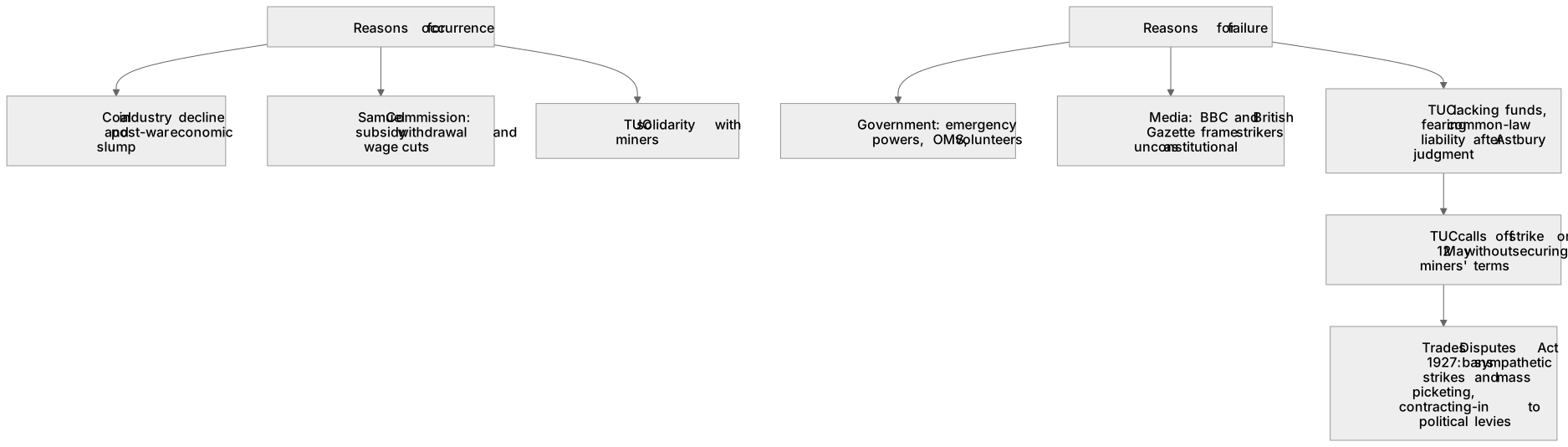
The General Strike of 1926 arose from coal miners' grievances over pay cuts and longer hours after the return to the gold standard, alongside TUC solidarity. It failed because the government effectively used emergency powers, the OMS, and volunteers to maintain supplies, while the BBC and British Gazette presented strikers as unconstitutional. The TUC, lacking funds and fearing common-law liability for damages following the Astbury judgment, called it off without securing miners' terms. The media shaped public opinion against the strike. The Trades Disputes Act 1927 subsequently banned sympathetic strikes and mass picketing, and forced union members to contract in to political levies, weakening Labour finances.
What earns the marks
- Explains reasons for occurrence: post-war economic slump, coal industry decline, and the 1925 Samuel Commission recommending subsidy withdrawal and wage cuts.
- Assesses the government's role in failure: Churchill's emergency measures, OMS, volunteer workers, and use of the BBC to broadcast government messages.
- Evaluates the TUC's role in failure: calling off the strike on 12 May without guarantees, fearing legal action and financial ruin under the Astbury judgment.
- Explains media influence: BBC and press framing strikers as revolutionary, dividing public opinion and undermining strike morale.
- Details the Trades Disputes Act 1927: outlawed sympathetic strikes, restricted picketing, and changed political levy to contracting-in, reducing Labour Party funds.
Common mistakes and how to put them right
Claiming the General Strike was a revolutionary attempt to overthrow the government.
Put it right: It was an industrial dispute in support of miners, though the government portrayed it as revolutionary.
Stating the TUC called off the strike after winning concessions.
Put it right: The TUC called it off unconditionally on 12 May 1926, leaving miners to fight alone.
Attributing the legal threat to union funds to the 1920 Emergency Powers Act.
Put it right: The direct legal threat to union funds was common-law liability highlighted by the Astbury judgment.
Exam tips
- Use specific dates and names: 4 May 1926, 12 May 1926, Samuel Commission, Astbury judgment, Stanley Baldwin.
- Link causes and failure: show how the government's preparedness and TUC's lack of legal protection contributed to both.
Try the lesson
The start of the Paper 3, Option 36.1: Protest, agitation and parliamentary reform in Britain, c1780–1928 - 5 Trades union militancy, 1915–27: The General Strike, 1926: reasons for its occurrence and failure; roles of media, government and TUC; reasons for its failure. The Trades Disputes Act 1927. lesson, made from checked teaching notes for this specification point.
Have a go first
In which year did the General Strike take place?
Listen
The General Strike of 1926 arose from coal miners' grievances over pay cuts and longer hours after the return to the gold standard, alongside TUC solidarity. It failed because the government effectively used emergency powers, the OMS, and volunteers to maintain supplies, while the BBC and British Gazette presented strikers as unconstitutional. The TUC, lacking funds and fearing common-law liability for damages following the Astbury judgment, called it off without securing miners' terms. The media shaped public opinion against the strike. The Trades Disputes Act 1927 subsequently banned sympathetic strikes and mass picketing, and forced union members to contract in to political levies, weakening Labour finances. A strong answer earns marks for these points. Explains reasons for occurrence: post-war economic slump, coal industry decline, and the 1925 Samuel Commission recommending subsidy withdrawal and wage cuts. Assesses the government's role in failure: Churchill's emergency measures, OMS, volunteer workers, and use of the BBC to broadcast government messages. Evaluates the TUC's role in failure: calling off the strike on 12 May without guarantees, fearing legal action and financial ruin under the Astbury judgment. Explains media influence: BBC and press framing strikers as revolutionary, dividing public opinion and undermining strike morale. A common slip: claiming the General Strike was a revolutionary attempt to overthrow the government. Instead, it was an industrial dispute in support of miners, though the government portrayed it as revolutionary. Exam tip: Use specific dates and names: 4 May 1926, 12 May 1926, Samuel Commission, Astbury judgment, Stanley Baldwin.
See it
Key words
Say what each word means before you turn the card.
Industrial conflict and class tension
Try answering aloud or in your head before turning the card.
Government intervention and emergency powers
Try answering aloud or in your head before turning the card.
Media influence and public opinion
Try answering aloud or in your head before turning the card.
Trade union decline and legal restrictions
Try answering aloud or in your head before turning the card.
See every definition
- Industrial conflict and class tension
- The General Strike arose from coal miners' grievances over pay cuts and longer hours, alongside TUC solidarity.
- Government intervention and emergency powers
- The government effectively used emergency powers, the OMS and volunteers to maintain supplies during the strike.
- Media influence and public opinion
- The BBC and British Gazette presented strikers as unconstitutional, and the media shaped public opinion against the strike.
- Trade union decline and legal restrictions
- The Trades Disputes Act 1927 banned sympathetic strikes and mass picketing, and forced union members to contract in to political levies.
Label the diagram
Some boxes have lost their names. Pick the right name for each number.
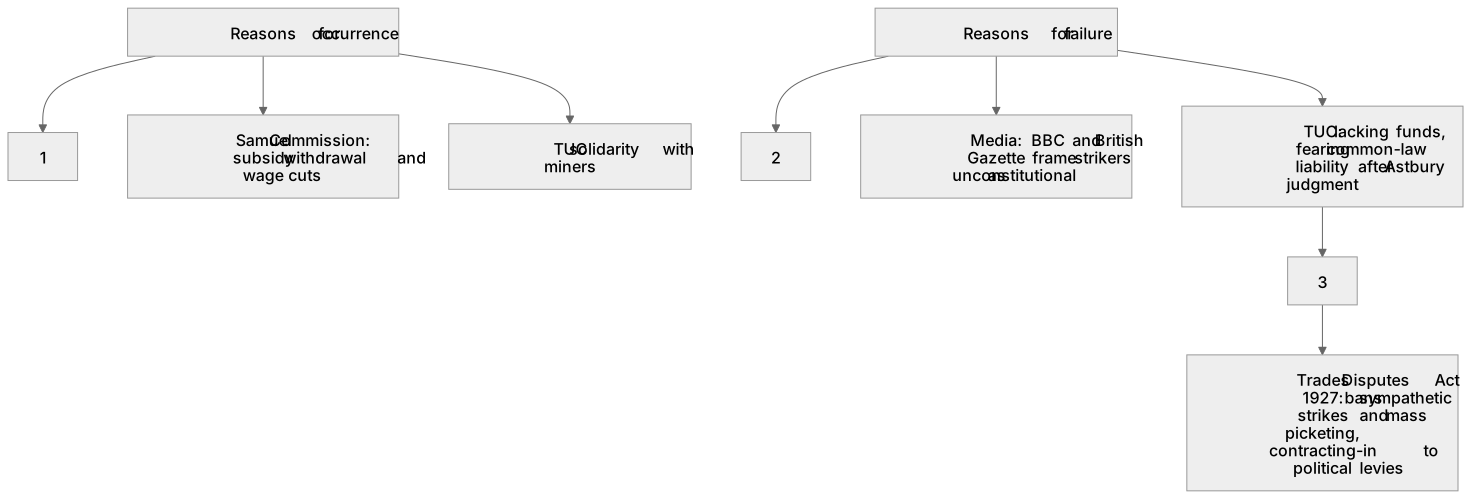
1Box 1
2Box 2
3Box 3
There is more to this lesson
The full lesson goes on to check your understanding and help you earn the marks. Create a free account to carry on, with your progress saved.
A week of Premium from your first lesson · Then the free plan continues · No card, no charge
Test your understanding of Paper 3, Option 36.1: Protest, agitation and parliamentary reform in Britain, c1780–1928 - 5 Trades union militancy, 1915–27: The General Strike, 1926: reasons for its occurrence and failure; roles of media, government and TUC; reasons for its failure. The Trades Disputes Act 1927.
Active recall beats re-reading. Take an instant quiz now to test what you’ve learned and lock it into long-term memory.
A week of Premium from your first lesson · Then the free plan continues · No card, no charge