Pearson Edexcel · A-Level · History
Course version: 9HI0 · Version from Sept 2015
Protest, agitation and parliamentary reform in Britain, c1780–1928 - 5…
Full specification wording
Paper 3, Option 36.1: Protest, agitation and parliamentary reform in Britain, c1780–1928 - 5 Trades union militancy, 1915–27: The roles of Manny Shinwell, James Maxton, Ernest Bevin and J H Thomas; the events and significance of the Glasgow rent strike, 1915, and the 40-hour strike, 1919.
This topic examines key figures and major industrial disputes shaping trade union militancy.
Checked against the Pearson Edexcel 9HI0 specification (opens in a new tab) on .
- Point 1 of 3
- 3 key terms
Study notes
From the checked teaching notes for this specification point.
The idea
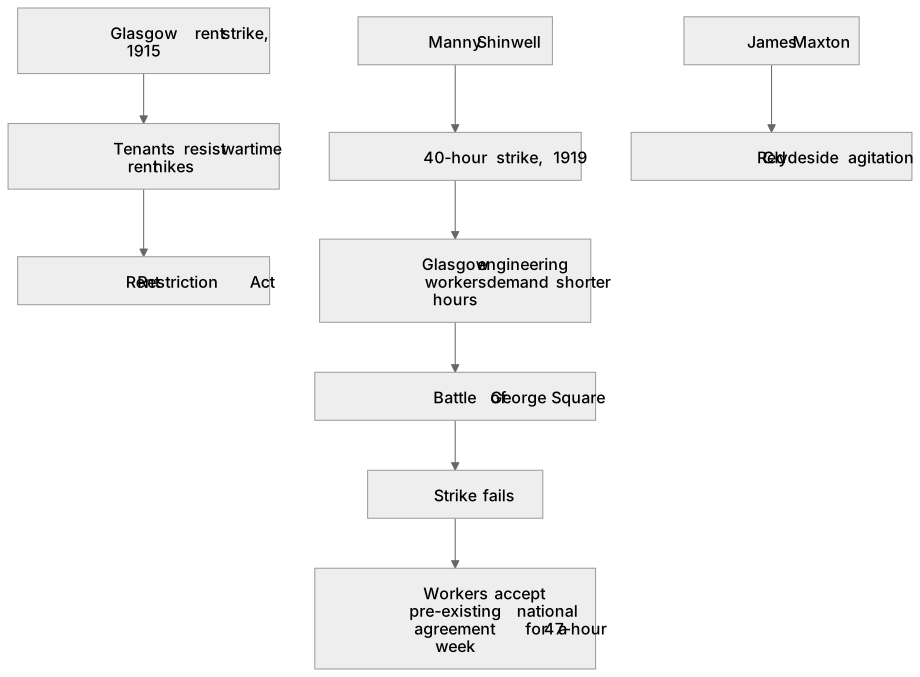
This topic examines key figures and major industrial disputes shaping trade union militancy. The 1915 Glasgow rent strike saw tenants successfully resist wartime rent hikes, forcing the Rent Restriction Act. The 1919 40-hour strike in Glasgow, led by figures like Manny Shinwell, demanded shorter hours to absorb returning soldiers. It culminated in the Battle of George Square but failed, forcing workers to accept a pre-existing national agreement for a 47-hour week. James Maxton, a prominent ILP figure, supported Red Clydeside agitation. Ernest Bevin gained prominence through the 1920 Shaw Inquiry and founding the TGWU, while J H Thomas led the railwaymen (NUR) and played a cautious role in the Triple Alliance, notably during Black Friday.
What earns the marks
- Explains the events and significance of the 1915 Glasgow rent strike: grassroots resistance to wartime rent increases leading to the Rent Restriction Act.
- Details the 1919 40-hour strike: Glasgow engineering workers demanding shorter hours, leading to the Battle of George Square, with Manny Shinwell acting as a key strike leader, and the ultimate failure of the strike.
- Assesses the roles of James Maxton and J H Thomas: Maxton as a radical ILP agitator on Clydeside, and Thomas as the moderate NUR leader involved in the Triple Alliance and Black Friday.
- Evaluates Ernest Bevin's significance: his advocacy for dockers at the 1920 Shaw Inquiry, involvement in the Council of Action, and creation of the TGWU.
Common mistakes and how to put them right
Attributing leadership of the 1919 40-hour strike to Ernest Bevin.
Put it right: The 1919 40-hour strike was a Glasgow-based dispute led by figures like Manny Shinwell; Bevin's prominence arose from the Shaw Inquiry and the TGWU.
Confusing the roles of Shinwell and Maxton.
Put it right: While both were Red Clydeside figures, Shinwell was directly involved in leading the 1919 40-hour strike and was imprisoned for it, whereas Maxton was a key ILP propagandist and agitator.
Assuming J H Thomas supported all militant action.
Put it right: Thomas was a moderate who often sought to avoid strikes, notably pulling the NUR out of the Triple Alliance strike on Black Friday in 1921.
Claiming the 1919 40-hour strike achieved a 47-hour week.
Put it right: The 47-hour week was a pre-existing national agreement that the strikers were forced to accept after their demand for 40 hours failed.
Exam tips
- When discussing the 1919 40-hour strike, explicitly link Manny Shinwell's leadership to the events at George Square and the government's fear of revolution.
- Contrast the radicalism of Red Clydeside figures (Shinwell, Maxton) with the more pragmatic or moderate national union leadership of Bevin and Thomas.
Try the lesson
The start of the Paper 3, Option 36.1: Protest, agitation and parliamentary reform in Britain, c1780–1928 - 5 Trades union militancy, 1915–27: The roles of Manny Shinwell, James Maxton, Ernest Bevin and J H Thomas; the events and significance of the Glasgow rent strike, 1915, and the 40-hour strike, 1919. lesson, made from checked teaching notes for this specification point.
Have a go first
What was the primary role of Manny Shinwell during the period of trades union militancy on Clydeside?
Listen
This topic examines key figures and major industrial disputes shaping trade union militancy. The 1915 Glasgow rent strike saw tenants successfully resist wartime rent hikes, forcing the Rent Restriction Act. The 1919 40-hour strike in Glasgow, led by figures like Manny Shinwell, demanded shorter hours to absorb returning soldiers. It culminated in the Battle of George Square but failed, forcing workers to accept a pre-existing national agreement for a 47-hour week. James Maxton, a prominent ILP figure, supported Red Clydeside agitation. Ernest Bevin gained prominence through the 1920 Shaw Inquiry and founding the TGWU, while J H Thomas led the railwaymen (NUR) and played a cautious role in the Triple Alliance, notably during Black Friday. A strong answer earns marks for these points. Explains the events and significance of the 1915 Glasgow rent strike: grassroots resistance to wartime rent increases leading to the Rent Restriction Act. Details the 1919 40-hour strike: Glasgow engineering workers demanding shorter hours, leading to the Battle of George Square, with Manny Shinwell acting as a key strike leader, and the ultimate failure of the strike. Assesses the roles of James Maxton and J H Thomas: Maxton as a radical ILP agitator on Clydeside, and Thomas as the moderate NUR leader involved in the Triple Alliance and Black Friday. Evaluates Ernest Bevin's significance: his advocacy for dockers at the 1920 Shaw Inquiry, involvement in the Council of Action, and creation of the TGWU. A common slip: attributing leadership of the 1919 40-hour strike to Ernest Bevin. Instead, the 1919 40-hour strike was a Glasgow-based dispute led by figures like Manny Shinwell; Bevin's prominence arose from the Shaw Inquiry and the TGWU. Exam tip: When discussing the 1919 40-hour strike, explicitly link Manny Shinwell's leadership to the events at George Square and the government's fear of revolution.
See it
Put the events in order
Put these events in the order they happened, earliest first.
- 1. Glasgow rent strike forced the Rent Restriction Act
- 2. J H Thomas pulled the NUR out on Black Friday
- 3. Ernest Bevin advocated for dockers at the Shaw Inquiry
Key words
Say what each word means before you turn the card.
Glasgow rent strike, 1915
Try answering aloud or in your head before turning the card.
40-hour strike, 1919
Try answering aloud or in your head before turning the card.
Red Clydeside
Try answering aloud or in your head before turning the card.
See every definition
- Glasgow rent strike, 1915
- Tenants successfully resisted wartime rent hikes, forcing the Rent Restriction Act.
- 40-hour strike, 1919
- Glasgow engineering workers demanded shorter hours to absorb returning soldiers; it led to the Battle of George Square and failed.
- Red Clydeside
- Agitation on Clydeside supported by James Maxton, a prominent ILP figure.
Label the diagram
Some boxes have lost their names. Pick the right name for each number.
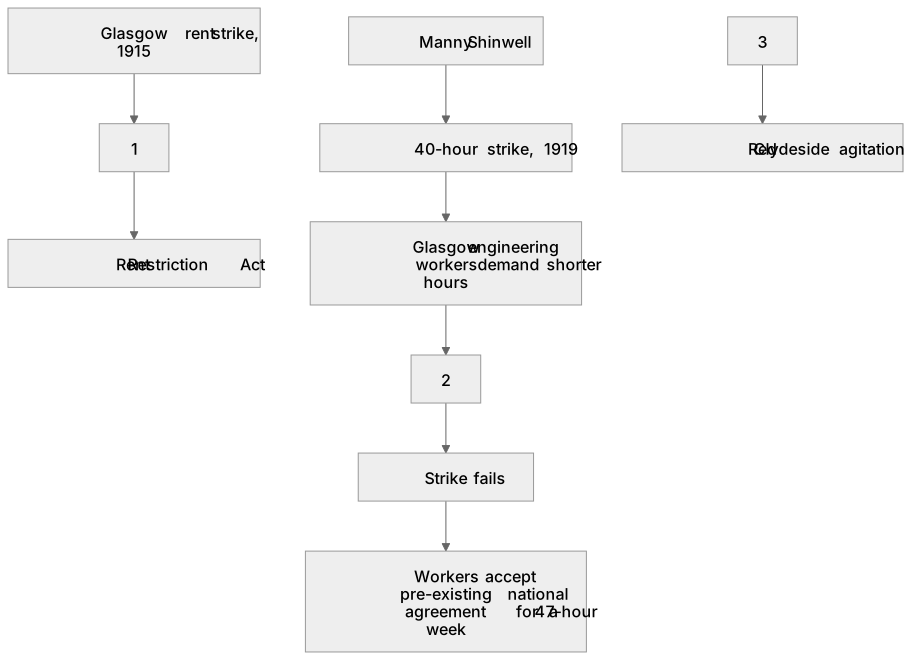
1Box 1
2Box 2
3Box 3
There is more to this lesson
The full lesson goes on to check your understanding and help you earn the marks. Create a free account to carry on, with your progress saved.
A week of Premium from your first lesson · Then the free plan continues · No card, no charge
Test your understanding of Paper 3, Option 36.1: Protest, agitation and parliamentary reform in Britain, c1780–1928 - 5 Trades union militancy, 1915–27: The roles of Manny Shinwell, James Maxton, Ernest Bevin and J H Thomas; the events and significance of the Glasgow rent strike, 1915, and the 40-hour strike, 1919.
Active recall beats re-reading. Take an instant quiz now to test what you’ve learned and lock it into long-term memory.
A week of Premium from your first lesson · Then the free plan continues · No card, no charge