Pearson Edexcel · A-Level · History
Course version: 9HI0 · Version from Sept 2015
Ireland and the Union, c1774–1923 - 2 British reaction: from resistance to…
Full specification wording
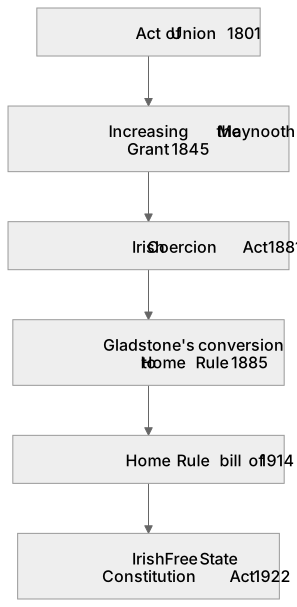
Paper 3, Option 36.2: Ireland and the Union, c1774–1923 - 2 British reaction: from resistance to acceptance: Evolving government policies c1774–1922: reasons for changing approaches to the government of Ireland (key developments: the Act of Union 1801, increasing the Maynooth Grant 1845, the Irish Coercion Act 1881, Gladstone’s conversion to Home Rule 1885; the Home Rule bill of 1914, the Irish Free State Constitution Act 1922).
British policy towards Ireland shifted between coercion and concession.
Checked against the Pearson Edexcel 9HI0 specification (opens in a new tab) on .
- Point 1 of 2
- 4 key terms
Study notes
From the checked teaching notes for this specification point.
The idea
British policy towards Ireland shifted between coercion and concession. The Act of Union 1801 abolished the Irish parliament and created the United Kingdom, but Catholic emancipation and later grievances kept Irish questions alive. Increasing the Maynooth Grant in 1845 was a conciliatory gesture towards Catholic education, though it angered some Protestants. The Irish Coercion Act 1881 showed the continuing use of force to suppress land agitation. Gladstone's conversion to Home Rule in 1885 marked a major change: a British leader accepted self-government in principle. The Home Rule bill of 1914 passed the Commons but was suspended by war, and the Irish Free State Constitution Act 1922 confirmed dominion status for the south. These changes reflect pressure from Irish nationalism, party politics, war and fear of civil conflict.
What earns the marks
- Explains the Act of Union 1801 as a constitutional change that ended the Irish parliament and joined Ireland to Britain.
- Explains the Maynooth Grant increase in 1845 as a conciliatory policy towards Catholic education and its political consequences.
- Explains the Irish Coercion Act 1881 as a coercive response to land agitation, showing the continuing use of force.
- Explains Gladstone's conversion to Home Rule in 1885 as a turning point in British policy, and the Home Rule bill of 1914 as a measure passed but suspended.
- Explains the Irish Free State Constitution Act 1922 as the acceptance of dominion status for the south, completing the shift from resistance to acceptance.
Common mistakes and how to put them right
Treating the Act of Union as simply a merger of parliaments.
Put it right by explaining that it abolished the Irish parliament and created the United Kingdom.
Confusing the Maynooth Grant with coercion.
Put it right by describing it as a conciliatory grant to a Catholic seminary, not a punitive law.
Assuming the 1914 Home Rule bill became law immediately.
Put it right by noting it was passed but suspended because of the First World War.
Exam tips
- Organise the answer chronologically or by policy type, ensuring each named development is explained.
- Use the named acts and dates precisely, and connect each to the reason for the change in British approach.
- Show change over time: from coercion and union, through concession, to Home Rule and dominion status.
Try the lesson
The start of the Paper 3, Option 36.2: Ireland and the Union, c1774–1923 - 2 British reaction: from resistance to acceptance: Evolving government policies c1774–1922: reasons for changing approaches to the government of Ireland (key developments: the Act of Union 1801, increasing the Maynooth Grant 1845, the Irish Coercion Act 1881, Gladstone’s conversion to Home Rule 1885; the Home Rule bill of 1914, the Irish Free State Constitution Act 1922). lesson, made from checked teaching notes for this specification point.
Have a go first
Which political development in 1885 acted as the primary catalyst for William Gladstone's conversion to supporting Irish Home Rule?
Listen
British policy towards Ireland shifted between coercion and concession. The Act of Union 1801 abolished the Irish parliament and created the United Kingdom, but Catholic emancipation and later grievances kept Irish questions alive. Increasing the Maynooth Grant in 1845 was a conciliatory gesture towards Catholic education, though it angered some Protestants. The Irish Coercion Act 1881 showed the continuing use of force to suppress land agitation. Gladstone's conversion to Home Rule in 1885 marked a major change: a British leader accepted self-government in principle. The Home Rule bill of 1914 passed the Commons but was suspended by war, and the Irish Free State Constitution Act 1922 confirmed dominion status for the south. These changes reflect pressure from Irish nationalism, party politics, war and fear of civil conflict. A strong answer earns marks for these points. Explains the Act of Union 1801 as a constitutional change that ended the Irish parliament and joined Ireland to Britain. Explains the Maynooth Grant increase in 1845 as a conciliatory policy towards Catholic education and its political consequences. Explains the Irish Coercion Act 1881 as a coercive response to land agitation, showing the continuing use of force. Explains Gladstone's conversion to Home Rule in 1885 as a turning point in British policy, and the Home Rule bill of 1914 as a measure passed but suspended. A common slip: Treating the Act of Union as simply a merger of parliaments. Instead, explaining that it abolished the Irish parliament and created the United Kingdom. Exam tip: Organise the answer chronologically or by policy type, ensuring each named development is explained.
See it
Put it in order
Put these steps in the order they happen.
- 1. Irish Coercion Act 1881
- 2. Increasing the Maynooth Grant 1845
- 3. Act of Union 1801
- 4. Irish Free State Constitution Act 1922
- 5. Home Rule bill of 1914
- 6. Gladstone's conversion to Home Rule 1885
Put the events in order
Put these events in the order they happened, earliest first.
- 1. Irish Coercion Act used force to suppress land agitation
- 2. Gladstone's conversion to Home Rule in principle
- 3. Home Rule bill passed the Commons but was suspended by war
- 4. Increase in the Maynooth Grant as a conciliatory gesture
- 5. Act of Union abolished the Irish parliament and created the United Kingdom
- 6. Irish Free State Constitution Act confirmed dominion status for the south
Key words
Say what each word means before you turn the card.
Union and constitutional change
Try answering aloud or in your head before turning the card.
Coercion and concession
Try answering aloud or in your head before turning the card.
Party politics and leadership
Try answering aloud or in your head before turning the card.
War, Home Rule and dominion status
Try answering aloud or in your head before turning the card.
See every definition
- Union and constitutional change
- The Act of Union 1801 abolished the Irish parliament and created the United Kingdom, joining Ireland to Britain.
- Coercion and concession
- British policy shifted between coercion, as with the Irish Coercion Act 1881, and concession, as with the increased Maynooth Grant in 1845.
- Party politics and leadership
- Gladstone's conversion to Home Rule in 1885 marked a major change, as a British leader accepted self-government in principle.
- War, Home Rule and dominion status
- The Home Rule bill of 1914 passed the Commons but was suspended by war, and the Irish Free State Constitution Act 1922 confirmed dominion status for the south.
Label the diagram
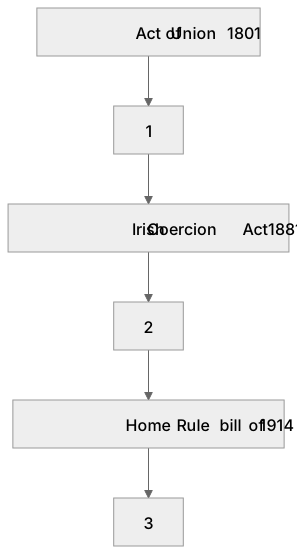
Some boxes have lost their names. Pick the right name for each number.
1Box 1
2Box 2
3Box 3
There is more to this lesson
The full lesson goes on to check your understanding and help you earn the marks. Create a free account to carry on, with your progress saved.
A week of Premium from your first lesson · Then the free plan continues · No card, no charge
Test your understanding of Paper 3, Option 36.2: Ireland and the Union, c1774–1923 - 2 British reaction: from resistance to acceptance: Evolving government policies c1774–1922: reasons for changing approaches to the government of Ireland (key developments: the Act of Union 1801, increasing the Maynooth Grant 1845, the Irish Coercion Act 1881, Gladstone’s conversion to Home Rule 1885; the Home Rule bill of 1914, the Irish Free State Constitution Act 1922).
Active recall beats re-reading. Take an instant quiz now to test what you’ve learned and lock it into long-term memory.
A week of Premium from your first lesson · Then the free plan continues · No card, no charge