Pearson Edexcel · A-Level · History
Course version: 9HI0 · Version from Sept 2015
Ireland and the Union, c1774–1923 - 3 The Irish Famine, 1843–51: Social…
Full specification wording
Paper 3, Option 36.2: Ireland and the Union, c1774–1923 - 3 The Irish Famine, 1843–51: Social and economic impacts of depopulation; migration and emigration; consolidation of land holdings and importance of the Encumbered Estates Act 1849.
The Famine transformed Irish society and land.
Checked against the Pearson Edexcel 9HI0 specification (opens in a new tab) on .
- Point 3 of 3
- 4 key terms
Study notes
From the checked teaching notes for this specification point.
The idea
The Famine transformed Irish society and land. Death and emigration cut the population sharply, with mass movement to Britain, North America and Australia. Emigration became a permanent feature, changing family structures and communities. Smaller farmers and labourers declined as land was consolidated into larger grazing and tillage holdings. The Encumbered Estates Act 1849 allowed indebted estates to be sold, transferring land to new owners who often raised rents and cleared tenants. Together these changes produced a more pastoral, less populous Ireland, embedding emigration and landlord-tenant conflict in later history.
What earns the marks
- Explains depopulation through death and emigration and its social effects on families and communities.
- Analyses migration and emigration patterns, including destinations and the shift to permanent emigration.
- Explains consolidation of land holdings and the decline of smallholders and labourers.
- Assesses the Encumbered Estates Act 1849 as a cause of land transfer and further clearances.
Common mistakes and how to put them right
Treating depopulation as only deaths.
Put it right by including emigration as a major cause.
Assuming the Encumbered Estates Act helped tenants.
Put it right by noting it often facilitated sales and clearances.
Ignoring regional variation: correct by recognising different impacts across Ireland.
Exam tips
- Quantify change where possible, for example population fall and emigration totals.
- Link land consolidation to social consequences such as rural depopulation.
- Use the Encumbered Estates Act as a turning point in land ownership.
Try the lesson
The start of the Paper 3, Option 36.2: Ireland and the Union, c1774–1923 - 3 The Irish Famine, 1843–51: Social and economic impacts of depopulation; migration and emigration; consolidation of land holdings and importance of the Encumbered Estates Act 1849. lesson, made from checked teaching notes for this specification point.
Have a go first
What was one major social impact of depopulation in Ireland after the Famine?
Listen
The Famine transformed Irish society and land. Death and emigration cut the population sharply, with mass movement to Britain, North America and Australia. Emigration became a permanent feature, changing family structures and communities. Smaller farmers and labourers declined as land was consolidated into larger grazing and tillage holdings. The Encumbered Estates Act 1849 allowed indebted estates to be sold, transferring land to new owners who often raised rents and cleared tenants. Together these changes produced a more pastoral, less populous Ireland, embedding emigration and landlord-tenant conflict in later history. A strong answer earns marks for these points. Explains depopulation through death and emigration and its social effects on families and communities. Analyses migration and emigration patterns, including destinations and the shift to permanent emigration. Explains consolidation of land holdings and the decline of smallholders and labourers. Assesses the Encumbered Estates Act 1849 as a cause of land transfer and further clearances. A common slip: Treating depopulation as only deaths. Instead, including emigration as a major cause. Exam tip: Quantify change where possible, for example population fall and emigration totals.
See it
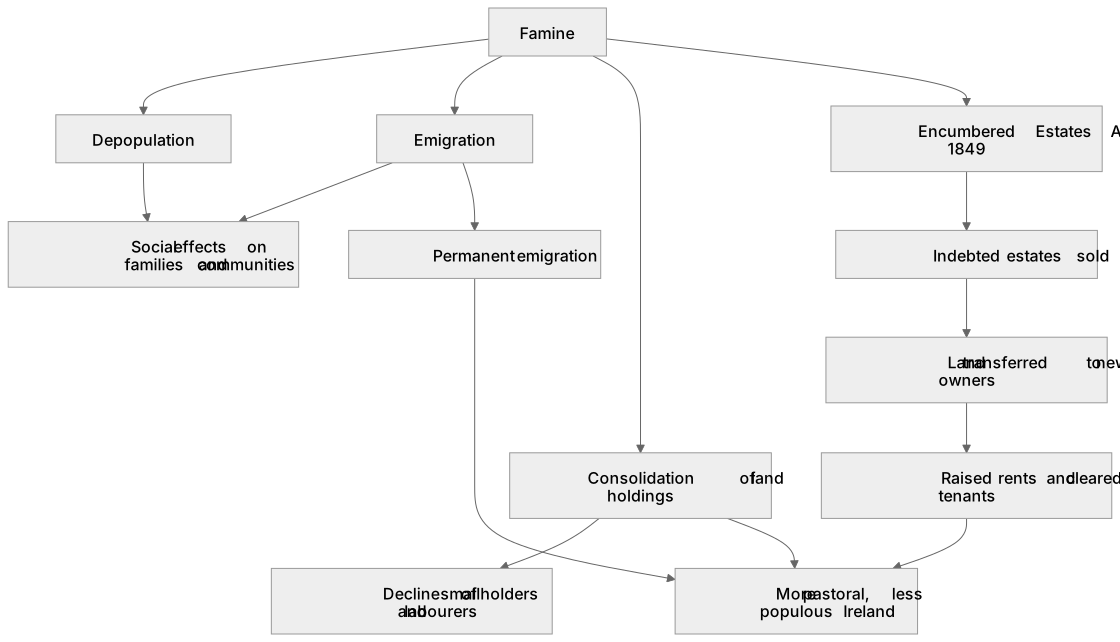
Key words
Say what each word means before you turn the card.
Depopulation
Try answering aloud or in your head before turning the card.
Emigration and migration
Try answering aloud or in your head before turning the card.
Land consolidation
Try answering aloud or in your head before turning the card.
Encumbered Estates Act 1849
Try answering aloud or in your head before turning the card.
See every definition
- Depopulation
- A sharp cut in the population through death and emigration, with social effects on families and communities.
- Emigration and migration
- Mass movement to Britain, North America and Australia that became a permanent feature, changing family structures and communities.
- Land consolidation
- The combining of land into larger grazing and tillage holdings, as smaller farmers and labourers declined.
- Encumbered Estates Act 1849
- A measure allowing indebted estates to be sold, transferring land to new owners who often raised rents and cleared tenants.
Label the diagram
Some boxes have lost their names. Pick the right name for each number.
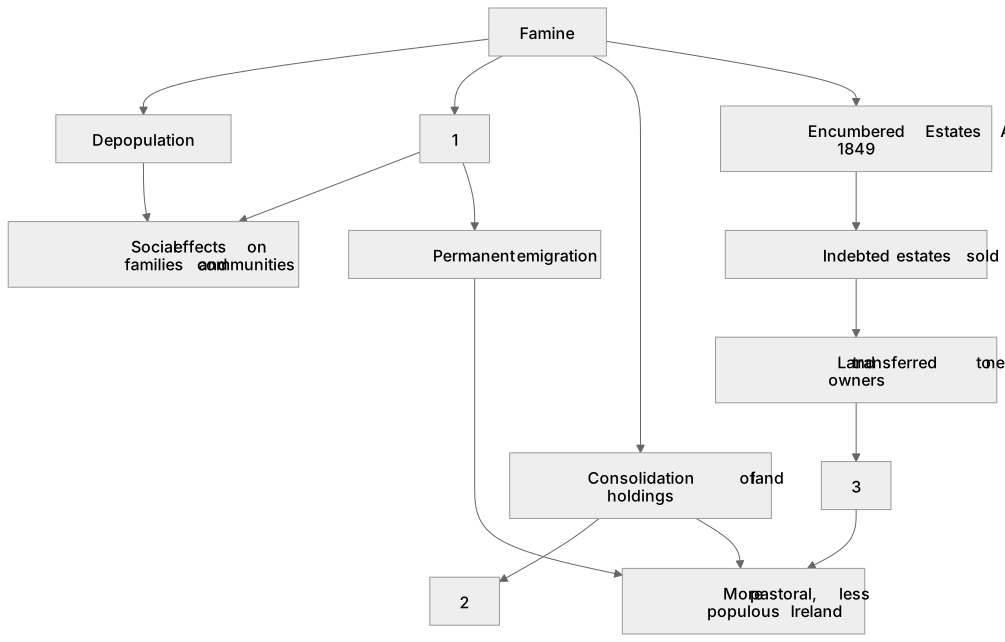
1Box 1
2Box 2
3Box 3
There is more to this lesson
The full lesson goes on to check your understanding and help you earn the marks. Create a free account to carry on, with your progress saved.
A week of Premium from your first lesson · Then the free plan continues · No card, no charge
Test your understanding of Paper 3, Option 36.2: Ireland and the Union, c1774–1923 - 3 The Irish Famine, 1843–51: Social and economic impacts of depopulation; migration and emigration; consolidation of land holdings and importance of the Encumbered Estates Act 1849.
Active recall beats re-reading. Take an instant quiz now to test what you’ve learned and lock it into long-term memory.
A week of Premium from your first lesson · Then the free plan continues · No card, no charge