Pearson Edexcel · A-Level · History
Course version: 9HI0 · Version from Sept 2015
Ireland and the Union, c1774–1923 - 3 The Irish Famine, 1843–51: The role…
Full specification wording
Paper 3, Option 36.2: Ireland and the Union, c1774–1923 - 3 The Irish Famine, 1843–51: The role of absentee landlords, middlemen, landholdings, monoculture and blight; impact of famine on populace.
Irish rural poverty before the Famine rested on a fragile land system.
Checked against the Pearson Edexcel 9HI0 specification (opens in a new tab) on .
- Point 1 of 3
- 4 key terms
Study notes
From the checked teaching notes for this specification point.
The idea
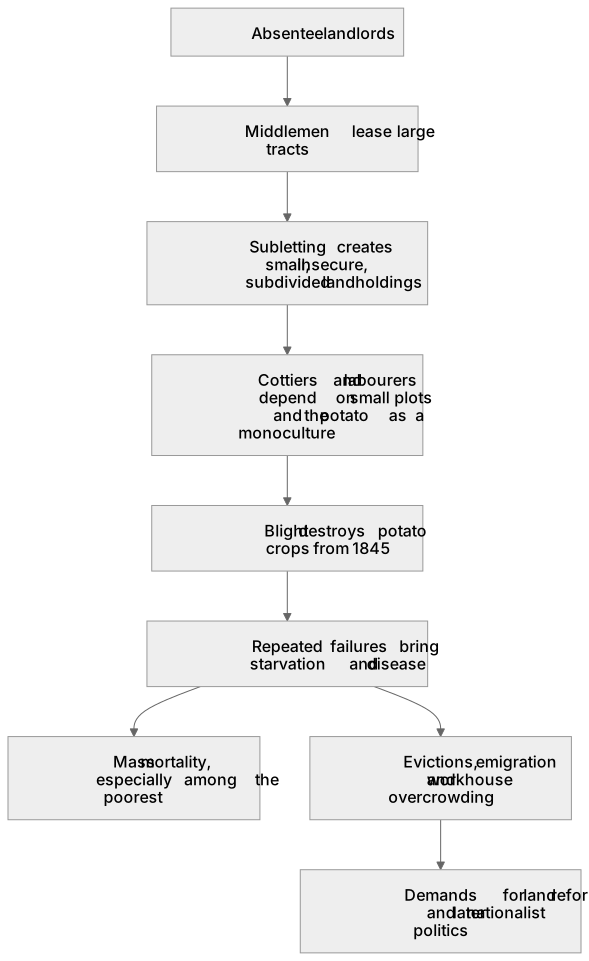
Irish rural poverty before the Famine rested on a fragile land system. Absentee landlords owned estates but lived elsewhere, drawing rents through agents and investing little. Middlemen leased large tracts and sublet at profit, leaving tenants on tiny, insecure holdings. Most cottiers and labourers depended on small plots and the potato as a monoculture, so a single crop failure threatened total destitution. When blight destroyed potato crops from 1845, repeated failures brought starvation, disease and mass mortality, especially among the poorest. Evictions, emigration and workhouse overcrowding transformed the populace, while the experience intensified demands for land reform and shaped later nationalist politics.
What earns the marks
- Explains how absentee landlords drained capital and reduced improvement on Irish estates.
- Explains the middleman system and how subletting created small, insecure and subdivided landholdings.
- Analyses the consequences of landholdings and monoculture, showing why potato dependence made the poor exceptionally vulnerable.
- Explains the role of blight in destroying potato crops and triggering repeated subsistence crises from 1845.
- Assesses the impact of famine on the populace, including starvation, disease, eviction, workhouse pressure and mass emigration.
- Links the Famine's social and economic effects to later political and land-reform developments.
Common mistakes and how to put them right
Treating the blight as the sole cause of the Famine.
Put it right by explaining how landlord, middleman and landholding structures created vulnerability.
Confusing absentee landlords with middlemen.
Put it right by distinguishing owners who lived away from those who leased and sublet land.
Assuming the Famine affected all classes equally.
Put it right by showing that cottiers, labourers and smallholders suffered most.
Exam tips
- Build causal chains that move from land structure to potato dependence to blight to famine impact.
- Use precise terms such as cottier, conacre, subdivision and middleman to show secure knowledge.
- Balance causes with consequences, ensuring the impact on the populace is fully addressed.
Try the lesson
The start of the Paper 3, Option 36.2: Ireland and the Union, c1774–1923 - 3 The Irish Famine, 1843–51: The role of absentee landlords, middlemen, landholdings, monoculture and blight; impact of famine on populace. lesson, made from checked teaching notes for this specification point.
Have a go first
In the context of pre-Famine Ireland, what was the role of a middleman?
Listen
Irish rural poverty before the Famine rested on a fragile land system. Absentee landlords owned estates but lived elsewhere, drawing rents through agents and investing little. Middlemen leased large tracts and sublet at profit, leaving tenants on tiny, insecure holdings. Most cottiers and labourers depended on small plots and the potato as a monoculture, so a single crop failure threatened total destitution. When blight destroyed potato crops from 1845, repeated failures brought starvation, disease and mass mortality, especially among the poorest. Evictions, emigration and workhouse overcrowding transformed the populace, while the experience intensified demands for land reform and shaped later nationalist politics. A strong answer earns marks for these points. Explains how absentee landlords drained capital and reduced improvement on Irish estates. Explains the middleman system and how subletting created small, insecure and subdivided landholdings. Analyses the consequences of landholdings and monoculture, showing why potato dependence made the poor exceptionally vulnerable. Explains the role of blight in destroying potato crops and triggering repeated subsistence crises from 1845. A common slip: Treating the blight as the sole cause of the Famine. Instead, explaining how landlord, middleman and landholding structures created vulnerability. Exam tip: Build causal chains that move from land structure to potato dependence to blight to famine impact.
See it
Key words
Say what each word means before you turn the card.
Absentee landlords
Try answering aloud or in your head before turning the card.
Middlemen
Try answering aloud or in your head before turning the card.
Monoculture
Try answering aloud or in your head before turning the card.
Blight
Try answering aloud or in your head before turning the card.
See every definition
- Absentee landlords
- Owners of estates who lived elsewhere, drawing rents through agents and investing little.
- Middlemen
- People who leased large tracts and sublet at profit, leaving tenants on tiny, insecure holdings.
- Monoculture
- Dependence on the potato as a single crop, so a single crop failure threatened total destitution.
- Blight
- The disease that destroyed potato crops from 1845, bringing repeated failures, starvation, disease and mass mortality.
Label the diagram
Some boxes have lost their names. Pick the right name for each number.
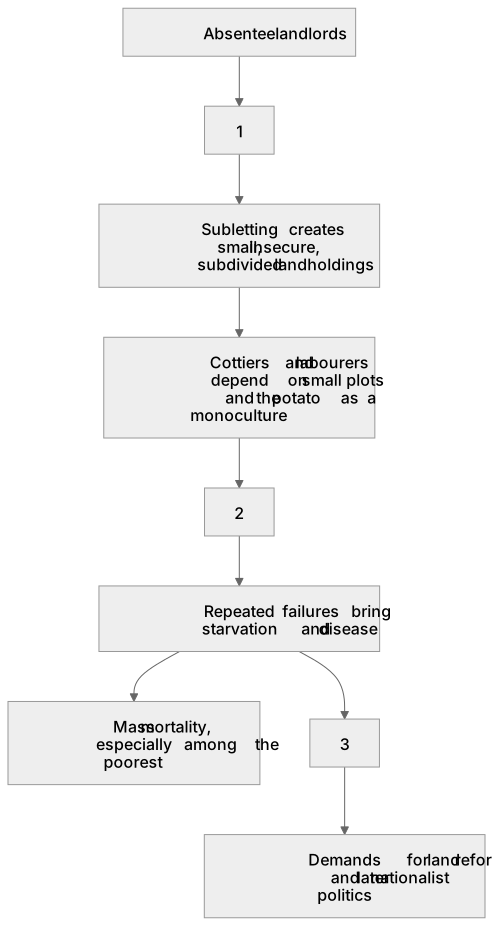
1Box 1
2Box 2
3Box 3
There is more to this lesson
The full lesson goes on to check your understanding and help you earn the marks. Create a free account to carry on, with your progress saved.
A week of Premium from your first lesson · Then the free plan continues · No card, no charge
Test your understanding of Paper 3, Option 36.2: Ireland and the Union, c1774–1923 - 3 The Irish Famine, 1843–51: The role of absentee landlords, middlemen, landholdings, monoculture and blight; impact of famine on populace.
Active recall beats re-reading. Take an instant quiz now to test what you’ve learned and lock it into long-term memory.
A week of Premium from your first lesson · Then the free plan continues · No card, no charge