Pearson Edexcel · A-Level · History
Course version: 9HI0 · Version from Sept 2015
The changing nature of warfare, 1859–1991: perception and reality - 2…
Full specification wording
Paper 3, Option 37.1: The changing nature of warfare, 1859–1991: perception and reality - 2 Attempts to influence the public response to war: The impact of propaganda and news control, 1859–1991 (key developments: the hostility to conscription in the US Civil War, the wave of anti-German sentiment 1917–18, the contrasting success of US governments with the media during the Vietnam and First Gulf War).
This topic assesses how propaganda and news control affected public responses from 1859 to 1991.
Checked against the Pearson Edexcel 9HI0 specification (opens in a new tab) on .
- Point 2 of 2
- 3 key terms
Study notes
From the checked teaching notes for this specification point.
The idea
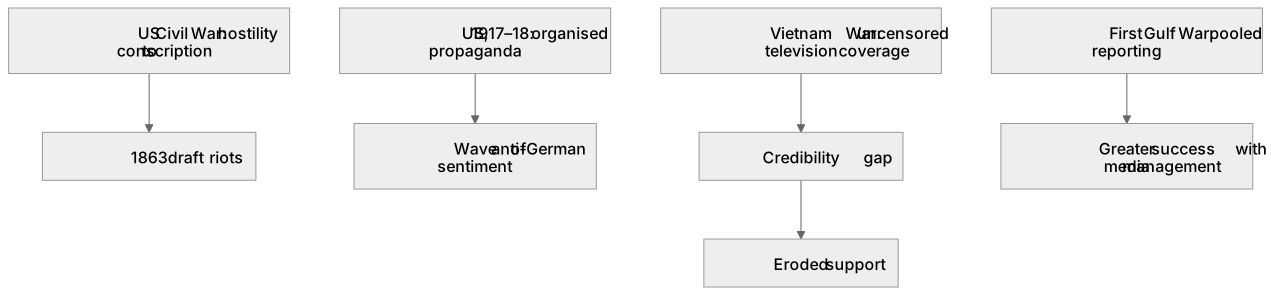
This topic assesses how propaganda and news control affected public responses from 1859 to 1991. In the US Civil War, conscription provoked hostility, notably the New York draft riots of 1863, showing the limits of official messaging. During the First World War, propaganda generated a wave of anti-German sentiment in the US in 1917–18, influencing enlistment and hostility to German culture. In contrast, US governments had more success with media management in the First Gulf War (1990–91) through pooled reporting, while the Vietnam War exposed a credibility gap as uncensored television coverage eroded support.
What earns the marks
- Explains the causes and consequences of hostility to conscription in the US Civil War, including the 1863 draft riots.
- Analyses how propaganda created and sustained a wave of anti-German sentiment in the US during 1917–18.
- Contrasts the US government's relationship with the media in the Vietnam War and the First Gulf War.
- Evaluates the extent to which news control shaped public perception in each case.
- Assesses the role of new media technologies in changing the effectiveness of propaganda and control.
Common mistakes and how to put them right
Assuming anti-German sentiment was spontaneous.
Put it right: Link it to organised propaganda and official campaigns in the US in 1917–18.
Treating Vietnam and the First Gulf War as identical.
Put it right: Contrast the credibility gap and uncensored reporting in Vietnam with pooled reporting in the Gulf War.
Overlooking domestic opposition; correction: include draft riots and dissent as evidence of limited control.
Exam tips
- Use precise examples such as the New York draft riots (1863) or the anti-German sentiment in the US (1917–18) to illustrate impact.
- Compare the Vietnam and First Gulf Wars explicitly to show contrasting success in media management.
Try the lesson
The start of the Paper 3, Option 37.1: The changing nature of warfare, 1859–1991: perception and reality - 2 Attempts to influence the public response to war: The impact of propaganda and news control, 1859–1991 (key developments: the hostility to conscription in the US Civil War, the wave of anti-German sentiment 1917–18, the contrasting success of US governments with the media during the Vietnam and First Gulf War). lesson, made from checked teaching notes for this specification point.
Have a go first
Which of the following was a key factor in generating the wave of anti-German sentiment in the United States during 1917–18?
Listen
This topic assesses how propaganda and news control affected public responses from 1859 to 1991. In the US Civil War, conscription provoked hostility, notably the New York draft riots of 1863, showing the limits of official messaging. During the First World War, propaganda generated a wave of anti-German sentiment in the US in 1917–18, influencing enlistment and hostility to German culture. In contrast, US governments had more success with media management in the First Gulf War (1990–91) through pooled reporting, while the Vietnam War exposed a credibility gap as uncensored television coverage eroded support. A strong answer earns marks for these points. Explains the causes and consequences of hostility to conscription in the US Civil War, including the 1863 draft riots. Analyses how propaganda created and sustained a wave of anti-German sentiment in the US during 1917–18. Contrasts the US government's relationship with the media in the Vietnam War and the First Gulf War. Evaluates the extent to which news control shaped public perception in each case. A common slip: Assuming anti-German sentiment was spontaneous. Instead, link it to organised propaganda and official campaigns in the US in 1917–18. Exam tip: Use precise examples such as the New York draft riots (1863) or the anti-German sentiment in the US (1917–18) to illustrate impact.
See it
Key words
Say what each word means before you turn the card.
Conscription and dissent
Try answering aloud or in your head before turning the card.
Anti-German propaganda
Try answering aloud or in your head before turning the card.
Government-media relations
Try answering aloud or in your head before turning the card.
See every definition
- Conscription and dissent
- Hostility to conscription in the US Civil War, notably the New York draft riots of 1863, showing the limits of official messaging.
- Anti-German propaganda
- Organised propaganda and official campaigns in the US in 1917–18 that created and sustained a wave of anti-German sentiment.
- Government-media relations
- The US government's relationship with the media, contrasting the Vietnam War with the First Gulf War.
Label the diagram
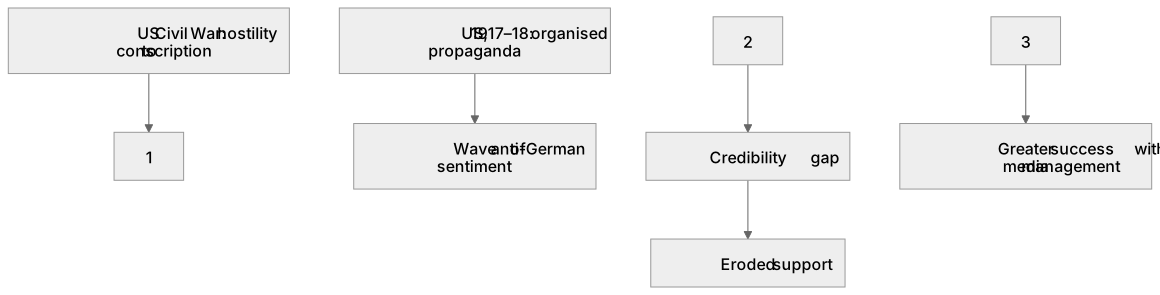
Some boxes have lost their names. Pick the right name for each number.
1Box 1
2Box 2
3Box 3
There is more to this lesson
The full lesson goes on to check your understanding and help you earn the marks. Create a free account to carry on, with your progress saved.
A week of Premium from your first lesson · Then the free plan continues · No card, no charge
Test your understanding of Paper 3, Option 37.1: The changing nature of warfare, 1859–1991: perception and reality - 2 Attempts to influence the public response to war: The impact of propaganda and news control, 1859–1991 (key developments: the hostility to conscription in the US Civil War, the wave of anti-German sentiment 1917–18, the contrasting success of US governments with the media during the Vietnam and First Gulf War).
Active recall beats re-reading. Take an instant quiz now to test what you’ve learned and lock it into long-term memory.
A week of Premium from your first lesson · Then the free plan continues · No card, no charge