Pearson Edexcel · A-Level · History
Course version: 9HI0 · Version from Sept 2015
The changing nature of warfare, 1859–1991: perception and reality - 4 The…
Full specification wording
Paper 3, Option 37.1: The changing nature of warfare, 1859–1991: perception and reality - 4 The war at sea, 1917–45: the impact of submarines, air power and complex codes: The impact of submarines, 1917–18: initial German triumph; British counter-measures and eventual success.
This topic examines the impact of submarines in 1917–18, focusing on Germany's initial success, British counter-measures, and the eventual British success.
Checked against the Pearson Edexcel 9HI0 specification (opens in a new tab) on .
- Point 1 of 3
Study notes
From the checked teaching notes for this specification point.
The idea
This topic examines the impact of submarines in 1917–18, focusing on Germany's initial success, British counter-measures, and the eventual British success. In early 1917, Germany's unrestricted submarine warfare sank Allied merchant ships faster than they could be replaced, bringing Britain close to starvation. Britain responded with convoy escorts, depth charges, hydrophones, mines and aircraft patrols, which reduced shipping losses. By 1918, convoy and improved anti-submarine tactics had largely contained the U-boat threat, allowing supplies to reach Britain. The episode shows how a new technology can dominate initially, but counter-measures and organisation can restore the balance.
What earns the marks
- Explains the initial German triumph: unrestricted submarine warfare in 1917 sank large numbers of merchant ships, threatening Britain's food and supply imports.
- Analyses British counter-measures: introduction of convoy system, escort vessels, depth charges, hydrophones, mines and air patrols.
- Evaluates the eventual success: convoy reduced losses and by 1918 U-boat effectiveness was significantly curtailed.
- Considers the limits of submarine impact: submarines could not fully blockade Britain once counter-measures were in place.
- Links the naval campaign to broader war effort: shipping losses affected munitions, food and morale.
Common mistakes and how to put them right
Assuming the convoy system was immediately accepted.
Put it right by noting initial resistance and its gradual adoption in 1917.
Overstating submarine success without noting British adaptation.
Put it right by balancing initial German triumph with effective counter-measures.
Confusing the impact of submarines in 1917–18 with later WWII campaigns.
Put it right by keeping focus on the stated period.
Exam tips
- Use specific figures or examples, such as the peak monthly shipping losses in 1917, to illustrate the initial triumph.
- Explain how each counter-measure worked, not just list them.
- Conclude with a judgement on how and why the balance shifted by 1918.
Try the lesson
The start of the Paper 3, Option 37.1: The changing nature of warfare, 1859–1991: perception and reality - 4 The war at sea, 1917–45: the impact of submarines, air power and complex codes: The impact of submarines, 1917–18: initial German triumph; British counter-measures and eventual success. lesson, made from checked teaching notes for this specification point.
Have a go first
What was the primary reason for the initial triumph of the German unrestricted submarine warfare campaign in early 1917?
Listen
This topic examines the impact of submarines in 1917–18, focusing on Germany's initial success, British counter-measures, and the eventual British success. In early 1917, Germany's unrestricted submarine warfare sank Allied merchant ships faster than they could be replaced, bringing Britain close to starvation. Britain responded with convoy escorts, depth charges, hydrophones, mines and aircraft patrols, which reduced shipping losses. By 1918, convoy and improved anti-submarine tactics had largely contained the U-boat threat, allowing supplies to reach Britain. The episode shows how a new technology can dominate initially, but counter-measures and organisation can restore the balance. A strong answer earns marks for these points. Explains the initial German triumph: unrestricted submarine warfare in 1917 sank large numbers of merchant ships, threatening Britain's food and supply imports. Analyses British counter-measures: introduction of convoy system, escort vessels, depth charges, hydrophones, mines and air patrols. Evaluates the eventual success: convoy reduced losses and by 1918 U-boat effectiveness was significantly curtailed. Considers the limits of submarine impact: submarines could not fully blockade Britain once counter-measures were in place. A common slip: Assuming the convoy system was immediately accepted. Instead, noting initial resistance and its gradual adoption in 1917. Exam tip: Use specific figures or examples, such as the peak monthly shipping losses in 1917, to illustrate the initial triumph.
See it
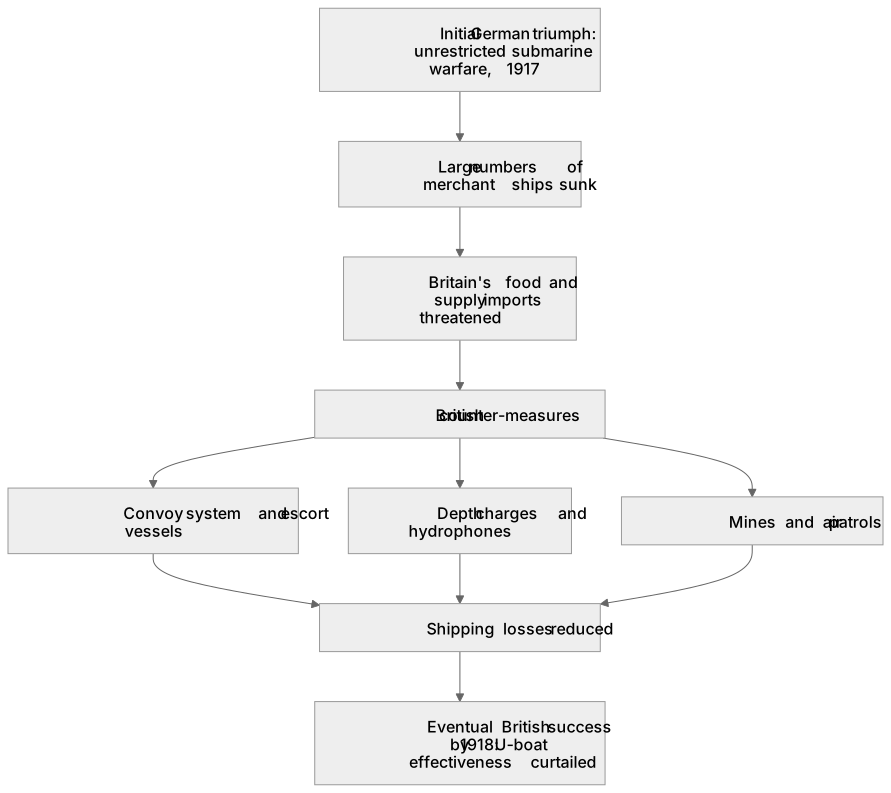
Label the diagram
Some boxes have lost their names. Pick the right name for each number.
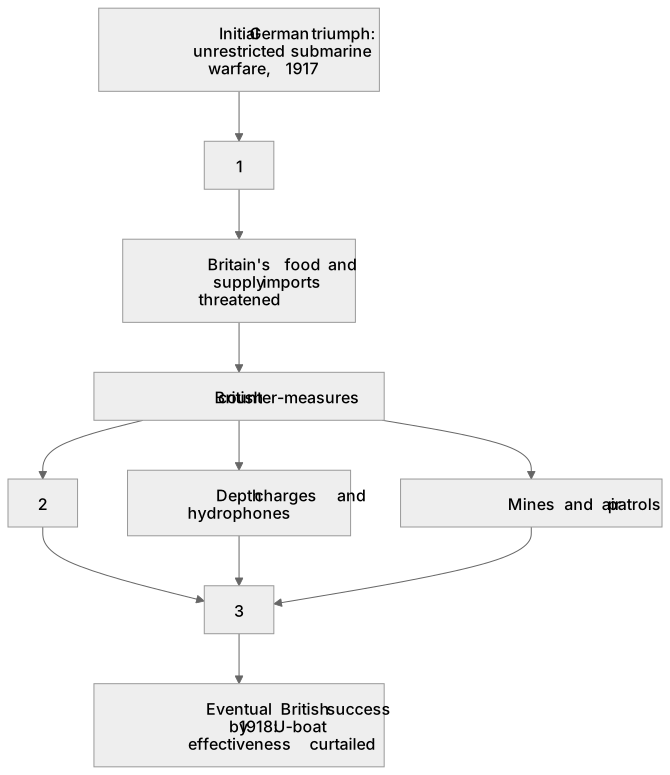
1Box 1
2Box 2
3Box 3
There is more to this lesson
The full lesson goes on to check your understanding and help you earn the marks. Create a free account to carry on, with your progress saved.
A week of Premium from your first lesson · Then the free plan continues · No card, no charge
Test your understanding of Paper 3, Option 37.1: The changing nature of warfare, 1859–1991: perception and reality - 4 The war at sea, 1917–45: the impact of submarines, air power and complex codes: The impact of submarines, 1917–18: initial German triumph; British counter-measures and eventual success.
Active recall beats re-reading. Take an instant quiz now to test what you’ve learned and lock it into long-term memory.
A week of Premium from your first lesson · Then the free plan continues · No card, no charge