Pearson Edexcel · A-Level · History
Course version: 9HI0 · Version from Sept 2015
The changing nature of warfare, 1859–1991: perception and reality - 4 The…
Full specification wording
Paper 3, Option 37.1: The changing nature of warfare, 1859–1991: perception and reality - 4 The war at sea, 1917–45: the impact of submarines, air power and complex codes: The impact of airpower: Yamamoto and the planning of the attack on Pearl Harbour 1941; Yamamoto and Nagumo against Nimitz and Spruance at Midway 1942.
Airpower transformed naval war in the Pacific.
Checked against the Pearson Edexcel 9HI0 specification (opens in a new tab) on .
- Point 3 of 3
- 4 key terms
Study notes
From the checked teaching notes for this specification point.
The idea
Airpower transformed naval war in the Pacific. Yamamoto planned the Pearl Harbour attack of 7 December 1941, using carrier-borne aircraft to cripple the US Pacific Fleet and buy Japan time. The raid succeeded tactically but missed US carriers and galvanised American resolve. At Midway in June 1942, Yamamoto sought to destroy those carriers, but Nimitz, warned by codebreaking, positioned Spruance's carriers to ambush the Japanese. Nagumo's indecision and the timing of strikes left Japanese carriers vulnerable; dive-bombers sank four. Midway showed that airpower, intelligence and command decisions, not battleship gunnery, now decided naval battles.
What earns the marks
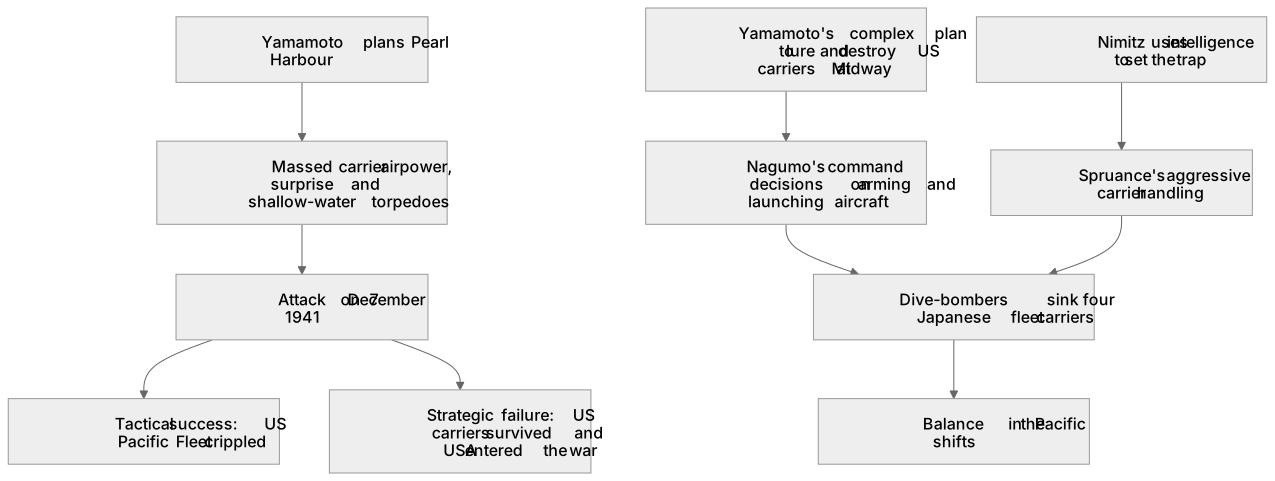
- Explains Yamamoto's planning for Pearl Harbour: the use of massed carrier airpower, surprise and shallow-water torpedoes to neutralise the US Pacific Fleet.
- Assesses the impact of the Pearl Harbour attack: tactical success but strategic failure because US carriers survived and the USA entered the war.
- Explains the roles of Yamamoto and Nagumo at Midway: Yamamoto's complex plan to lure and destroy US carriers, and Nagumo's command decisions on arming and launching aircraft.
- Explains the roles of Nimitz and Spruance: Nimitz's use of intelligence to set the trap, and Spruance's aggressive carrier handling at the battle.
- Analyses how airpower decided Midway: dive-bombers sank four Japanese fleet carriers, shifting the balance in the Pacific.
- Reaches a supported judgement on the extent to which airpower and intelligence, rather than battleship strength, determined the outcome of Pearl Harbour and Midway.
Common mistakes and how to put them right
Treating Pearl Harbour as a total Japanese victory without noting the survival of US carriers and the strategic consequences.
Put it right: Explain the mixed outcome.
Confusing the roles of Yamamoto and Nagumo at Midway.
Put it right: Distinguish Yamamoto's overall plan from Nagumo's tactical command of the carrier force.
Assuming Midway was won solely by luck.
Put it right: Show how codebreaking, timing and command decisions shaped the result.
Overlooking Nimitz and Spruance.
Put it right: Explain how Nimitz used intelligence and Spruance executed the carrier ambush.
Exam tips
- Structure your answer around the two battles and the named commanders, showing how airpower was used and assessed.
- Use specific evidence, such as dates, ship names or codebreaking, to support your analysis of impact and command decisions.
- Compare the planning and outcomes of Pearl Harbour and Midway to show change over time in the use of airpower.
- When discussing command, weigh the decisions of Yamamoto, Nagumo, Nimitz and Spruance against broader factors such as intelligence and technology.
Try the lesson
The start of the Paper 3, Option 37.1: The changing nature of warfare, 1859–1991: perception and reality - 4 The war at sea, 1917–45: the impact of submarines, air power and complex codes: The impact of airpower: Yamamoto and the planning of the attack on Pearl Harbour 1941; Yamamoto and Nagumo against Nimitz and Spruance at Midway 1942. lesson, made from checked teaching notes for this specification point.
Have a go first
Who was the Japanese admiral responsible for planning the attack on Pearl Harbour in 1941?
Listen
Airpower transformed naval war in the Pacific. Yamamoto planned the Pearl Harbour attack of 7 December 1941, using carrier-borne aircraft to cripple the US Pacific Fleet and buy Japan time. The raid succeeded tactically but missed US carriers and galvanised American resolve. At Midway in June 1942, Yamamoto sought to destroy those carriers, but Nimitz, warned by codebreaking, positioned Spruance's carriers to ambush the Japanese. Nagumo's indecision and the timing of strikes left Japanese carriers vulnerable; dive-bombers sank four. Midway showed that airpower, intelligence and command decisions, not battleship gunnery, now decided naval battles. A strong answer earns marks for these points. Explains Yamamoto's planning for Pearl Harbour: the use of massed carrier airpower, surprise and shallow-water torpedoes to neutralise the US Pacific Fleet. Assesses the impact of the Pearl Harbour attack: tactical success but strategic failure because US carriers survived and the USA entered the war. Explains the roles of Yamamoto and Nagumo at Midway: Yamamoto's complex plan to lure and destroy US carriers, and Nagumo's command decisions on arming and launching aircraft. Explains the roles of Nimitz and Spruance: Nimitz's use of intelligence to set the trap, and Spruance's aggressive carrier handling at the battle. A common slip: Treating Pearl Harbour as a total Japanese victory without noting the survival of US carriers and the strategic consequences. Instead, explain the mixed outcome. Exam tip: Structure your answer around the two battles and the named commanders, showing how airpower was used and assessed.
See it
Key words
Say what each word means before you turn the card.
carrier-borne aircraft
Try answering aloud or in your head before turning the card.
codebreaking
Try answering aloud or in your head before turning the card.
command decisions
Try answering aloud or in your head before turning the card.
dive-bombers
Try answering aloud or in your head before turning the card.
See every definition
- carrier-borne aircraft
- Aircraft used to cripple the US Pacific Fleet in Yamamoto's planning of the Pearl Harbour attack of 7 December 1941.
- codebreaking
- Intelligence that warned Nimitz, allowing him to position Spruance's carriers to ambush the Japanese at Midway in June 1942.
- command decisions
- Choices such as Nagumo's indecision and the timing of strikes, which left Japanese carriers vulnerable at Midway.
- dive-bombers
- Aircraft that sank four Japanese fleet carriers at Midway, showing that airpower now decided naval battles.
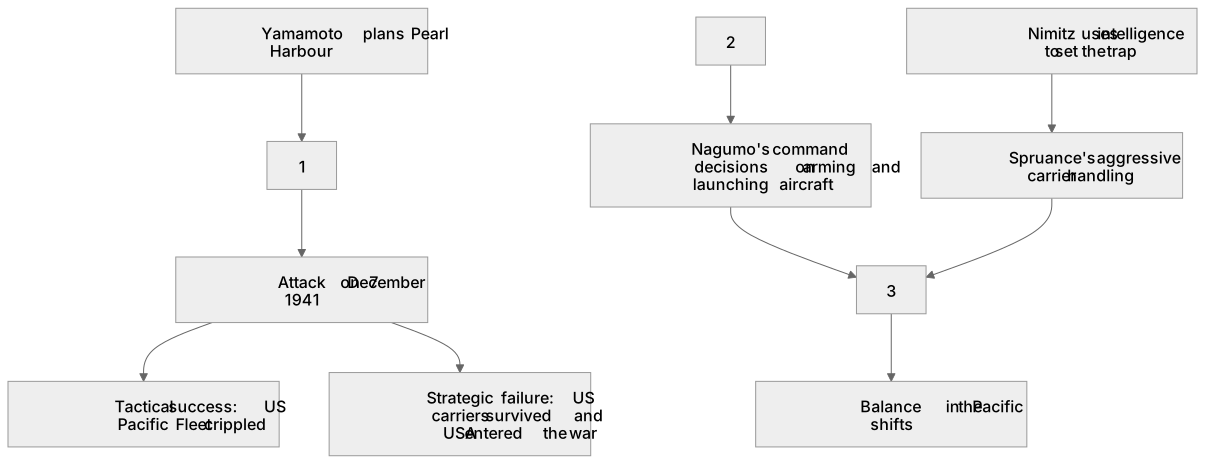
Label the diagram
Some boxes have lost their names. Pick the right name for each number.
1Box 1
2Box 2
3Box 3
There is more to this lesson
The full lesson goes on to check your understanding and help you earn the marks. Create a free account to carry on, with your progress saved.
A week of Premium from your first lesson · Then the free plan continues · No card, no charge
Test your understanding of Paper 3, Option 37.1: The changing nature of warfare, 1859–1991: perception and reality - 4 The war at sea, 1917–45: the impact of submarines, air power and complex codes: The impact of airpower: Yamamoto and the planning of the attack on Pearl Harbour 1941; Yamamoto and Nagumo against Nimitz and Spruance at Midway 1942.
Active recall beats re-reading. Take an instant quiz now to test what you’ve learned and lock it into long-term memory.
A week of Premium from your first lesson · Then the free plan continues · No card, no charge