Pearson Edexcel · A-Level · History
Course version: 9HI0 · Version from Sept 2015
The changing nature of warfare, 1859–1991: perception and reality - 5 Air…
Full specification wording
Paper 3, Option 37.1: The changing nature of warfare, 1859–1991: perception and reality - 5 Air power and nuclear weapons, 1943–91: The significance of developments in aerial warfare: bombs and counter-measures, jet engines, missiles and nuclear weapons; their influence on strategic planning.
From 1943 air power was transformed by four linked developments.
Checked against the Pearson Edexcel 9HI0 specification (opens in a new tab) on .
- Point 1 of 3
- 3 key terms
Study notes
From the checked teaching notes for this specification point.
The idea
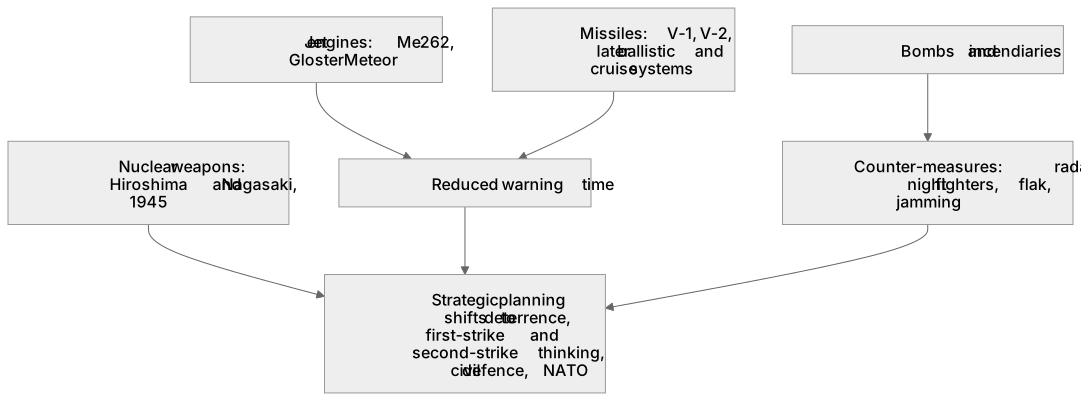
From 1943 air power was transformed by four linked developments. Heavier bombs and incendiaries made city attack possible, while counter-measures such as radar, night fighters, flak and electronic jamming contested it. Jet engines, pioneered in the Me 262 and Gloster Meteor, raised speed and altitude, shrinking warning time. Missiles, from V-1 and V-2 to later ballistic and cruise systems, removed the pilot from the delivery leg. Nuclear weapons, used at Hiroshima and Nagasaki in 1945, gave one aircraft unprecedented destructive power. Together these shifted strategic planning from attritional bombing toward deterrence, first-strike and second-strike thinking, civil defence and alliance structures such as NATO.
What earns the marks
- Explains how improved bombs and incendiaries increased the destructive reach of bombing, using examples such as the 1943 Hamburg raids.
- Analyses counter-measures such as radar, night fighters, anti-aircraft fire and electronic jamming as a contest that shaped raid tactics and losses.
- Assesses jet engines as a step change in speed, altitude and interception, citing aircraft such as the Me 262 and Gloster Meteor.
- Evaluates missiles, including V-1 and V-2 and later ballistic systems, as removing the pilot and compressing warning time.
- Explains how nuclear weapons after 1945 made deterrence, first-strike and second-strike calculations central to strategic planning.
- Judges the relative significance of these developments, for example whether nuclear weapons outweighed conventional bombing advances.
Common mistakes and how to put them right
Treating the four developments as separate and unconnected.
Put it right: Show interaction, such as jets and missiles both reducing warning time.
Assuming nuclear weapons immediately ended all conventional bombing planning.
Put it right: Note continued conventional air power and limited-war thinking.
Describing counter-measures only as defensive and therefore unimportant.
Put it right: Show they forced changes in altitude, timing, routing and escort tactics.
Exam tips
- Anchor each development to a dated example so significance is evidenced rather than asserted.
- Use the phrase 'influence on strategic planning' explicitly when linking technology to doctrine, deterrence or alliance policy.
- Rank the developments and justify your ranking to reach analysis rather than a list.
Try the lesson
The start of the Paper 3, Option 37.1: The changing nature of warfare, 1859–1991: perception and reality - 5 Air power and nuclear weapons, 1943–91: The significance of developments in aerial warfare: bombs and counter-measures, jet engines, missiles and nuclear weapons; their influence on strategic planning. lesson, made from checked teaching notes for this specification point.
Have a go first
Which development in aerial warfare during the period 1943–91 allowed bombers to fly at higher altitudes and speeds than the piston-engined aircraft they replaced?
Listen
From 1943 air power was transformed by four linked developments. Heavier bombs and incendiaries made city attack possible, while counter-measures such as radar, night fighters, flak and electronic jamming contested it. Jet engines, pioneered in the Me 262 and Gloster Meteor, raised speed and altitude, shrinking warning time. Missiles, from V-1 and V-2 to later ballistic and cruise systems, removed the pilot from the delivery leg. Nuclear weapons, used at Hiroshima and Nagasaki in 1945, gave one aircraft unprecedented destructive power. Together these shifted strategic planning from attritional bombing toward deterrence, first-strike and second-strike thinking, civil defence and alliance structures such as NATO. A strong answer earns marks for these points. Explains how improved bombs and incendiaries increased the destructive reach of bombing, using examples such as the 1943 Hamburg raids. Analyses counter-measures such as radar, night fighters, anti-aircraft fire and electronic jamming as a contest that shaped raid tactics and losses. Assesses jet engines as a step change in speed, altitude and interception, citing aircraft such as the Me 262 and Gloster Meteor. Evaluates missiles, including V-1 and V-2 and later ballistic systems, as removing the pilot and compressing warning time. A common slip: Treating the four developments as separate and unconnected. Instead, show interaction, such as jets and missiles both reducing warning time. Exam tip: Anchor each development to a dated example so significance is evidenced rather than asserted.
See it
Key words
Say what each word means before you turn the card.
Counter-measures
Try answering aloud or in your head before turning the card.
Jet engines
Try answering aloud or in your head before turning the card.
Missiles
Try answering aloud or in your head before turning the card.
See every definition
- Counter-measures
- Radar, night fighters, flak and electronic jamming, which contested city attack and shaped raid tactics and losses.
- Jet engines
- Pioneered in the Me 262 and Gloster Meteor, these raised speed and altitude and shrank warning time.
- Missiles
- Systems from V-1 and V-2 to later ballistic and cruise weapons that removed the pilot from the delivery leg.
Label the diagram
Some boxes have lost their names. Pick the right name for each number.
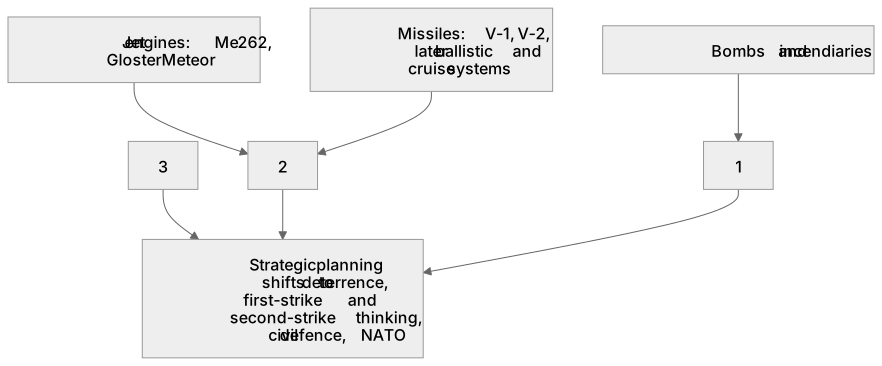
1Box 1
2Box 2
3Box 3
There is more to this lesson
The full lesson goes on to check your understanding and help you earn the marks. Create a free account to carry on, with your progress saved.
A week of Premium from your first lesson · Then the free plan continues · No card, no charge
Test your understanding of Paper 3, Option 37.1: The changing nature of warfare, 1859–1991: perception and reality - 5 Air power and nuclear weapons, 1943–91: The significance of developments in aerial warfare: bombs and counter-measures, jet engines, missiles and nuclear weapons; their influence on strategic planning.
Active recall beats re-reading. Take an instant quiz now to test what you’ve learned and lock it into long-term memory.
A week of Premium from your first lesson · Then the free plan continues · No card, no charge