Pearson Edexcel · A-Level · History
Course version: 9HI0 · Version from Sept 2015
The changing nature of warfare, 1859–1991: perception and reality - 5 Air…
Full specification wording
Paper 3, Option 37.1: The changing nature of warfare, 1859–1991: perception and reality - 5 Air power and nuclear weapons, 1943–91: Varying impacts of air power: USAF and North Vietnam, 1964–73; tactical airpower in the First Gulf War 1991.
Air power had varying impacts in two conflicts.
Checked against the Pearson Edexcel 9HI0 specification (opens in a new tab) on .
- Point 3 of 3
- 4 key terms
Study notes
From the checked teaching notes for this specification point.
The idea
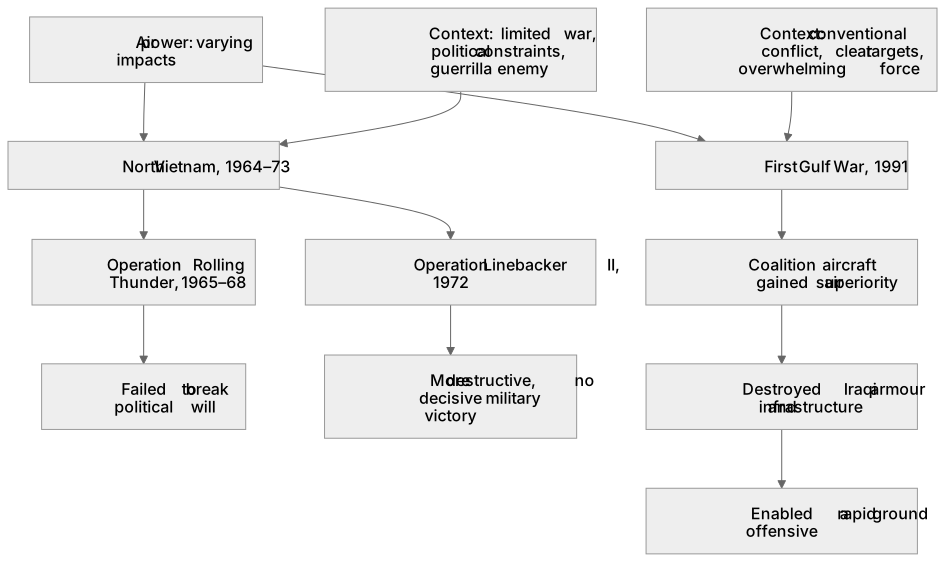
Air power had varying impacts in two conflicts. In Vietnam, the USAF's Operation Rolling Thunder (1965–68) sought to bomb North Vietnam into negotiation, but failed to break political will; Operation Linebacker II (1972) was more destructive yet still did not achieve a decisive military victory. Tactical air power in the First Gulf War (1991) was far more effective: coalition aircraft gained air superiority, then destroyed Iraqi armour and infrastructure, enabling a rapid ground offensive. The key difference lies in context: Vietnam was a limited war with political constraints and a guerrilla enemy; the Gulf War was a conventional conflict with clear targets and overwhelming force.
What earns the marks
- Explains the aims of USAF bombing in North Vietnam, such as interdiction of the Ho Chi Minh Trail and strategic bombing of industrial and military targets.
- Assesses the impact of Operations Rolling Thunder and Linebacker II, noting limited success in coercing North Vietnam and heavy civilian casualties.
- Describes the role of tactical air power in the First Gulf War, including achieving air superiority and supporting the ground campaign.
- Compares the effectiveness of air power in the two conflicts, considering factors such as political constraints, terrain, enemy tactics, and technological advantages.
- Evaluates the extent to which air power alone can achieve strategic objectives, using examples from both conflicts.
Common mistakes and how to put them right
Assuming that air power alone won the Gulf War.
Put it right: Air power was crucial but the ground offensive was necessary to liberate Kuwait.
Overstating the success of Rolling Thunder.
Put it right: It failed to stop North Vietnamese support for the Viet Cong and increased civilian suffering.
Ignoring the political context of Vietnam.
Put it right: Restrictive rules of engagement and fear of Chinese or Soviet intervention limited USAF operations.
Exam tips
- Use specific operations (Rolling Thunder, Linebacker II, Desert Storm) to illustrate your points.
- Compare and contrast the two conflicts explicitly, rather than describing them separately.
- Analyse the reasons for varying impacts, such as technology, geography, and political will.
Try the lesson
The start of the Paper 3, Option 37.1: The changing nature of warfare, 1859–1991: perception and reality - 5 Air power and nuclear weapons, 1943–91: Varying impacts of air power: USAF and North Vietnam, 1964–73; tactical airpower in the First Gulf War 1991. lesson, made from checked teaching notes for this specification point.
Have a go first
In which year did the United States Air Force begin Operation Rolling Thunder against North Vietnam?
Listen
Air power had varying impacts in two conflicts. In Vietnam, the USAF's Operation Rolling Thunder (1965–68) sought to bomb North Vietnam into negotiation, but failed to break political will; Operation Linebacker II (1972) was more destructive yet still did not achieve a decisive military victory. Tactical air power in the First Gulf War (1991) was far more effective: coalition aircraft gained air superiority, then destroyed Iraqi armour and infrastructure, enabling a rapid ground offensive. The key difference lies in context: Vietnam was a limited war with political constraints and a guerrilla enemy; the Gulf War was a conventional conflict with clear targets and overwhelming force. A strong answer earns marks for these points. Explains the aims of USAF bombing in North Vietnam, such as interdiction of the Ho Chi Minh Trail and strategic bombing of industrial and military targets. Assesses the impact of Operations Rolling Thunder and Linebacker II, noting limited success in coercing North Vietnam and heavy civilian casualties. Describes the role of tactical air power in the First Gulf War, including achieving air superiority and supporting the ground campaign. Compares the effectiveness of air power in the two conflicts, considering factors such as political constraints, terrain, enemy tactics, and technological advantages. A common slip: Assuming that air power alone won the Gulf War. Instead, air power was crucial but the ground offensive was necessary to liberate Kuwait. Exam tip: Use specific operations (Rolling Thunder, Linebacker II, Desert Storm) to illustrate your points.
See it
Put the events in order
Put these events in the order they happened, earliest first.
- 1. Operation Rolling Thunder sought to bomb North Vietnam into negotiation
- 2. Tactical air power proved far more effective in the First Gulf War
- 3. Operation Linebacker II was more destructive yet not decisive
Key words
Say what each word means before you turn the card.
Operation Rolling Thunder
Try answering aloud or in your head before turning the card.
Operation Linebacker II
Try answering aloud or in your head before turning the card.
Air superiority
Try answering aloud or in your head before turning the card.
Limited war
Try answering aloud or in your head before turning the card.
See every definition
- Operation Rolling Thunder
- USAF bombing of North Vietnam from 1965 to 1968 that sought to bomb North Vietnam into negotiation but failed to break political will.
- Operation Linebacker II
- More destructive bombing in 1972 that still did not achieve a decisive military victory.
- Air superiority
- Advantage gained by coalition aircraft in the First Gulf War before destroying Iraqi armour and infrastructure and enabling a rapid ground offensive.
- Limited war
- A war with political constraints and a guerrilla enemy, as in Vietnam, unlike a conventional conflict with clear targets and overwhelming force.
Label the diagram
Some boxes have lost their names. Pick the right name for each number.
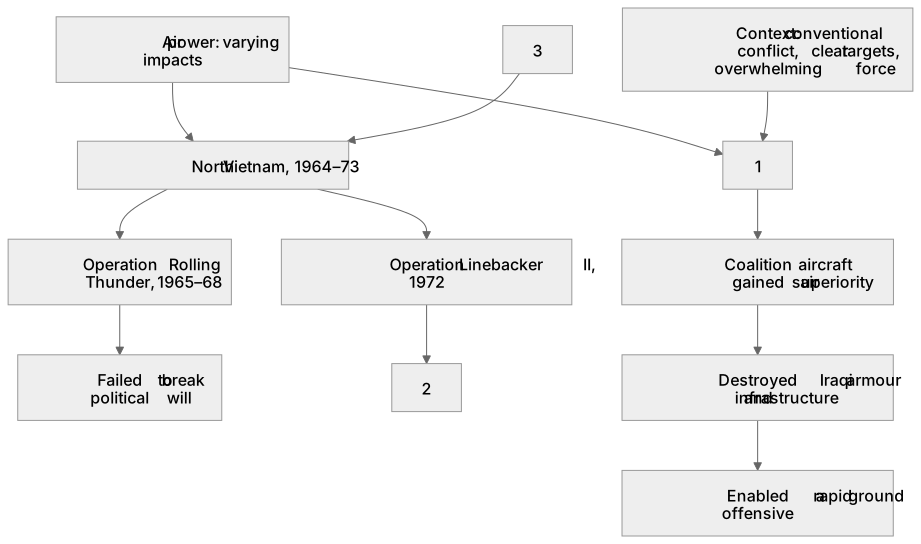
1Box 1
2Box 2
3Box 3
There is more to this lesson
The full lesson goes on to check your understanding and help you earn the marks. Create a free account to carry on, with your progress saved.
A week of Premium from your first lesson · Then the free plan continues · No card, no charge
Test your understanding of Paper 3, Option 37.1: The changing nature of warfare, 1859–1991: perception and reality - 5 Air power and nuclear weapons, 1943–91: Varying impacts of air power: USAF and North Vietnam, 1964–73; tactical airpower in the First Gulf War 1991.
Active recall beats re-reading. Take an instant quiz now to test what you’ve learned and lock it into long-term memory.
A week of Premium from your first lesson · Then the free plan continues · No card, no charge