Pearson Edexcel · A-Level · History
Course version: 9HI0 · Version from Sept 2015
Germany, 1871–1990: united, divided and reunited - 1 Ruling the Second…
Full specification wording
Paper 3, Option 37.2: Germany, 1871–1990: united, divided and reunited - 1 Ruling the Second Reich, 1871–79: Impact of the new Germany's constitution: trying to reconcile unity and division; the federal government and the Länder.
The 1871 constitution tried to reconcile German unity with existing divisions.
Checked against the Pearson Edexcel 9HI0 specification (opens in a new tab) on .
- Point 1 of 3
- 4 key terms
Study notes
From the checked teaching notes for this specification point.
The idea
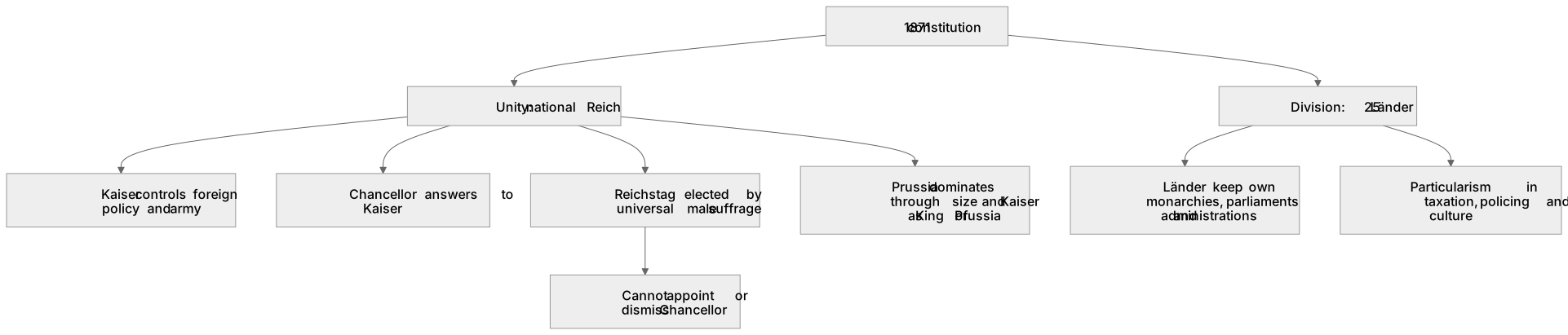
The 1871 constitution tried to reconcile German unity with existing divisions. It created a federal state with a national government, the Reich, alongside 25 member states, the Länder, which kept their own monarchies, parliaments and administrations. The Kaiser controlled foreign policy and the army, the Chancellor answered to him, and the Reichstag was elected by universal male suffrage but could not appoint or dismiss the Chancellor. Prussia dominated through its size and its king holding the imperial title. This gave unity in foreign policy and law while preserving particularism in taxation, policing and culture. Assess how far the settlement balanced unity and division.
What earns the marks
- Explains that the 1871 constitution created a federal Germany combining a national Reich with 25 member states, the Länder.
- Explains that the Länder retained their own monarchies, parliaments and administrative powers, preserving regional identity.
- Explains that the Kaiser controlled foreign policy and the army, and the Chancellor was responsible to him rather than to the Reichstag.
- Explains that the Reichstag was elected by universal male suffrage but had limited powers, unable to appoint or dismiss the Chancellor.
- Explains that Prussia's size and the Kaiser's dual role as King of Prussia gave it dominance within the federal structure.
- Judges how far the constitution reconciled unity with division, noting both integration and persistent particularism.
Common mistakes and how to put them right
Assuming the Reichstag controlled the government.
Put it right by noting it could debate and approve budgets but could not appoint or dismiss the Chancellor.
Treating the Länder as powerless.
Put it right by noting they kept monarchies, parliaments and control over policing, taxation and culture.
Describing Germany as a simple unitary state.
Put it right by explaining its federal structure and the reserved powers of the member states.
Exam tips
- Use the terms Reich, Länder, Kaiser, Chancellor and Reichstag precisely and consistently.
- Support claims about unity or division with a specific institution or power, such as army control or regional taxation.
- Balance the argument by showing both integrating and divisive features of the constitution.
Try the lesson
The start of the Paper 3, Option 37.2: Germany, 1871–1990: united, divided and reunited - 1 Ruling the Second Reich, 1871–79: Impact of the new Germany's constitution: trying to reconcile unity and division; the federal government and the Länder. lesson, made from checked teaching notes for this specification point.
Have a go first
Under the 1871 constitution, which body represented the individual German states?
Listen
The 1871 constitution tried to reconcile German unity with existing divisions. It created a federal state with a national government, the Reich, alongside 25 member states, the Länder, which kept their own monarchies, parliaments and administrations. The Kaiser controlled foreign policy and the army, the Chancellor answered to him, and the Reichstag was elected by universal male suffrage but could not appoint or dismiss the Chancellor. Prussia dominated through its size and its king holding the imperial title. This gave unity in foreign policy and law while preserving particularism in taxation, policing and culture. Assess how far the settlement balanced unity and division. A strong answer earns marks for these points. Explains that the 1871 constitution created a federal Germany combining a national Reich with 25 member states, the Länder. Explains that the Länder retained their own monarchies, parliaments and administrative powers, preserving regional identity. Explains that the Kaiser controlled foreign policy and the army, and the Chancellor was responsible to him rather than to the Reichstag. Explains that the Reichstag was elected by universal male suffrage but had limited powers, unable to appoint or dismiss the Chancellor. A common slip: Assuming the Reichstag controlled the government. Instead, noting it could debate and approve budgets but could not appoint or dismiss the Chancellor. Exam tip: Use the terms Reich, Länder, Kaiser, Chancellor and Reichstag precisely and consistently.
See it
Key words
Say what each word means before you turn the card.
Federalism and particularism
Try answering aloud or in your head before turning the card.
Constitutional monarchy and authority
Try answering aloud or in your head before turning the card.
Representation and limited democracy
Try answering aloud or in your head before turning the card.
Prussian dominance
Try answering aloud or in your head before turning the card.
See every definition
- Federalism and particularism
- The 1871 constitution created a federal state with a national government, the Reich, alongside 25 member states, the Länder, preserving particularism in taxation, policing and culture.
- Constitutional monarchy and authority
- The Kaiser controlled foreign policy and the army, and the Chancellor answered to him rather than to the Reichstag.
- Representation and limited democracy
- The Reichstag was elected by universal male suffrage but could not appoint or dismiss the Chancellor.
- Prussian dominance
- Prussia dominated through its size and its king holding the imperial title.
Label the diagram
Some boxes have lost their names. Pick the right name for each number.
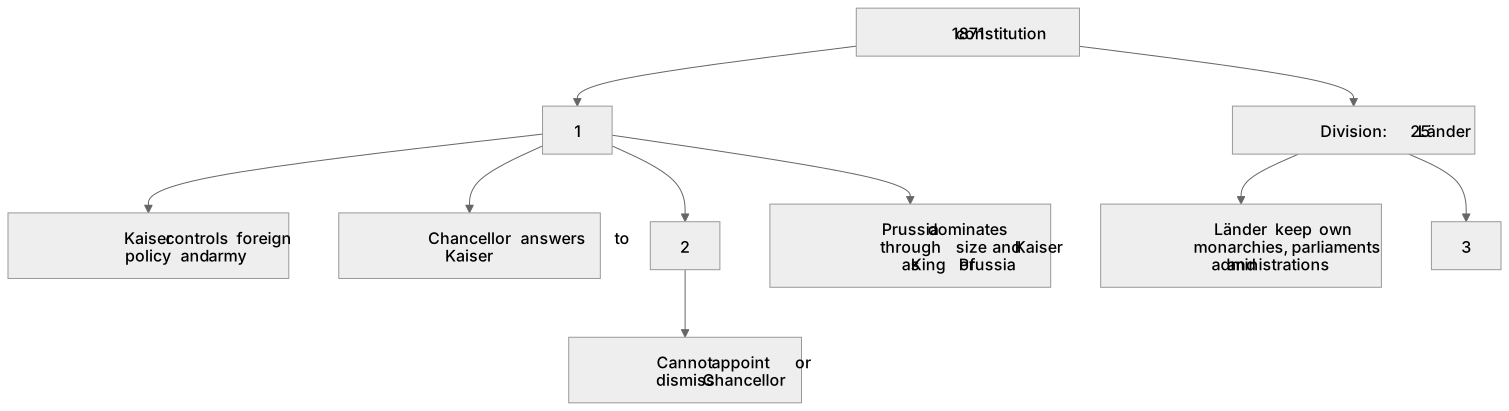
1Box 1
2Box 2
3Box 3
There is more to this lesson
The full lesson goes on to check your understanding and help you earn the marks. Create a free account to carry on, with your progress saved.
A week of Premium from your first lesson · Then the free plan continues · No card, no charge
Test your understanding of Paper 3, Option 37.2: Germany, 1871–1990: united, divided and reunited - 1 Ruling the Second Reich, 1871–79: Impact of the new Germany's constitution: trying to reconcile unity and division; the federal government and the Länder.
Active recall beats re-reading. Take an instant quiz now to test what you’ve learned and lock it into long-term memory.
A week of Premium from your first lesson · Then the free plan continues · No card, no charge