Pearson Edexcel · A-Level · History
Course version: 9HI0 · Version from Sept 2015
Germany, 1871–1990: united, divided and reunited - 3 A new Reich, 1933–35:…
Full specification wording
Paper 3, Option 37.2: Germany, 1871–1990: united, divided and reunited - 3 A new Reich, 1933–35: Gleichschaltung, 1933–34: creating a totalitarian state; abolition of political parties and trade unions; the establishment of DAF; the 'coordination' of regional and local government; impact of the Night of the Long Knives.
Gleichschaltung means 'coordination': by 1933–34 the Nazis aligned German institutions under one-party control, creating a totalitarian state.
Checked against the Pearson Edexcel 9HI0 specification (opens in a new tab) on .
- Point 1 of 3
- 3 key terms
Study notes
From the checked teaching notes for this specification point.
The idea
Gleichschaltung means 'coordination': by 1933–34 the Nazis aligned German institutions under one-party control, creating a totalitarian state. Political parties were banned or dissolved, leaving the NSDAP; trade unions were abolished and replaced by the German Labour Front (DAF), which controlled workers rather than bargaining for them. Regional and local government was coordinated: Länder parliaments lost power, Reich governors were appointed, and councils were purged. The Night of the Long Knives in June–July 1934 removed the SA leadership and other rivals, securing Hitler's position and the army's support. Example: after Hindenburg died in August 1934, Hitler combined Chancellor and President, showing coordination complete.
What earns the marks
- Defines Gleichschaltung as the Nazi process of coordinating political, social and governmental institutions under party control to create a totalitarian state.
- Explains the abolition of political parties and trade unions, leaving the NSDAP dominant and removing organised labour opposition.
- Describes the establishment of the DAF, which replaced independent unions and regulated workers within the Nazi state.
- Explains the coordination of regional and local government through Reich governors, purged councils and loss of Länder autonomy.
- Assesses the impact of the Night of the Long Knives: the SA leadership was eliminated, Hitler gained the army's loyalty and internal rivals were removed.
Common mistakes and how to put them right
Treating Gleichschaltung as only a legal change.
Put it right: See it as political, social and administrative control.
Confusing the DAF with a genuine trade union.
Put it right: It controlled labour and banned strikes rather than negotiating freely.
Seeing the Night of the Long Knives as only a purge of the SA.
Put it right: It also removed other critics and secured army and elite support.
Exam tips
- Define Gleichschaltung briefly, then show it operating across parties, unions, and regional government.
- Use the Night of the Long Knives as evidence of how coordination was enforced by violence as well as law.
- Judge how far by 1934 Germany had become a totalitarian state, noting limits as well as controls.
Try the lesson
The start of the Paper 3, Option 37.2: Germany, 1871–1990: united, divided and reunited - 3 A new Reich, 1933–35: Gleichschaltung, 1933–34: creating a totalitarian state; abolition of political parties and trade unions; the establishment of DAF; the 'coordination' of regional and local government; impact of the Night of the Long Knives. lesson, made from checked teaching notes for this specification point.
Have a go first
Which organisation was established in 1933 as the single Nazi labour front replacing the independent trade unions?
Listen
Gleichschaltung means 'coordination': by 1933–34 the Nazis aligned German institutions under one-party control, creating a totalitarian state. Political parties were banned or dissolved, leaving the NSDAP; trade unions were abolished and replaced by the German Labour Front (DAF), which controlled workers rather than bargaining for them. Regional and local government was coordinated: Länder parliaments lost power, Reich governors were appointed, and councils were purged. The Night of the Long Knives in June–July 1934 removed the SA leadership and other rivals, securing Hitler's position and the army's support. Example: after Hindenburg died in August 1934, Hitler combined Chancellor and President, showing coordination complete. A strong answer earns marks for these points. Defines Gleichschaltung as the Nazi process of coordinating political, social and governmental institutions under party control to create a totalitarian state. Explains the abolition of political parties and trade unions, leaving the NSDAP dominant and removing organised labour opposition. Describes the establishment of the DAF, which replaced independent unions and regulated workers within the Nazi state. Explains the coordination of regional and local government through Reich governors, purged councils and loss of Länder autonomy. A common slip: Treating Gleichschaltung as only a legal change. Instead, see it as political, social and administrative control. Exam tip: Define Gleichschaltung briefly, then show it operating across parties, unions, and regional government.
See it

Key words
Say what each word means before you turn the card.
Gleichschaltung
Try answering aloud or in your head before turning the card.
DAF
Try answering aloud or in your head before turning the card.
Night of the Long Knives
Try answering aloud or in your head before turning the card.
See every definition
- Gleichschaltung
- The Nazi process of coordinating political, social and governmental institutions under party control to create a totalitarian state.
- DAF
- The German Labour Front, which replaced independent unions and regulated workers within the Nazi state.
- Night of the Long Knives
- The June–July 1934 removal of the SA leadership and other rivals, securing Hitler's position and the army's support.
Label the diagram
Some boxes have lost their names. Pick the right name for each number.
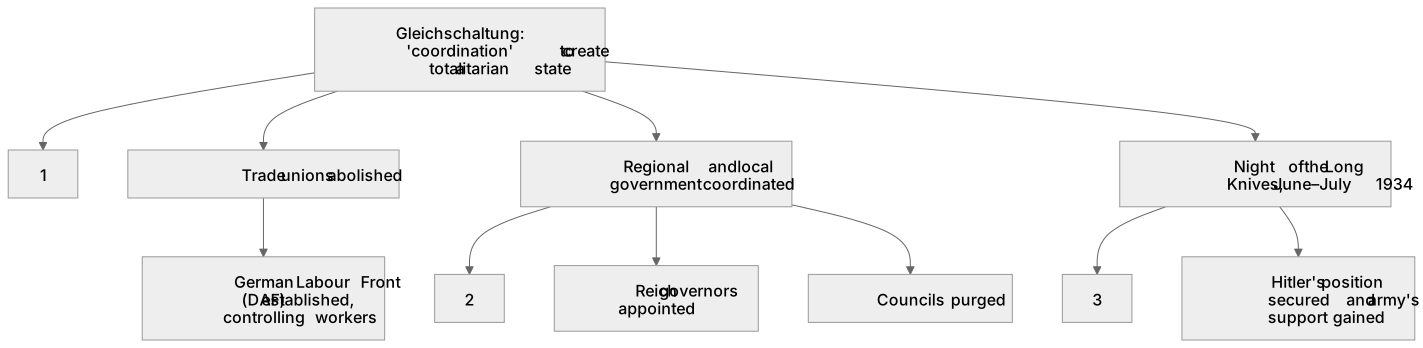
1Box 1
2Box 2
3Box 3
There is more to this lesson
The full lesson goes on to check your understanding and help you earn the marks. Create a free account to carry on, with your progress saved.
A week of Premium from your first lesson · Then the free plan continues · No card, no charge
Test your understanding of Paper 3, Option 37.2: Germany, 1871–1990: united, divided and reunited - 3 A new Reich, 1933–35: Gleichschaltung, 1933–34: creating a totalitarian state; abolition of political parties and trade unions; the establishment of DAF; the 'coordination' of regional and local government; impact of the Night of the Long Knives.
Active recall beats re-reading. Take an instant quiz now to test what you’ve learned and lock it into long-term memory.
A week of Premium from your first lesson · Then the free plan continues · No card, no charge