Pearson Edexcel · A-Level · History
Course version: 9HI0 · Version from Sept 2015
Germany, 1871–1990: united, divided and reunited - 3 A new Reich, 1933–35:…
Full specification wording
Paper 3, Option 37.2: Germany, 1871–1990: united, divided and reunited - 3 A new Reich, 1933–35: The nature of the new Nazi state: the relationship of state and party; attempts to create a Volksgemeinschaft; racial policy, including the significance of the Nuremberg Laws.
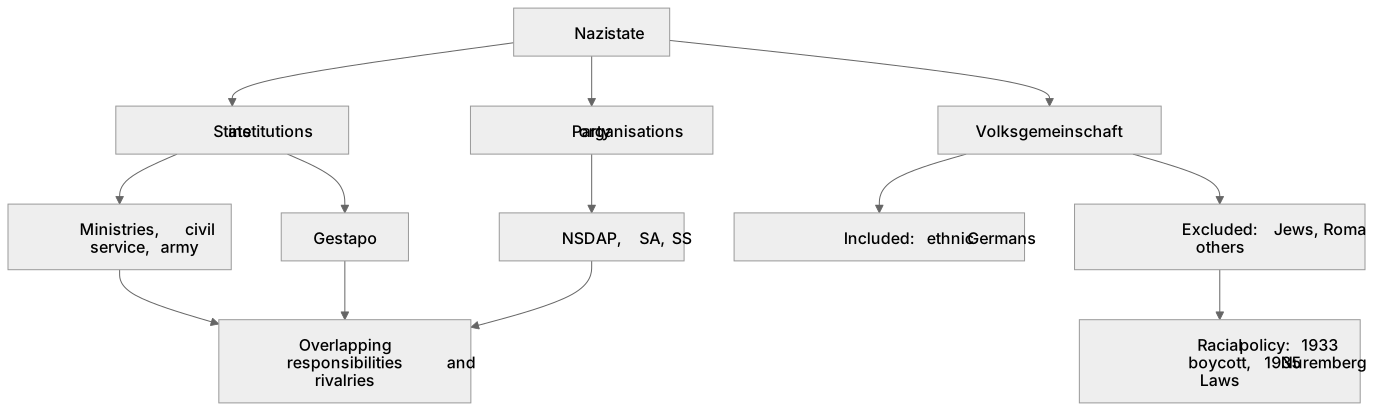
The Nazi state was a dual system: traditional state institutions (ministries, civil service, army, Gestapo) coexisted with party organisations (NSDAP, SA, SS).
Checked against the Pearson Edexcel 9HI0 specification (opens in a new tab) on .
- Point 3 of 3
- 3 key terms
Study notes
From the checked teaching notes for this specification point.
The idea
The Nazi state was a dual system: traditional state institutions (ministries, civil service, army, Gestapo) coexisted with party organisations (NSDAP, SA, SS). This created overlapping responsibilities and rivalries, as Hitler often allowed both to operate. The Volksgemeinschaft aimed to unite ethnic Germans through propaganda, rituals, and welfare schemes such as Winterhilfswerk, while excluding Jews, Roma, and others. Racial policy escalated from the 1933 boycott of Jewish businesses and the 1935 Nuremberg Laws, which stripped Jewish citizenship and banned marriage or sexual relations between Jews and non-Jews. These laws defined who was Jewish and institutionalised persecution, marking a radicalisation of the regime.
What earns the marks
- Explains the relationship between state and party as overlapping and competitive, with party agencies often duplicating or bypassing state functions.
- Describes attempts to create a Volksgemeinschaft through propaganda, mass organisations, and welfare schemes, and notes who was included and excluded.
- Analyses racial policy, including the 1933 boycott of Jewish businesses and the exclusion of Jews from public life.
- Assesses the significance of the Nuremberg Laws of 1935 in defining Jewishness, removing citizenship, and criminalising relations between Jews and non-Jews.
Common mistakes and how to put them right
Treating the Nazi state as a single, efficiently coordinated machine.
Put it right: It was a polycratic mix of state and party bodies with overlapping jurisdictions and rivalries.
Assuming the Volksgemeinschaft benefited all Germans equally.
Put it right: It was racially exclusive, promoting ethnic Germans while excluding and persecuting Jews, Roma, and others.
Classifying the Gestapo as a party organisation.
Put it right: The Gestapo was a state secret police agency, although it came under the control of the SS (a party organisation).
Exam tips
- Use specific examples: the Enabling Act, the Reichsbürgergesetz, the Blutschutzgesetz, the Hitler Youth, and the Winterhilfswerk.
- Explain how state and party rivalry affected policy implementation, not just that it existed.
Try the lesson
The start of the Paper 3, Option 37.2: Germany, 1871–1990: united, divided and reunited - 3 A new Reich, 1933–35: The nature of the new Nazi state: the relationship of state and party; attempts to create a Volksgemeinschaft; racial policy, including the significance of the Nuremberg Laws. lesson, made from checked teaching notes for this specification point.
Have a go first
What was a key feature of the Nuremberg Laws introduced by the Nazi regime in September 1935?
Listen
The Nazi state was a dual system: traditional state institutions (ministries, civil service, army, Gestapo) coexisted with party organisations (NSDAP, SA, SS). This created overlapping responsibilities and rivalries, as Hitler often allowed both to operate. The Volksgemeinschaft aimed to unite ethnic Germans through propaganda, rituals, and welfare schemes such as Winterhilfswerk, while excluding Jews, Roma, and others. Racial policy escalated from the 1933 boycott of Jewish businesses and the 1935 Nuremberg Laws, which stripped Jewish citizenship and banned marriage or sexual relations between Jews and non-Jews. These laws defined who was Jewish and institutionalised persecution, marking a radicalisation of the regime. A strong answer earns marks for these points. Explains the relationship between state and party as overlapping and competitive, with party agencies often duplicating or bypassing state functions. Describes attempts to create a Volksgemeinschaft through propaganda, mass organisations, and welfare schemes, and notes who was included and excluded. Analyses racial policy, including the 1933 boycott of Jewish businesses and the exclusion of Jews from public life. Assesses the significance of the Nuremberg Laws of 1935 in defining Jewishness, removing citizenship, and criminalising relations between Jews and non-Jews. A common slip: treating the Nazi state as a single, efficiently coordinated machine. Instead, it was a polycratic mix of state and party bodies with overlapping jurisdictions and rivalries. Exam tip: Use specific examples: the Enabling Act, the Reichsbürgergesetz, the Blutschutzgesetz, the Hitler Youth, and the Winterhilfswerk.
See it
Key words
Say what each word means before you turn the card.
Dual state and party structures
Try answering aloud or in your head before turning the card.
Volksgemeinschaft
Try answering aloud or in your head before turning the card.
Racial exclusion and persecution
Try answering aloud or in your head before turning the card.
See every definition
- Dual state and party structures
- Traditional state institutions coexisted with party organisations, creating overlapping responsibilities and rivalries as Hitler often allowed both to operate.
- Volksgemeinschaft
- Aims to unite ethnic Germans through propaganda, rituals and welfare schemes such as Winterhilfswerk, while excluding Jews, Roma and others.
- Racial exclusion and persecution
- Escalated from the 1933 boycott of Jewish businesses and the 1935 Nuremberg Laws, which stripped Jewish citizenship and banned marriage or sexual relations between Jews and non-Jews.
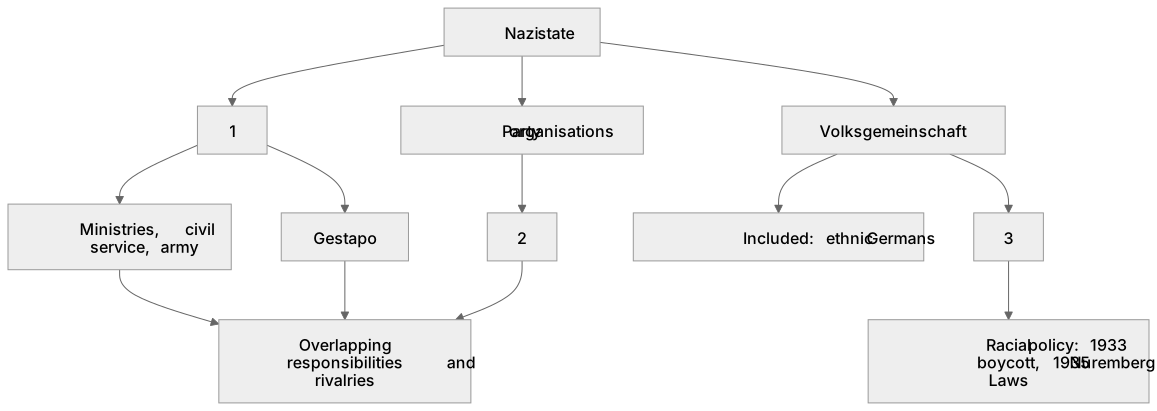
Label the diagram
Some boxes have lost their names. Pick the right name for each number.
1Box 1
2Box 2
3Box 3
There is more to this lesson
The full lesson goes on to check your understanding and help you earn the marks. Create a free account to carry on, with your progress saved.
A week of Premium from your first lesson · Then the free plan continues · No card, no charge
Test your understanding of Paper 3, Option 37.2: Germany, 1871–1990: united, divided and reunited - 3 A new Reich, 1933–35: The nature of the new Nazi state: the relationship of state and party; attempts to create a Volksgemeinschaft; racial policy, including the significance of the Nuremberg Laws.
Active recall beats re-reading. Take an instant quiz now to test what you’ve learned and lock it into long-term memory.
A week of Premium from your first lesson · Then the free plan continues · No card, no charge