Pearson Edexcel · A-Level · History
Course version: 9HI0 · Version from Sept 2015
Germany, 1871–1990: united, divided and reunited - 4 Establishing and…
Full specification wording
Paper 3, Option 37.2: Germany, 1871–1990: united, divided and reunited - 4 Establishing and ruling the new Federal Republic, 1949–60: The creation of the FRG and the impact of the new Constitution: the attempt to reconcile difference and liberty.
The Federal Republic of Germany (FRG) was proclaimed in May 1949, built from the three western occupation zones after the Basic Law was approved.
Checked against the Pearson Edexcel 9HI0 specification (opens in a new tab) on .
- Point 1 of 3
- 3 key terms
Study notes
From the checked teaching notes for this specification point.
The idea
The Federal Republic of Germany (FRG) was proclaimed in May 1949, built from the three western occupation zones after the Basic Law was approved. West Berlin was not a constituent part of the new FRG; it remained under Allied occupation with non-voting Bundestag representatives. The creators faced a double task: preventing a repeat of Weimar's collapse while protecting individual liberty. The Constitution attempted to reconcile difference—federalism, party pluralism, and regional diversity—with liberty through entrenched basic rights, a Constitutional Court, and a constructive vote of no confidence. The Basic Law was deliberately provisional, pending reunification. This settlement shaped West German politics and the impact of the new Constitution.
What earns the marks
- Explains why the FRG was created in 1949 from the three western zones, noting West Berlin's special associated status rather than being a constituent part.
- Analyses how the Constitution sought to reconcile difference: federalism, pluralism, and protection of minority and regional interests.
- Explains how liberty was protected: entrenched basic rights, the Federal Constitutional Court, and limits on emergency powers.
- Evaluates the impact of the new Constitution, including the constructive vote of no confidence and the five per cent threshold in stabilising democracy.
Common mistakes and how to put them right
Stating that West Berlin was a constituent part of the new FRG in 1949.
Put it right: West Berlin remained under Allied occupation, and its Bundestag representatives were non-voting.
Treating the Basic Law as a full constitution for a permanently divided Germany.
Put it right: It was framed as a provisional arrangement pending reunification.
Assuming the FRG was created by a popular referendum.
Put it right: It was established through the Parliamentary Council and approval by the western occupation authorities and Land parliaments.
Exam tips
- Link each constitutional feature to the problem it was designed to solve, such as Weimar's instability or Nazi centralisation.
- Balance the attempt to reconcile difference and liberty in every paragraph rather than treating them as separate topics.
Try the lesson
The start of the Paper 3, Option 37.2: Germany, 1871–1990: united, divided and reunited - 4 Establishing and ruling the new Federal Republic, 1949–60: The creation of the FRG and the impact of the new Constitution: the attempt to reconcile difference and liberty. lesson, made from checked teaching notes for this specification point.
Have a go first
In which year was the Federal Republic of Germany founded, with the Basic Law coming into force?
Listen
The Federal Republic of Germany (FRG) was proclaimed in May 1949, built from the three western occupation zones after the Basic Law was approved. West Berlin was not a constituent part of the new FRG; it remained under Allied occupation with non-voting Bundestag representatives. The creators faced a double task: preventing a repeat of Weimar's collapse while protecting individual liberty. The Constitution attempted to reconcile difference—federalism, party pluralism, and regional diversity—with liberty through entrenched basic rights, a Constitutional Court, and a constructive vote of no confidence. The Basic Law was deliberately provisional, pending reunification. This settlement shaped West German politics and the impact of the new Constitution. A strong answer earns marks for these points. Explains why the FRG was created in 1949 from the three western zones, noting West Berlin's special associated status rather than being a constituent part. Analyses how the Constitution sought to reconcile difference: federalism, pluralism, and protection of minority and regional interests. Explains how liberty was protected: entrenched basic rights, the Federal Constitutional Court, and limits on emergency powers. Evaluates the impact of the new Constitution, including the constructive vote of no confidence and the five per cent threshold in stabilising democracy. A common slip: Stating that West Berlin was a constituent part of the new FRG in 1949. Instead, West Berlin remained under Allied occupation, and its Bundestag representatives were non-voting. Exam tip: Link each constitutional feature to the problem it was designed to solve, such as Weimar's instability or Nazi centralisation.
See it
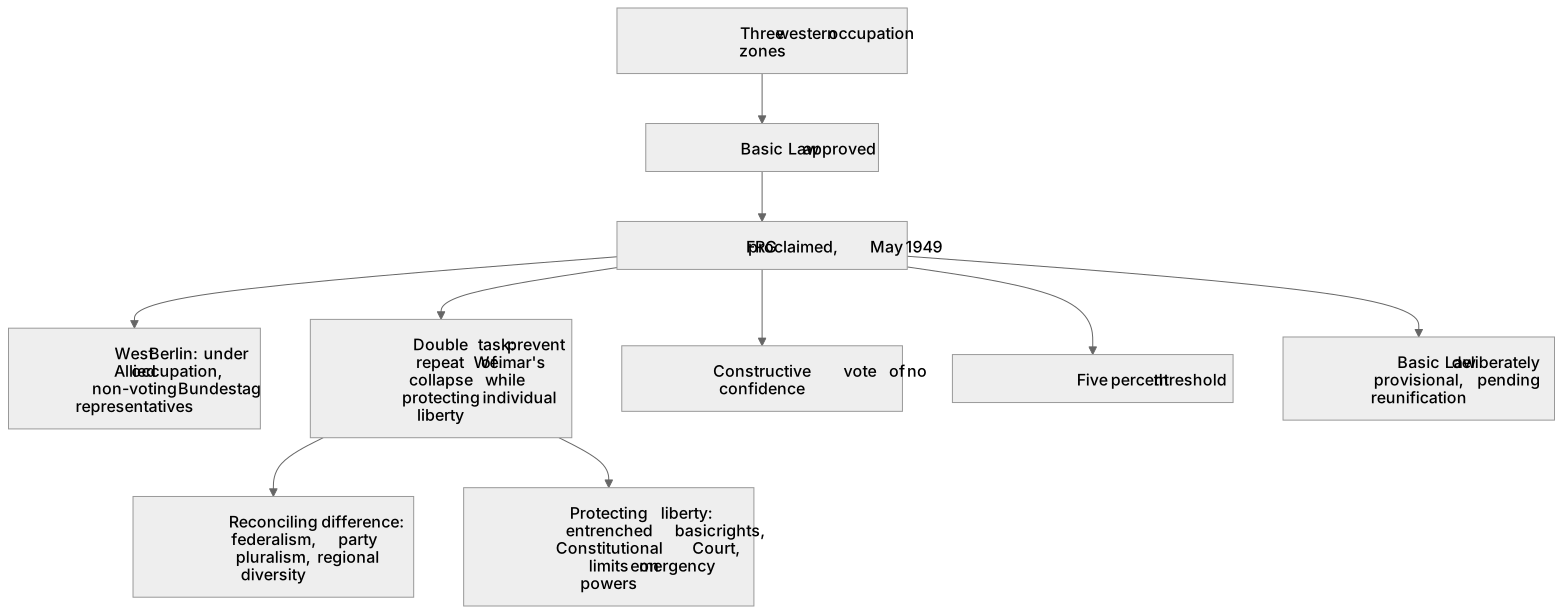
Key words
Say what each word means before you turn the card.
Constitutional design and democratic stability
Try answering aloud or in your head before turning the card.
Federalism and pluralism
Try answering aloud or in your head before turning the card.
Provisional sovereignty and reunification
Try answering aloud or in your head before turning the card.
See every definition
- Constitutional design and democratic stability
- The Constitution attempted to reconcile difference with liberty through entrenched basic rights, a Constitutional Court, and a constructive vote of no confidence, shaping West German politics.
- Federalism and pluralism
- Difference was reconciled with liberty through federalism, party pluralism, and regional diversity, alongside protection of minority and regional interests.
- Provisional sovereignty and reunification
- The Basic Law was deliberately provisional, pending reunification, rather than a full constitution for a permanently divided Germany.
Label the diagram
Some boxes have lost their names. Pick the right name for each number.
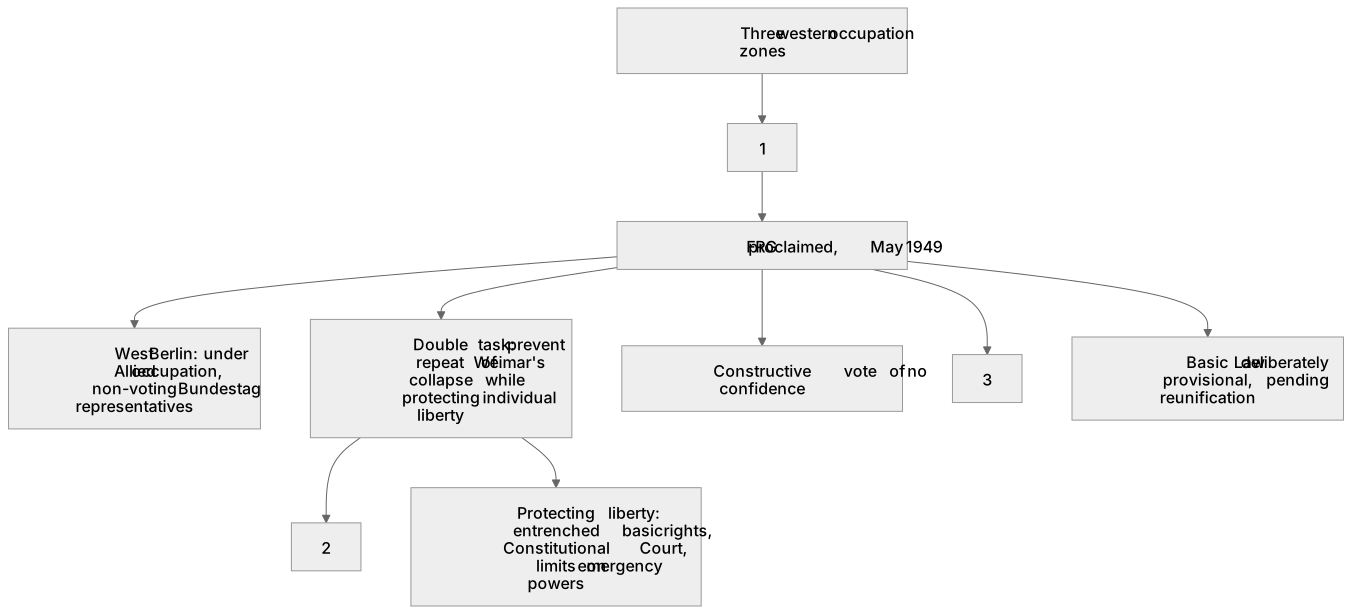
1Box 1
2Box 2
3Box 3
There is more to this lesson
The full lesson goes on to check your understanding and help you earn the marks. Create a free account to carry on, with your progress saved.
A week of Premium from your first lesson · Then the free plan continues · No card, no charge
Test your understanding of Paper 3, Option 37.2: Germany, 1871–1990: united, divided and reunited - 4 Establishing and ruling the new Federal Republic, 1949–60: The creation of the FRG and the impact of the new Constitution: the attempt to reconcile difference and liberty.
Active recall beats re-reading. Take an instant quiz now to test what you’ve learned and lock it into long-term memory.
A week of Premium from your first lesson · Then the free plan continues · No card, no charge