Pearson Edexcel · A-Level · History
Course version: 9HI0 · Version from Sept 2015
Germany, 1871–1990: united, divided and reunited - 4 Establishing and…
Full specification wording
Paper 3, Option 37.2: Germany, 1871–1990: united, divided and reunited - 4 Establishing and ruling the new Federal Republic, 1949–60: The process and significance of de-Nazification and ‘coming to terms with the past’ in the 1950s.
De-Nazification in the 1950s was a contested process of addressing Nazi legacies in the Federal Republic.
Checked against the Pearson Edexcel 9HI0 specification (opens in a new tab) on .
- Point 3 of 3
- 4 key terms
Study notes
From the checked teaching notes for this specification point.
The idea
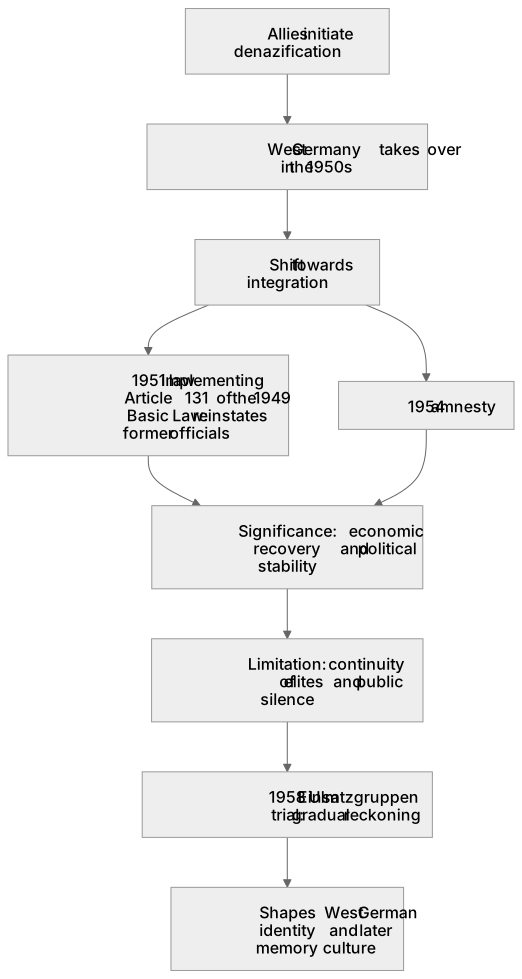
De-Nazification in the 1950s was a contested process of addressing Nazi legacies in the Federal Republic. While the Allies initiated denazification, West Germany took over in the 1950s, shifting towards integration. This involved legal measures, such as the 1951 law implementing Article 131 of the 1949 Basic Law to reinstate former officials, and the 1954 amnesty. Coming to terms with the past (Vergangenheitsbewältigung) was significant: it allowed economic recovery and political stability but led to continuity of elites and public silence. The 1958 Ulm Einsatzgruppen trial showed a gradual reckoning. The significance lies in shaping West German identity, balancing justice with integration, and setting a pattern for later memory culture.
What earns the marks
- Explains the shift to West German handling of de-Nazification, including the 1951 law implementing Article 131 of the 1949 Basic Law and the 1954 amnesty.
- Assesses the significance for political stability and economic recovery, such as enabling former Nazis to contribute to the Wirtschaftswunder.
- Discusses the limitations of coming to terms with the past, such as the persistence of former Nazis in the judiciary and civil service, and public reluctance to confront the past.
- Uses specific examples like the Ulm trial (1958) to illustrate the process of Vergangenheitsbewältigung and its impact on West German identity and memory culture.
Common mistakes and how to put them right
Falsely distinguishing 'de-Nazification' and 'denazification' as distinct historical terms for West German and Allied processes respectively.
Put it right: No such standard distinction exists; both terms refer to the same overarching process, though the West German phase in the 1950s shifted towards integration.
Incorrectly dating Article 131 of the Basic Law to 1951.
Put it right: Article 131 was part of the 1949 Basic Law, but the law implementing it to reinstate officials was passed in 1951.
Overstating the success of coming to terms with the past.
Put it right: Acknowledge both progress and continuity, using evidence like the Ulm trial.
Exam tips
- Plan your essay to address both the process (how it was done) and the significance (why it mattered) of de-Nazification and coming to terms with the past in the 1950s.
- Use precise dates and terms, such as the 1951 implementing law for Article 131 and the 1954 amnesty, to show detailed knowledge.
Try the lesson
The start of the Paper 3, Option 37.2: Germany, 1871–1990: united, divided and reunited - 4 Establishing and ruling the new Federal Republic, 1949–60: The process and significance of de-Nazification and ‘coming to terms with the past’ in the 1950s. lesson, made from checked teaching notes for this specification point.
Have a go first
Which Allied policy after 1945 aimed to remove former Nazi Party members from positions of influence in German public life?
Listen
De-Nazification in the 1950s was a contested process of addressing Nazi legacies in the Federal Republic. While the Allies initiated denazification, West Germany took over in the 1950s, shifting towards integration. This involved legal measures, such as the 1951 law implementing Article 131 of the 1949 Basic Law to reinstate former officials, and the 1954 amnesty. Coming to terms with the past (Vergangenheitsbewältigung) was significant: it allowed economic recovery and political stability but led to continuity of elites and public silence. The 1958 Ulm Einsatzgruppen trial showed a gradual reckoning. The significance lies in shaping West German identity, balancing justice with integration, and setting a pattern for later memory culture. A strong answer earns marks for these points. Explains the shift to West German handling of de-Nazification, including the 1951 law implementing Article 131 of the 1949 Basic Law and the 1954 amnesty. Assesses the significance for political stability and economic recovery, such as enabling former Nazis to contribute to the Wirtschaftswunder. Discusses the limitations of coming to terms with the past, such as the persistence of former Nazis in the judiciary and civil service, and public reluctance to confront the past. Uses specific examples like the Ulm trial (1958) to illustrate the process of Vergangenheitsbewältigung and its impact on West German identity and memory culture. A common slip: Falsely distinguishing 'de-Nazification' and 'denazification' as distinct historical terms for West German and Allied processes respectively. Instead, no such standard distinction exists; both terms refer to the same overarching process, though the West German phase in the 1950s shifted towards integration. Exam tip: Plan your essay to address both the process (how it was done) and the significance (why it mattered) of de-Nazification and coming to terms with the past in the 1950s.
See it
Key words
Say what each word means before you turn the card.
de-Nazification
Try answering aloud or in your head before turning the card.
coming to terms with the past
Try answering aloud or in your head before turning the card.
1954 amnesty
Try answering aloud or in your head before turning the card.
Ulm Einsatzgruppen trial
Try answering aloud or in your head before turning the card.
See every definition
- de-Nazification
- A contested process of addressing Nazi legacies in the Federal Republic, initiated by the Allies and taken over by West Germany in the 1950s, shifting towards integration.
- coming to terms with the past
- Also called Vergangenheitsbewältigung; a significant process that allowed economic recovery and political stability but led to continuity of elites and public silence.
- 1954 amnesty
- A legal measure of the 1950s, alongside the 1951 law implementing Article 131 of the 1949 Basic Law, through which West Germany handled de-Nazification.
- Ulm Einsatzgruppen trial
- A 1958 trial that showed a gradual reckoning and illustrated the process of Vergangenheitsbewältigung and its impact on West German identity and memory culture.
Label the diagram
Some boxes have lost their names. Pick the right name for each number.
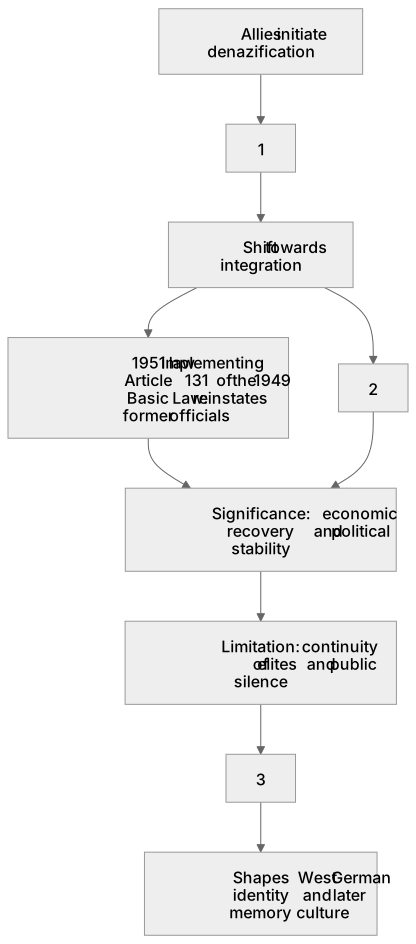
1Box 1
2Box 2
3Box 3
There is more to this lesson
The full lesson goes on to check your understanding and help you earn the marks. Create a free account to carry on, with your progress saved.
A week of Premium from your first lesson · Then the free plan continues · No card, no charge
Test your understanding of Paper 3, Option 37.2: Germany, 1871–1990: united, divided and reunited - 4 Establishing and ruling the new Federal Republic, 1949–60: The process and significance of de-Nazification and ‘coming to terms with the past’ in the 1950s.
Active recall beats re-reading. Take an instant quiz now to test what you’ve learned and lock it into long-term memory.
A week of Premium from your first lesson · Then the free plan continues · No card, no charge