Pearson Edexcel · A-Level · History
Course version: 9HI0 · Version from Sept 2015
The making of modern Russia, 1855–1991 - 1 The political reforms of…
Full specification wording
Paper 3, Option 38.1: The making of modern Russia, 1855–1991 - 1 The political reforms of Alexander II, 1855–70: The impact of the Crimean War; impetus to reform; army reforms, including to training, weapons, promotions, the period of conscription and to military bureaucracy.
Defeat in the Crimean War (1853–56) exposed Russia's backwardness: the Allies' rifled muskets and steam transport outmatched smoothbore weapons and ox-drawn supply, and the Treaty of Paris (1856)…
Checked against the Pearson Edexcel 9HI0 specification (opens in a new tab) on .
- Point 1 of 3
- 3 key terms
Study notes
From the checked teaching notes for this specification point.
The idea
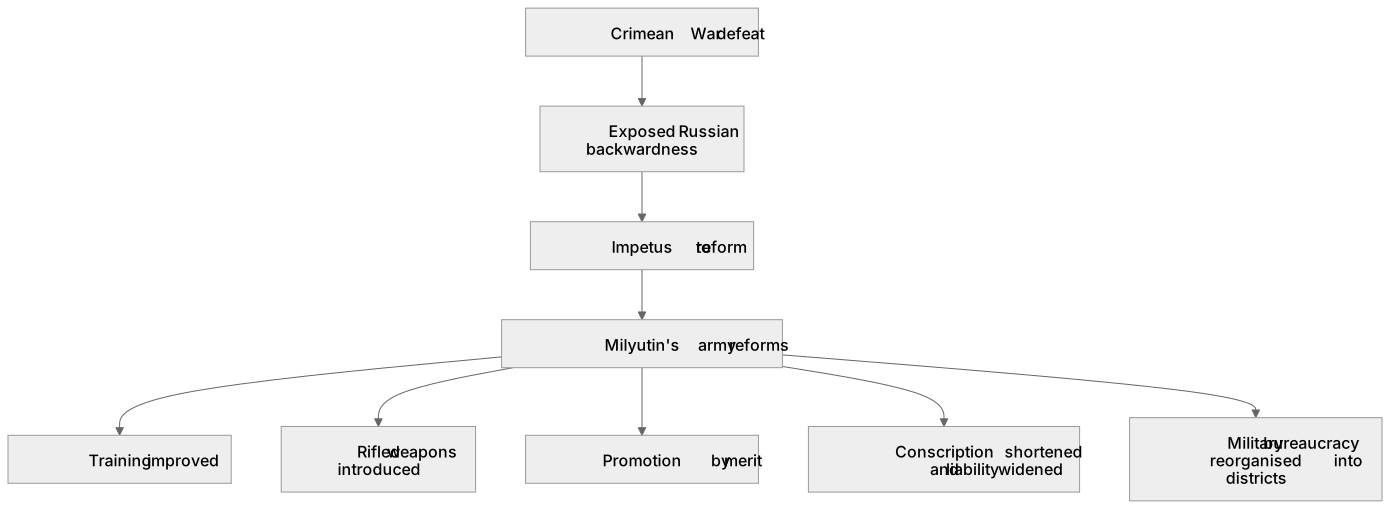
Defeat in the Crimean War (1853–56) exposed Russia's backwardness: the Allies' rifled muskets and steam transport outmatched smoothbore weapons and ox-drawn supply, and the Treaty of Paris (1856) ended Black Sea naval presence. This humiliation gave Alexander II the impetus to reform, since serfdom and military rigidity were blamed. War Minister Milyutin's army reforms (1860s–70s) shortened conscription from 25 years to 6 years active plus 9 reserve, made service universal in principle, improved training and officer promotion by merit, introduced rifled weapons, and reorganised military bureaucracy into districts. Assess impact, impetus and each reform strand.
What earns the marks
- Explains how Crimean defeat exposed logistical, technological and administrative weakness, giving impetus to reform.
- Analyses Milyutin's reforms: reduced conscription term, universal liability, reserve system and their social effects.
- Evaluates changes to training, rifled weapons and promotion by merit, and their limits in practice.
- Assesses reform of military bureaucracy, including district organisation and its effect on efficiency.
- Judges relative significance of military reform against other pressures for change under Alexander II.
Common mistakes and how to put them right
Treating the Crimean War as a victory.
Put it right by stating it was a defeat exposing Russian weakness.
Assuming conscription was abolished.
Put it right by explaining the term was shortened and liability widened, not ended.
Claiming all reforms were fully implemented.
Put it right by noting practical limits and resistance.
Exam tips
- Link each reform to the wartime failure it addressed.
- Use specific terms and dates, such as the 1856 Treaty of Paris.
- Balance military reform against other pressures for change.
Try the lesson
The start of the Paper 3, Option 38.1: The making of modern Russia, 1855–1991 - 1 The political reforms of Alexander II, 1855–70: The impact of the Crimean War; impetus to reform; army reforms, including to training, weapons, promotions, the period of conscription and to military bureaucracy. lesson, made from checked teaching notes for this specification point.
Have a go first
Which military reform was introduced in Russia after the Crimean War as part of the drive to modernise the army?
Listen
Defeat in the Crimean War (1853–56) exposed Russia's backwardness: the Allies' rifled muskets and steam transport outmatched smoothbore weapons and ox-drawn supply, and the Treaty of Paris (1856) ended Black Sea naval presence. This humiliation gave Alexander II the impetus to reform, since serfdom and military rigidity were blamed. War Minister Milyutin's army reforms (1860s–70s) shortened conscription from 25 years to 6 years active plus 9 reserve, made service universal in principle, improved training and officer promotion by merit, introduced rifled weapons, and reorganised military bureaucracy into districts. Assess impact, impetus and each reform strand. A strong answer earns marks for these points. Explains how Crimean defeat exposed logistical, technological and administrative weakness, giving impetus to reform. Analyses Milyutin's reforms: reduced conscription term, universal liability, reserve system and their social effects. Evaluates changes to training, rifled weapons and promotion by merit, and their limits in practice. Assesses reform of military bureaucracy, including district organisation and its effect on efficiency. A common slip: Treating the Crimean War as a victory. Instead, stating it was a defeat exposing Russian weakness. Exam tip: Link each reform to the wartime failure it addressed.
See it
Key words
Say what each word means before you turn the card.
Military modernisation
Try answering aloud or in your head before turning the card.
Impact of defeat
Try answering aloud or in your head before turning the card.
Conscription and society
Try answering aloud or in your head before turning the card.
See every definition
- Military modernisation
- Reform of training, weapons, promotions, conscription and military bureaucracy, introduced by War Minister Milyutin in the 1860s–70s.
- Impact of defeat
- Crimean defeat exposed logistical, technological and administrative weakness, giving impetus to reform.
- Conscription and society
- Conscription was shortened from 25 years to 6 years active plus 9 reserve, and service was made universal in principle.
Label the diagram
Some boxes have lost their names. Pick the right name for each number.
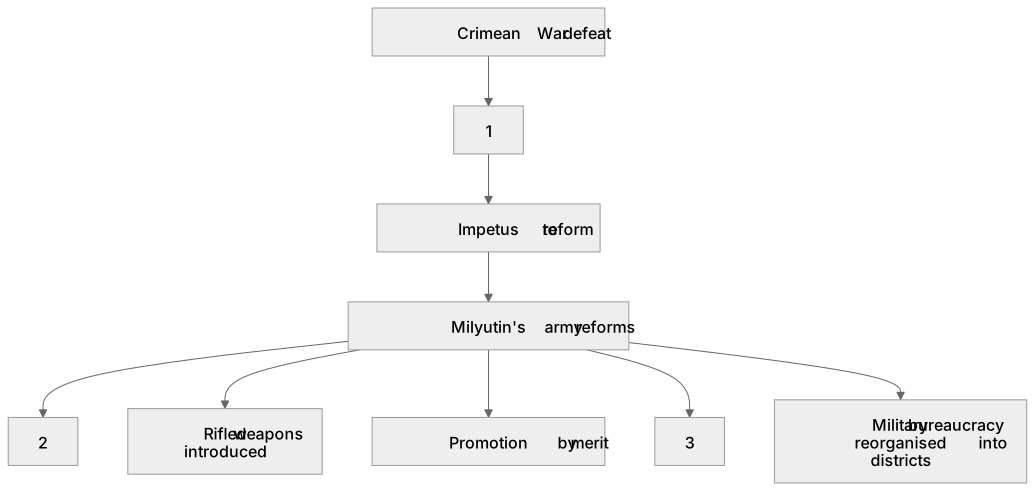
1Box 1
2Box 2
3Box 3
There is more to this lesson
The full lesson goes on to check your understanding and help you earn the marks. Create a free account to carry on, with your progress saved.
A week of Premium from your first lesson · Then the free plan continues · No card, no charge
Test your understanding of Paper 3, Option 38.1: The making of modern Russia, 1855–1991 - 1 The political reforms of Alexander II, 1855–70: The impact of the Crimean War; impetus to reform; army reforms, including to training, weapons, promotions, the period of conscription and to military bureaucracy.
Active recall beats re-reading. Take an instant quiz now to test what you’ve learned and lock it into long-term memory.
A week of Premium from your first lesson · Then the free plan continues · No card, no charge