Pearson Edexcel · A-Level · History
Course version: 9HI0 · Version from Sept 2015
The making of modern Russia, 1855–1991 - 3 The end of the Romanovs and the…
Full specification wording
Paper 3, Option 38.1: The making of modern Russia, 1855–1991 - 3 The end of the Romanovs and the triumph of the Bolsheviks, 1916–18: The Bolsheviks in power, 1917–18: concessions and violence; dissolving the Constituent Assembly and setting up the Cheka and the Red Army; making peace with Germany.
After seizing power in October 1917, the Bolsheviks faced the challenge of consolidating a minority revolution.
Checked against the Pearson Edexcel 9HI0 specification (opens in a new tab) on .
- Point 3 of 3
- 4 key terms
Study notes
From the checked teaching notes for this specification point.
The idea
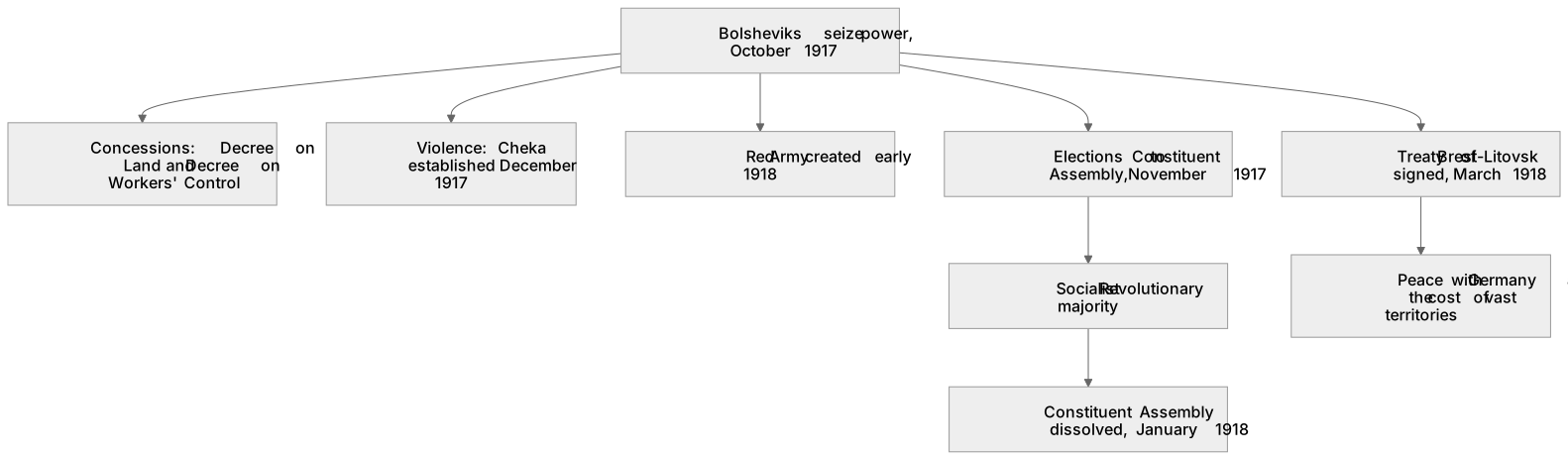
After seizing power in October 1917, the Bolsheviks faced the challenge of consolidating a minority revolution. They made concessions to secure support: the Decree on Land legitimised peasant seizures, and the Decree on Workers' Control gave factory committees a role. But they also used violence: the Cheka was established in December 1917 to suppress counter-revolution and sabotage, and the Red Army was created in early 1918 to defend the regime. When elections to the Constituent Assembly in November 1917 produced a Socialist Revolutionary majority, the Bolsheviks dissolved the assembly in January 1918. In March 1918, they signed the Treaty of Brest-Litovsk, making peace with Germany at the cost of vast territories. These measures show how the Bolsheviks combined ideological flexibility with coercion to survive.
What earns the marks
- Explains that concessions such as the Decree on Land and Workers' Control were designed to win popular support and divide opponents.
- Analyses the significance of dissolving the Constituent Assembly in January 1918 as a rejection of democratic legitimacy in favour of one-party rule.
- Assesses the role of the Cheka, founded in December 1917, in establishing a system of revolutionary terror to eliminate opposition.
- Evaluates the creation of the Red Army in early 1918 as a necessary step to defend the revolution and later to fight the Civil War.
- Explains the terms and consequences of the Treaty of Brest-Litovsk in March 1918, including the loss of Ukraine, the Baltic provinces, and Finland, and the political impact of making peace with Germany.
Common mistakes and how to put them right
Confusing the sequence of events.
Put it right by placing the election in November 1917 and dissolution in January 1918.
Assuming the Cheka was created after the Civil War began.
Put it right by noting it was established in December 1917, before the main Civil War conflicts.
Overlooking that the Treaty of Brest-Litovsk was a separate peace with Germany and its allies, not a general armistice.
Put it right by specifying it was signed on 3 March 1918 and ended Russia's participation in the First World War.
Exam tips
- Use precise dates and names to show chronological understanding, such as December 1917 for the Cheka and March 1918 for Brest-Litovsk.
- Link each measure to the Bolshevik aim of consolidating power, explaining how it addressed immediate threats or secured support.
- When discussing violence, distinguish between the Cheka's extrajudicial actions and the Red Army's military role, and consider their impact on Bolshevik control.
Try the lesson
The start of the Paper 3, Option 38.1: The making of modern Russia, 1855–1991 - 3 The end of the Romanovs and the triumph of the Bolsheviks, 1916–18: The Bolsheviks in power, 1917–18: concessions and violence; dissolving the Constituent Assembly and setting up the Cheka and the Red Army; making peace with Germany. lesson, made from checked teaching notes for this specification point.
Have a go first
Which body did the Bolsheviks set up in December 1917 to suppress counter-revolution and sabotage?
Listen
After seizing power in October 1917, the Bolsheviks faced the challenge of consolidating a minority revolution. They made concessions to secure support: the Decree on Land legitimised peasant seizures, and the Decree on Workers' Control gave factory committees a role. But they also used violence: the Cheka was established in December 1917 to suppress counter-revolution and sabotage, and the Red Army was created in early 1918 to defend the regime. When elections to the Constituent Assembly in November 1917 produced a Socialist Revolutionary majority, the Bolsheviks dissolved the assembly in January 1918. In March 1918, they signed the Treaty of Brest-Litovsk, making peace with Germany at the cost of vast territories. These measures show how the Bolsheviks combined ideological flexibility with coercion to survive. A strong answer earns marks for these points. Explains that concessions such as the Decree on Land and Workers' Control were designed to win popular support and divide opponents. Analyses the significance of dissolving the Constituent Assembly in January 1918 as a rejection of democratic legitimacy in favour of one-party rule. Assesses the role of the Cheka, founded in December 1917, in establishing a system of revolutionary terror to eliminate opposition. Evaluates the creation of the Red Army in early 1918 as a necessary step to defend the revolution and later to fight the Civil War. A common slip: Confusing the sequence of events: the Constituent Assembly was dissolved after the Bolsheviks lost the election, not before. Instead, placing the election in November 1917 and dissolution in January 1918. Exam tip: Use precise dates and names to show chronological understanding, such as December 1917 for the Cheka and March 1918 for Brest-Litovsk.
See it
Key words
Say what each word means before you turn the card.
Consolidation of power
Try answering aloud or in your head before turning the card.
Revolutionary violence and terror
Try answering aloud or in your head before turning the card.
Ideological compromise
Try answering aloud or in your head before turning the card.
Impact of the First World War
Try answering aloud or in your head before turning the card.
See every definition
- Consolidation of power
- The challenge the Bolsheviks faced after seizing power in October 1917 was consolidating a minority revolution.
- Revolutionary violence and terror
- The Cheka was established in December 1917 to suppress counter-revolution and sabotage, establishing a system of revolutionary terror to eliminate opposition.
- Ideological compromise
- Concessions such as the Decree on Land and the Decree on Workers' Control were designed to win popular support and divide opponents, showing ideological flexibility combined with coercion.
- Impact of the First World War
- The Treaty of Brest-Litovsk, signed in March 1918, made peace with Germany at the cost of vast territories and ended Russia's participation in the First World War.
Label the diagram
Some boxes have lost their names. Pick the right name for each number.
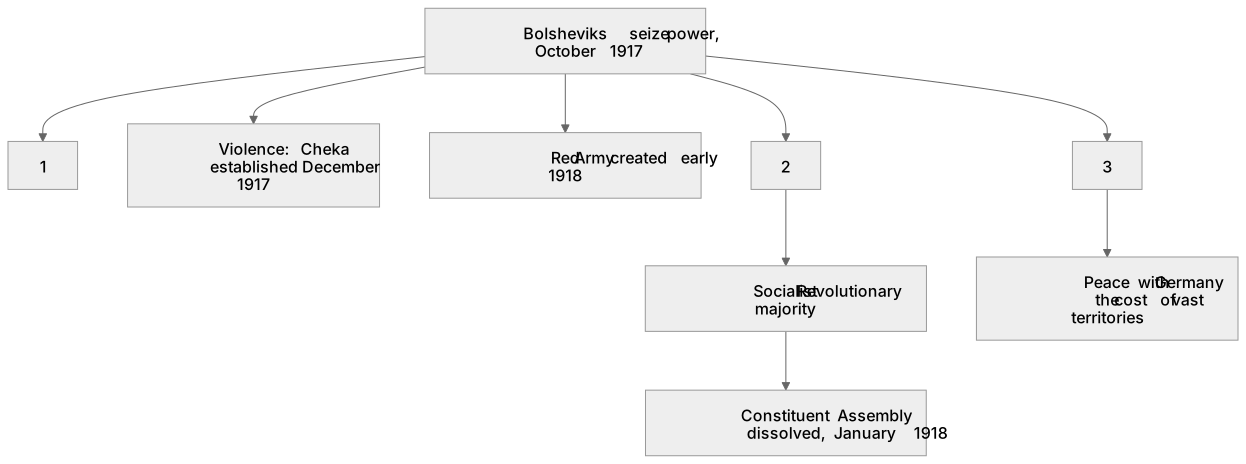
1Box 1
2Box 2
3Box 3
There is more to this lesson
The full lesson goes on to check your understanding and help you earn the marks. Create a free account to carry on, with your progress saved.
A week of Premium from your first lesson · Then the free plan continues · No card, no charge
Test your understanding of Paper 3, Option 38.1: The making of modern Russia, 1855–1991 - 3 The end of the Romanovs and the triumph of the Bolsheviks, 1916–18: The Bolsheviks in power, 1917–18: concessions and violence; dissolving the Constituent Assembly and setting up the Cheka and the Red Army; making peace with Germany.
Active recall beats re-reading. Take an instant quiz now to test what you’ve learned and lock it into long-term memory.
A week of Premium from your first lesson · Then the free plan continues · No card, no charge