Pearson Edexcel · A-Level · History
Course version: 9HI0 · Version from Sept 2015
The making of modern Russia, 1855–1991 - 4 Khrushchev and attempts to…
Full specification wording
Paper 3, Option 38.1: The making of modern Russia, 1855–1991 - 4 Khrushchev and attempts to reform the Soviet system, 1956–61: Administrative reforms: decentralisation; the restructuring of the security apparatus. Extent of new intellectual and cultural freedom, and limitations, including the closure of churches.
Khrushchev's administrative reforms aimed to make the Soviet system more efficient.
Checked against the Pearson Edexcel 9HI0 specification (opens in a new tab) on .
- Point 3 of 3
- 4 key terms
Study notes
From the checked teaching notes for this specification point.
The idea
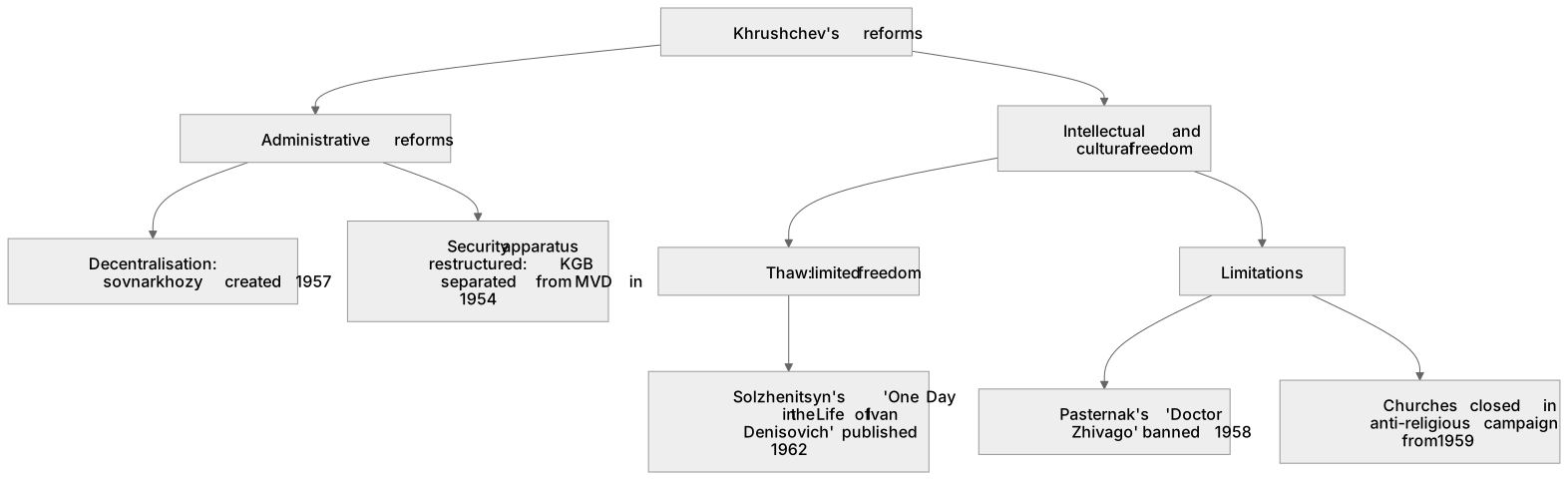
Khrushchev's administrative reforms aimed to make the Soviet system more efficient. Decentralisation included creating regional economic councils (sovnarkhozy) in 1957 to replace many central ministries, giving local managers more control over production. The security apparatus was restructured: the KGB was separated from the MVD in 1954 and placed under party control; terror was reduced. Culturally, the 'Thaw' brought limited freedom: Solzhenitsyn's 'One Day in the Life of Ivan Denisovich' was published in 1962, and more Western works appeared. But limitations remained: Pasternak's 'Doctor Zhivago' was banned in 1958, and churches were closed in the anti-religious campaign from 1959. Thus reform was real but controlled.
What earns the marks
- Explains decentralisation: the 1957 creation of sovnarkhozy (regional economic councils) to replace central industrial ministries, aiming to improve local decision-making and reduce bureaucratic inefficiency.
- Describes the restructuring of the security apparatus: the 1954 separation of the KGB from the MVD, the KGB's subordination to the party, and the reduction of mass terror, though the KGB still suppressed dissent.
- Explains limitations on cultural freedom: the banning of Pasternak's 'Doctor Zhivago' in 1958, the persecution of Boris Pasternak, and the 1962-63 campaign against 'formalist' art (e.g., the Manege exhibition).
- Describes the closure of churches: from 1959, a renewed anti-religious campaign closed many churches, monasteries and seminaries, and restricted religious practice.
- Evaluates the overall impact: administrative reforms were often reversed or chaotic, and cultural freedom was inconsistent, showing Khrushchev's attempt to reform without losing party control.
Common mistakes and how to put them right
Stating that decentralisation meant full local autonomy.
Put it right: Sovnarkhozy were still under party control and central planning remained; the reforms were administrative, not market-based.
Claiming that the KGB was abolished or that terror ended completely.
Put it right: The KGB was separated from the MVD in 1954 and became the main security organ; it continued to suppress dissent, though mass terror ended.
Saying that the 'Thaw' gave complete freedom of speech and press.
Put it right: Censorship persisted; works like 'Doctor Zhivago' were banned and authors could be persecuted, as seen in the 1962-63 anti-formalist campaign.
Asserting that all churches were closed immediately after 1956.
Put it right: The anti-religious campaign intensified from 1959, leading to widespread but not total closures by 1964.
Exam tips
- Use specific examples to show both reform and limitation: sovnarkhozy for decentralisation, KGB for security, 'One Day in the Life of Ivan Denisovich' for cultural freedom, and church closures for limits.
- When discussing cultural freedom, distinguish between official tolerance and continued censorship; mention the Pasternak affair as a clear limit.
- For administrative reforms, explain their aims and assess whether they achieved their goals; note that many were reversed after Khrushchev's fall in 1964.
- Link the reforms to Khrushchev's overall aim: to modernise and legitimise the Soviet system without democratising it.
Try the lesson
The start of the Paper 3, Option 38.1: The making of modern Russia, 1855–1991 - 4 Khrushchev and attempts to reform the Soviet system, 1956–61: Administrative reforms: decentralisation; the restructuring of the security apparatus. Extent of new intellectual and cultural freedom, and limitations, including the closure of churches. lesson, made from checked teaching notes for this specification point.
Have a go first
Which administrative change did Khrushchev introduce to decentralise economic management in 1957?
Listen
Khrushchev's administrative reforms aimed to make the Soviet system more efficient. Decentralisation included creating regional economic councils (sovnarkhozy) in 1957 to replace many central ministries, giving local managers more control over production. The security apparatus was restructured: the KGB was separated from the MVD in 1954 and placed under party control; terror was reduced. Culturally, the 'Thaw' brought limited freedom: Solzhenitsyn's 'One Day in the Life of Ivan Denisovich' was published in 1962, and more Western works appeared. But limitations remained: Pasternak's 'Doctor Zhivago' was banned in 1958, and churches were closed in the anti-religious campaign from 1959. Thus reform was real but controlled. A strong answer earns marks for these points. Explains decentralisation: the 1957 creation of sovnarkhozy (regional economic councils) to replace central industrial ministries, aiming to improve local decision-making and reduce bureaucratic inefficiency. Describes the restructuring of the security apparatus: the 1954 separation of the KGB from the MVD, the KGB's subordination to the party, and the reduction of mass terror, though the KGB still suppressed dissent. Assesses the extent of new intellectual and cultural freedom: the 'Thaw' allowed publication of some critical works (e.g., Solzhenitsyn's 'One Day in the Life of Ivan Denisovich' in 1962) and greater contact with the West, but censorship continued. Explains limitations on cultural freedom: the banning of Pasternak's 'Doctor Zhivago' in 1958, the persecution of Boris Pasternak, and the 1962-63 campaign against 'formalist' art (e.g., the Manege exhibition). A common slip: stating that decentralisation meant full local autonomy. Instead, sovnarkhozy were still under party control and central planning remained; the reforms were administrative, not market-based. Exam tip: Use specific examples to show both reform and limitation: sovnarkhozy for decentralisation, KGB for security, 'One Day in the Life of Ivan Denisovich' for cultural freedom, and church closures for limits.
See it
Put the events in order
Put these events in the order they happened, earliest first.
- 1. Regional economic councils replaced many central ministries
- 2. The KGB was separated from the MVD
- 3. Solzhenitsyn's 'One Day in the Life of Ivan Denisovich' was published
- 4. Pasternak's 'Doctor Zhivago' was banned
- 5. An anti-religious campaign closed churches
Key words
Say what each word means before you turn the card.
Decentralisation
Try answering aloud or in your head before turning the card.
Restructuring of the security apparatus
Try answering aloud or in your head before turning the card.
'Thaw'
Try answering aloud or in your head before turning the card.
Closure of churches
Try answering aloud or in your head before turning the card.
See every definition
- Decentralisation
- Creating regional economic councils (sovnarkhozy) in 1957 to replace many central ministries, giving local managers more control over production.
- Restructuring of the security apparatus
- The KGB was separated from the MVD in 1954 and placed under party control, and terror was reduced.
- 'Thaw'
- Brought limited freedom, with more Western works appearing, but limitations remained.
- Closure of churches
- Churches were closed in the anti-religious campaign from 1959.
Label the diagram
Some boxes have lost their names. Pick the right name for each number.
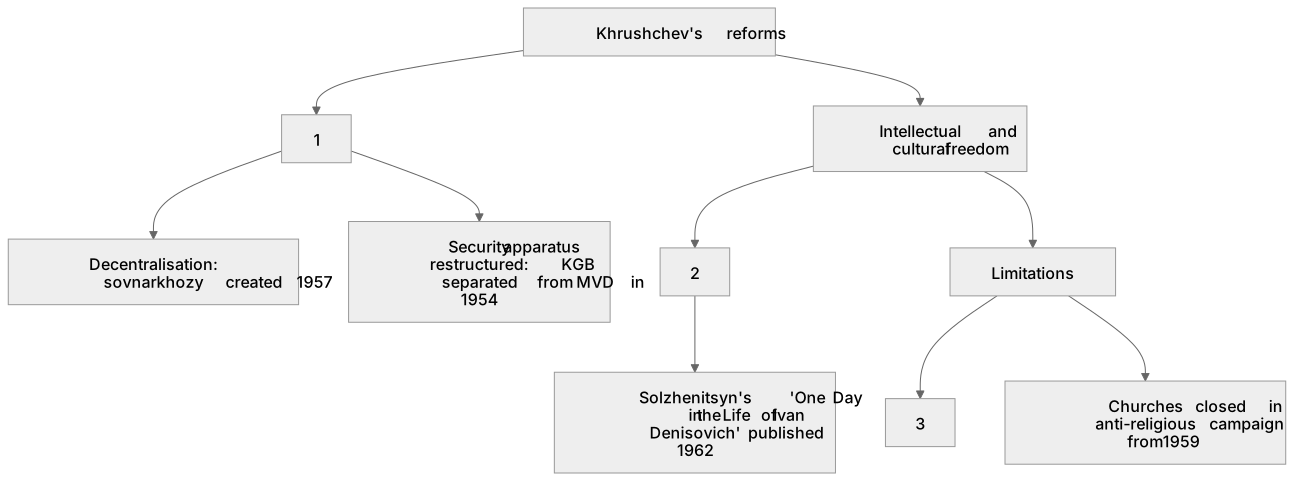
1Box 1
2Box 2
3Box 3
There is more to this lesson
The full lesson goes on to check your understanding and help you earn the marks. Create a free account to carry on, with your progress saved.
A week of Premium from your first lesson · Then the free plan continues · No card, no charge
Test your understanding of Paper 3, Option 38.1: The making of modern Russia, 1855–1991 - 4 Khrushchev and attempts to reform the Soviet system, 1956–61: Administrative reforms: decentralisation; the restructuring of the security apparatus. Extent of new intellectual and cultural freedom, and limitations, including the closure of churches.
Active recall beats re-reading. Take an instant quiz now to test what you’ve learned and lock it into long-term memory.
A week of Premium from your first lesson · Then the free plan continues · No card, no charge