Pearson Edexcel · A-Level · History
Course version: 9HI0 · Version from Sept 2015
The making of modern China, 1860–1997 - 1 The growth of industry: The…
Full specification wording
Paper 3, Option 38.2: The making of modern China, 1860–1997 - 1 The growth of industry: The growth of mining and manufacturing, 1860–1997 (key developments: the growth of textile production in Shanghai in the later Qing Empire, developments in Manchuria under the Japanese in the 1930s, the first Five-Year Plan 1953–57, electrical power, technological innovation in the digital age).
This theme traces how mining and manufacturing expanded across roughly 137 years, from 1860 to 1997.
Checked against the Pearson Edexcel 9HI0 specification (opens in a new tab) on .
- Point 2 of 2
- 4 key terms
Study notes
From the checked teaching notes for this specification point.
The idea
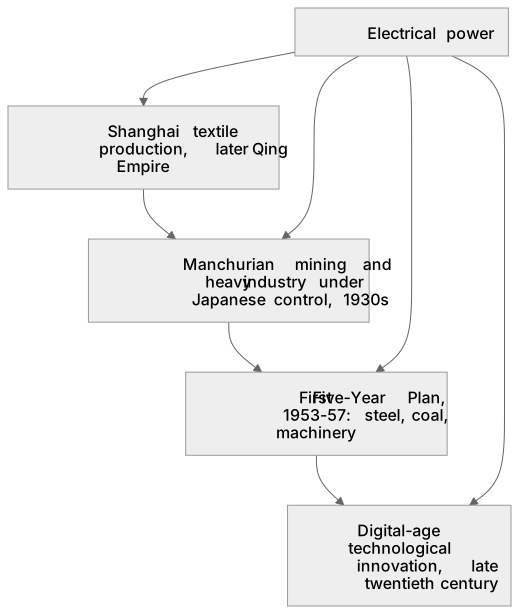
This theme traces how mining and manufacturing expanded across roughly 137 years, from 1860 to 1997. Begin with Shanghai's later Qing textile mills, where foreign treaty-port capital and Chinese merchant investment built cotton-spinning capacity. Then examine Manchuria in the 1930s, where Japanese occupation drove coal, iron and steel extraction for imperial needs. The first Five-Year Plan (1953–57) redirected industry towards heavy sectors such as steel, coal and machinery under state planning. Electrical power underpinned all these stages, powering mills, mines and factories. Finally, digital-age technological innovation from the late twentieth century reshaped production. Weigh continuity, regional variation and the roles of foreign, private and state capital.
What earns the marks
- Locates Shanghai textile growth within the later Qing Empire, linking treaty ports, foreign investment and Chinese merchant capital to cotton manufacturing.
- Explains Manchurian mining and heavy industry in the 1930s as shaped by Japanese imperial control and resource extraction.
- Analyses the first Five-Year Plan (1953–57) as state-directed heavy industrialisation with targets for steel, coal and machinery.
- Assesses electrical power as infrastructure enabling mining and manufacturing across the whole period.
- Evaluates digital-age technological innovation as a later phase transforming production methods and industrial output.
Common mistakes and how to put them right
Treating industrial growth as one smooth upward line.
Put it right by noting regional unevenness and disruption, such as war and policy shifts.
Assuming Shanghai textiles were purely Chinese-owned.
Put it right by recognising foreign treaty-port investment alongside Chinese capital.
Describing Manchurian development as simply Chinese industrialisation.
Put it right by explaining Japanese imperial direction and resource extraction.
Exam tips
- Anchor each key development to its dates so chronology is explicit in your answer.
- Use named sectors such as cotton, coal, iron and steel to give concrete industrial detail.
- Compare phases directly, for example state planning in the 1950s against market-era digital innovation.
Try the lesson
The start of the Paper 3, Option 38.2: The making of modern China, 1860–1997 - 1 The growth of industry: The growth of mining and manufacturing, 1860–1997 (key developments: the growth of textile production in Shanghai in the later Qing Empire, developments in Manchuria under the Japanese in the 1930s, the first Five-Year Plan 1953–57, electrical power, technological innovation in the digital age). lesson, made from checked teaching notes for this specification point.
Have a go first
Which city became the leading centre of textile production in China during the later Qing Empire?
Listen
This theme traces how mining and manufacturing expanded across roughly 137 years, from 1860 to 1997. Begin with Shanghai's later Qing textile mills, where foreign treaty-port capital and Chinese merchant investment built cotton-spinning capacity. Then examine Manchuria in the 1930s, where Japanese occupation drove coal, iron and steel extraction for imperial needs. The first Five-Year Plan (1953–57) redirected industry towards heavy sectors such as steel, coal and machinery under state planning. Electrical power underpinned all these stages, powering mills, mines and factories. Finally, digital-age technological innovation from the late twentieth century reshaped production. Weigh continuity, regional variation and the roles of foreign, private and state capital. A strong answer earns marks for these points. Locates Shanghai textile growth within the later Qing Empire, linking treaty ports, foreign investment and Chinese merchant capital to cotton manufacturing. Explains Manchurian mining and heavy industry in the 1930s as shaped by Japanese imperial control and resource extraction. Analyses the first Five-Year Plan (1953–57) as state-directed heavy industrialisation with targets for steel, coal and machinery. Assesses electrical power as infrastructure enabling mining and manufacturing across the whole period. A common slip: Treating industrial growth as one smooth upward line. Instead, noting regional unevenness and disruption, such as war and policy shifts. Exam tip: Anchor each key development to its dates so chronology is explicit in your answer.
See it
Key words
Say what each word means before you turn the card.
Industrialisation and economic change
Try answering aloud or in your head before turning the card.
Foreign influence and imperialism
Try answering aloud or in your head before turning the card.
State planning and central direction
Try answering aloud or in your head before turning the card.
Technology and infrastructure
Try answering aloud or in your head before turning the card.
See every definition
- Industrialisation and economic change
- The growth of mining and manufacturing across roughly 137 years, from 1860 to 1997, traced through key developments.
- Foreign influence and imperialism
- Foreign treaty-port capital in Shanghai's textile mills and Japanese imperial control of Manchurian mining and heavy industry in the 1930s.
- State planning and central direction
- The first Five-Year Plan of 1953–57, which redirected industry towards heavy sectors such as steel, coal and machinery.
- Technology and infrastructure
- Electrical power, which underpinned all stages by powering mills, mines and factories, and digital-age technological innovation reshaping production.
Label the diagram
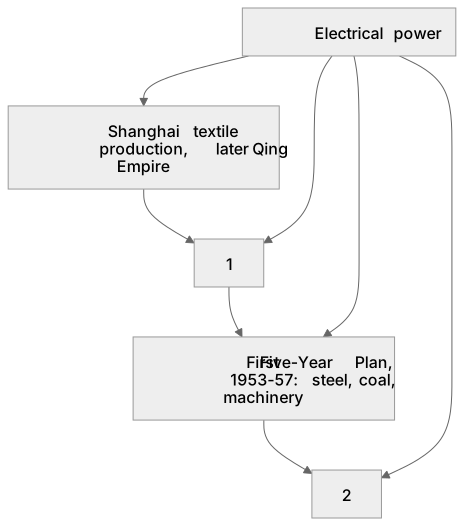
Some boxes have lost their names. Pick the right name for each number.
1Box 1
2Box 2
There is more to this lesson
The full lesson goes on to check your understanding and help you earn the marks. Create a free account to carry on, with your progress saved.
A week of Premium from your first lesson · Then the free plan continues · No card, no charge
Test your understanding of Paper 3, Option 38.2: The making of modern China, 1860–1997 - 1 The growth of industry: The growth of mining and manufacturing, 1860–1997 (key developments: the growth of textile production in Shanghai in the later Qing Empire, developments in Manchuria under the Japanese in the 1930s, the first Five-Year Plan 1953–57, electrical power, technological innovation in the digital age).
Active recall beats re-reading. Take an instant quiz now to test what you’ve learned and lock it into long-term memory.
A week of Premium from your first lesson · Then the free plan continues · No card, no charge