Pearson Edexcel · A-Level · History
Course version: 9HI0 · Version from Sept 2015
The making of modern China, 1860–1997 - 4 The Sino- Soviet split, 1958–69:…
Full specification wording
Paper 3, Option 38.2: The making of modern China, 1860–1997 - 4 The Sino- Soviet split, 1958–69: The significance of military confrontation in 1969.
In 1969, military confrontation between China and the USSR peaked in border clashes, notably on Zhenbao Island in the Ussuri River.
Checked against the Pearson Edexcel 9HI0 specification (opens in a new tab) on .
- Point 3 of 3
- 3 key terms
Study notes
From the checked teaching notes for this specification point.
The idea
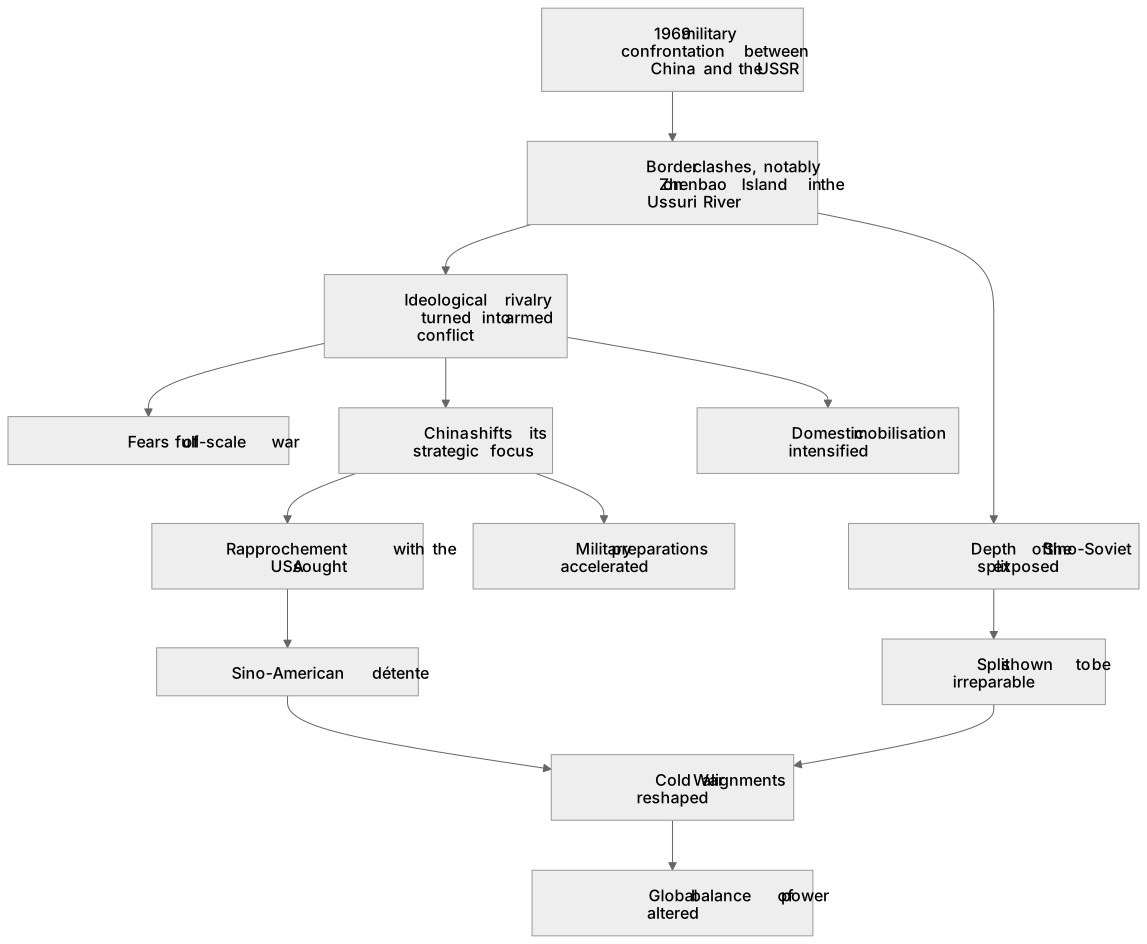
In 1969, military confrontation between China and the USSR peaked in border clashes, notably on Zhenbao Island in the Ussuri River. These were significant because they turned ideological rivalry into armed conflict, raising fears of full-scale war. The clashes exposed the depth of the Sino-Soviet split, prompting China to shift its strategic focus, accelerate military preparations, and seek rapprochement with the USA. They also intensified domestic mobilisation and contributed to the Sino-American détente that reshaped Cold War alignments. Thus, 1969 military confrontation was a turning point: it demonstrated that the split was irreparable, pushed China towards the West, and altered the global balance of power.
What earns the marks
- Explains that the 1969 clashes (e.g., Zhenbao Island) marked the first direct military conflict between two major communist states, escalating the Sino-Soviet split from ideological dispute to armed confrontation.
- Analyses how the clashes led China to reassess its security, prompting increased military spending and a shift from a two-front threat to prioritising the Soviet threat.
- Assesses the impact on China's foreign policy, including moves towards rapprochement with the USA, which culminated in Nixon's visit in 1972.
- Evaluates the global significance: the confrontation contributed to the broader Cold War realignment, with China moving from the Soviet bloc towards the Western camp, affecting the balance of power.
- Considers the domestic impact in China, such as heightened propaganda, mobilisation, and the role of the military in politics during the Cultural Revolution.
- Discusses the significance in terms of the split's irreversibility, as the clashes demonstrated that reconciliation between China and the USSR was unlikely.
Common mistakes and how to put them right
Treating the 1969 clashes as the start of the Sino-Soviet split.
Put it right: The split had origins in the late 1950s and 1960s; 1969 was a culmination and escalation, not the beginning.
Overstating the scale of the conflict as a full-scale war.
Put it right: The clashes were limited border skirmishes, but their significance lies in their political and strategic impact, not the scale of fighting.
Ignoring the link to Sino-American rapprochement.
Put it right: The confrontation was a key factor pushing China to seek better relations with the USA, so it should be connected to the broader diplomatic realignment.
Exam tips
- Plan your answer to address 'significance' by considering short-term and long-term consequences, and different dimensions (political, military, diplomatic).
- Use precise evidence, such as the dates and locations of clashes (e.g., Zhenbao Island, March 1969), to support your arguments.
- Link the confrontation to the broader theme of the Sino-Soviet split and the Cold War, showing how it changed China's position internationally.
Try the lesson
The start of the Paper 3, Option 38.2: The making of modern China, 1860–1997 - 4 The Sino- Soviet split, 1958–69: The significance of military confrontation in 1969. lesson, made from checked teaching notes for this specification point.
Have a go first
What was the primary historical significance of the 1969 military confrontation between China and the Soviet Union at Zhenbao Island?
Listen
In 1969, military confrontation between China and the USSR peaked in border clashes, notably on Zhenbao Island in the Ussuri River. These were significant because they turned ideological rivalry into armed conflict, raising fears of full-scale war. The clashes exposed the depth of the Sino-Soviet split, prompting China to shift its strategic focus, accelerate military preparations, and seek rapprochement with the USA. They also intensified domestic mobilisation and contributed to the Sino-American détente that reshaped Cold War alignments. Thus, 1969 military confrontation was a turning point: it demonstrated that the split was irreparable, pushed China towards the West, and altered the global balance of power. A strong answer earns marks for these points. Explains that the 1969 clashes (e.g., Zhenbao Island) marked the first direct military conflict between two major communist states, escalating the Sino-Soviet split from ideological dispute to armed confrontation. Analyses how the clashes led China to reassess its security, prompting increased military spending and a shift from a two-front threat to prioritising the Soviet threat. Assesses the impact on China's foreign policy, including moves towards rapprochement with the USA, which culminated in Nixon's visit in 1972. Evaluates the global significance: the confrontation contributed to the broader Cold War realignment, with China moving from the Soviet bloc towards the Western camp, affecting the balance of power. A common slip: Treating the 1969 clashes as the start of the Sino-Soviet split. Instead, The split had origins in the late 1950s and 1960s; 1969 was a culmination and escalation, not the beginning. Exam tip: Plan your answer to address 'significance' by considering short-term and long-term consequences, and different dimensions (political, military, diplomatic).
See it
Key words
Say what each word means before you turn the card.
Cold War alliances
Try answering aloud or in your head before turning the card.
Border conflicts and territorial disputes
Try answering aloud or in your head before turning the card.
Foreign policy realignment
Try answering aloud or in your head before turning the card.
See every definition
- Cold War alliances
- Alignments reshaped by the Sino-American détente, with China moving from the Soviet bloc towards the Western camp and altering the global balance of power.
- Border conflicts and territorial disputes
- Clashes between China and the USSR in 1969, notably on Zhenbao Island in the Ussuri River, that turned ideological rivalry into armed conflict.
- Foreign policy realignment
- A shift in China's strategic focus, prompting rapprochement with the USA and contributing to the Sino-American détente that reshaped Cold War alignments.
Label the diagram
Some boxes have lost their names. Pick the right name for each number.
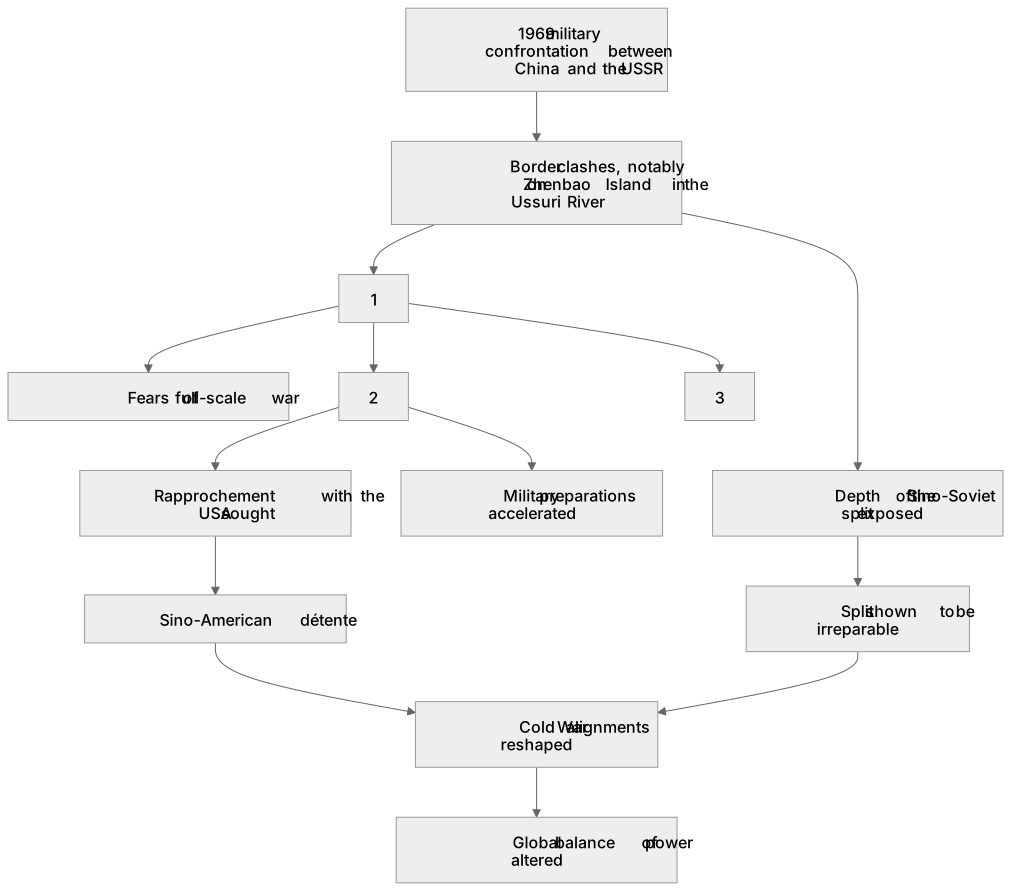
1Box 1
2Box 2
3Box 3
There is more to this lesson
The full lesson goes on to check your understanding and help you earn the marks. Create a free account to carry on, with your progress saved.
A week of Premium from your first lesson · Then the free plan continues · No card, no charge
Test your understanding of Paper 3, Option 38.2: The making of modern China, 1860–1997 - 4 The Sino- Soviet split, 1958–69: The significance of military confrontation in 1969.
Active recall beats re-reading. Take an instant quiz now to test what you’ve learned and lock it into long-term memory.
A week of Premium from your first lesson · Then the free plan continues · No card, no charge