Pearson Edexcel · A-Level · History
Course version: 9HI0 · Version from Sept 2015
Civil rights and race relations in the USA, 1850–2009 - 1 The changing…
Full specification wording
Paper 3, Option 39.1: Civil rights and race relations in the USA, 1850–2009 - 1 The changing geography of civil rights issues: The changing geographical distribution of black Americans, 1850–2009 (key developments: freedom in 1865, the slow drift north, the First Great Migration c1910–30, the Second Great Migration c1940–70 , the migration back to the old south in the late twentieth century).
This topic traces where black Americans lived and why the map shifted.
Checked against the Pearson Edexcel 9HI0 specification (opens in a new tab) on .
- Point 1 of 2
Study notes
From the checked teaching notes for this specification point.
The idea
This topic traces where black Americans lived and why the map shifted. In 1850 most were enslaved in the southern states. Freedom in 1865 did not bring movement: sharecropping, debt and violence tied families to the land, so change was a slow drift north and west. The First Great Migration c1910–30 carried perhaps over a million people to cities such as Chicago, Detroit and New York, pushed by crop failure and Jim Crow and pulled by wartime jobs. The Second Great Migration c1940–70 was larger and more urban, following defence work and the mechanisation of southern farming. From the late twentieth century the flow reversed: the migration back to the old south, as industry, cheaper housing and family ties drew people to cities like Atlanta. Learn each phase as push, pull and consequence.
What earns the marks
- Places the starting point in 1850: the great majority of black Americans were enslaved in the southern states, so the geographical distribution was largely forced rather than chosen.
- Explains that freedom in 1865 did not produce mass movement: sharecropping, debt peonage, poverty and racial violence kept most freedpeople in the rural south.
- Defines the slow drift north as a gradual, limited movement before c1910, including movement to southern towns and a small northern stream.
- Accounts for the First Great Migration c1910–30 using push factors such as boll weevil damage, floods and Jim Crow, and pull factors such as industrial and wartime labour demand.
- Accounts for the Second Great Migration c1940–70 using defence-industry jobs, agricultural mechanisation and chain migration to northern and western cities.
- Explains the migration back to the old south in the late twentieth century through employment growth, lower living costs, retirement and family links, and notes the resulting urban concentration.
- Uses accurate supporting detail, for example named destination cities, and links each phase to its consequences for black communities.
Common mistakes and how to put them right
Treating 1865 as an instant turning point that immediately redistributed the black population.
Put it right: Emancipation was legal and political, while economic and violent coercion kept most people in the rural south for decades.
Collapsing the two Great Migrations into one event.
Put it right: Separate the First c1910–30 from the Second c1940–70 by scale, timing, destinations and causes.
Assuming migration only ever ran south to north.
Put it right: Include the late twentieth-century return to the old south and the earlier slow drift within the south.
Exam tips
- Anchor every phase to dates and a named place so the examiner can see chronological and geographical precision.
- For each migration, write a push factor and a pull factor in the same sentence to show causation rather than description.
- Use the final paragraph to judge continuity and change across the whole period, for example contrasting 1850 confinement with late twentieth-century return migration.
Try the lesson
The start of the Paper 3, Option 39.1: Civil rights and race relations in the USA, 1850–2009 - 1 The changing geography of civil rights issues: The changing geographical distribution of black Americans, 1850–2009 (key developments: freedom in 1865, the slow drift north, the First Great Migration c1910–30, the Second Great Migration c1940–70 , the migration back to the old south in the late twentieth century). lesson, made from checked teaching notes for this specification point.
Have a go first
Which of these key developments in the geographical distribution of black Americans is correctly placed in time?
Listen
This topic traces where black Americans lived and why the map shifted. In 1850 most were enslaved in the southern states. Freedom in 1865 did not bring movement: sharecropping, debt and violence tied families to the land, so change was a slow drift north and west. The First Great Migration c1910–30 carried perhaps over a million people to cities such as Chicago, Detroit and New York, pushed by crop failure and Jim Crow and pulled by wartime jobs. The Second Great Migration c1940–70 was larger and more urban, following defence work and the mechanisation of southern farming. From the late twentieth century the flow reversed: the migration back to the old south, as industry, cheaper housing and family ties drew people to cities like Atlanta. Learn each phase as push, pull and consequence. A strong answer earns marks for these points. Places the starting point in 1850: the great majority of black Americans were enslaved in the southern states, so the geographical distribution was largely forced rather than chosen. Explains that freedom in 1865 did not produce mass movement: sharecropping, debt peonage, poverty and racial violence kept most freedpeople in the rural south. Defines the slow drift north as a gradual, limited movement before c1910, including movement to southern towns and a small northern stream. Accounts for the First Great Migration c1910–30 using push factors such as boll weevil damage, floods and Jim Crow, and pull factors such as industrial and wartime labour demand. A common slip: Treating 1865 as an instant turning point that immediately redistributed the black population. Instead, emancipation was legal and political, while economic and violent coercion kept most people in the rural south for decades. Exam tip: Anchor every phase to dates and a named place so the examiner can see chronological and geographical precision.
See it
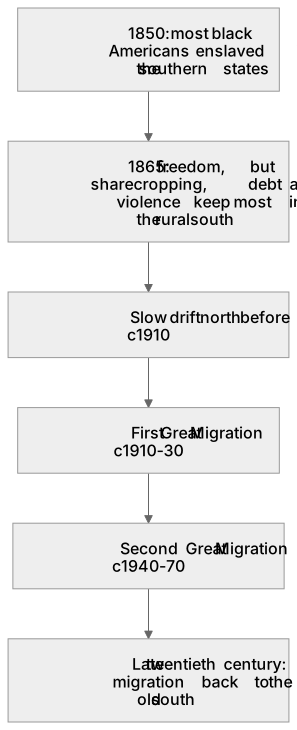
Put it in order
Put these steps in the order they happen.
- 1. Slow drift north before c1910
- 2. 1865: freedom, but sharecropping, debt and violence keep most in the rural south
- 3. 1850: most black Americans enslaved in the southern states
- 4. Late twentieth century: migration back to the old south
- 5. Second Great Migration c1940-70
- 6. First Great Migration c1910-30
Label the diagram
Some boxes have lost their names. Pick the right name for each number.
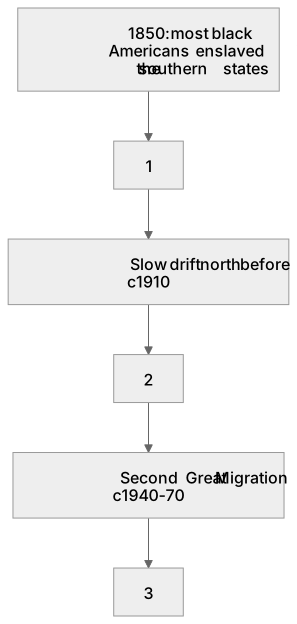
1Box 1
2Box 2
3Box 3
There is more to this lesson
The full lesson goes on to check your understanding and help you earn the marks. Create a free account to carry on, with your progress saved.
A week of Premium from your first lesson · Then the free plan continues · No card, no charge
Test your understanding of Paper 3, Option 39.1: Civil rights and race relations in the USA, 1850–2009 - 1 The changing geography of civil rights issues: The changing geographical distribution of black Americans, 1850–2009 (key developments: freedom in 1865, the slow drift north, the First Great Migration c1910–30, the Second Great Migration c1940–70 , the migration back to the old south in the late twentieth century).
Active recall beats re-reading. Take an instant quiz now to test what you’ve learned and lock it into long-term memory.
A week of Premium from your first lesson · Then the free plan continues · No card, no charge