Pearson Edexcel · A-Level · History
Course version: 9HI0 · Version from Sept 2015
Civil rights and race relations in the USA, 1850–2009 - 3 The New Deal and…
Full specification wording
Paper 3, Option 39.1: Civil rights and race relations in the USA, 1850–2009 - 3 The New Deal and race relations, 1933–41: The influence of southern whites in the Democrat Party.
Southern whites shaped the Democrat Party in the 1930s through Congress.
Checked against the Pearson Edexcel 9HI0 specification (opens in a new tab) on .
- Point 1 of 3
- 3 key terms
Study notes
From the checked teaching notes for this specification point.
The idea
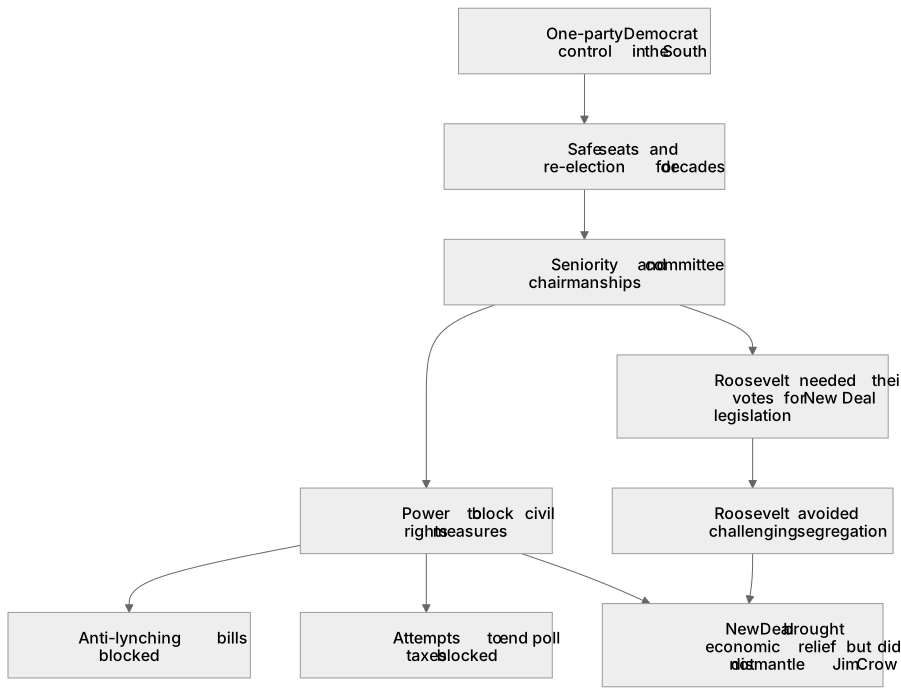
Southern whites shaped the Democrat Party in the 1930s through Congress. One-party Democratic control in the South meant senators and representatives were re-elected for decades, giving them committee chairmanships and seniority. They used this power to block civil rights measures, including anti-lynching bills and attempts to end poll taxes. President Roosevelt needed their votes for New Deal legislation, so he avoided challenging segregation. This influence explains why the New Deal brought economic relief to many black Americans but did not dismantle Jim Crow or secure federal protection against racial violence.
For example: The anti-lynching bill stalled in the Senate despite Roosevelt's private sympathy.
What earns the marks
- Explain that southern states were effectively one-party Democrat, so southern white politicians held safe seats and accumulated seniority.
- Show how seniority gave southern Democrats control of key congressional committees, allowing them to block civil rights legislation.
- Link Roosevelt's need for southern Democrat votes to pass New Deal programmes to his reluctance to support anti-lynching or anti-poll-tax measures.
- Use a specific example, such as the failure of the Costigan-Wagner anti-lynching bill, to illustrate southern Democrat influence.
- Assess the extent to which this influence, rather than other factors, limited federal action on civil rights in 1933–41.
Common mistakes and how to put them right
Assuming all Democrats were southern whites.
Put it right: The Democrat Party included northern liberals and black voters, but southern whites held disproportionate power in Congress.
Claiming Roosevelt was personally opposed to all civil rights.
Put it right: Roosevelt privately sympathised with some aims but prioritised New Deal legislation and avoided alienating southern Democrats.
Treating southern Democrat influence as total.
Put it right: Some New Deal programmes did aid black Americans, and black voters began shifting towards the Democrats, so the influence was powerful but not absolute.
Exam tips
- Define 'southern whites' and 'Democrat Party' in your introduction to show precise understanding.
- Use specific congressional mechanisms, such as committee chairmanships and filibusters, to explain how influence worked.
- Balance your argument by considering limits to southern Democrat influence, such as northern Democrat support for civil rights or black activism.
Try the lesson
The start of the Paper 3, Option 39.1: Civil rights and race relations in the USA, 1850–2009 - 3 The New Deal and race relations, 1933–41: The influence of southern whites in the Democrat Party. lesson, made from checked teaching notes for this specification point.
Have a go first
Which group of Democrat politicians used their seniority in Congress to block legislation that threatened racial segregation during the 1930s?
Listen
Southern whites shaped the Democrat Party in the 1930s through Congress. One-party Democratic control in the South meant senators and representatives were re-elected for decades, giving them committee chairmanships and seniority. They used this power to block civil rights measures, including anti-lynching bills and attempts to end poll taxes. President Roosevelt needed their votes for New Deal legislation, so he avoided challenging segregation. This influence explains why the New Deal brought economic relief to many black Americans but did not dismantle Jim Crow or secure federal protection against racial violence. For example, the anti-lynching bill stalled in the Senate despite Roosevelt's private sympathy. A strong answer earns marks for these points. Explain that southern states were effectively one-party Democrat, so southern white politicians held safe seats and accumulated seniority. Show how seniority gave southern Democrats control of key congressional committees, allowing them to block civil rights legislation. Link Roosevelt's need for southern Democrat votes to pass New Deal programmes to his reluctance to support anti-lynching or anti-poll-tax measures. Use a specific example, such as the failure of the Costigan-Wagner anti-lynching bill, to illustrate southern Democrat influence. A common slip: Assuming all Democrats were southern whites. Instead, the Democrat Party included northern liberals and black voters, but southern whites held disproportionate power in Congress. Exam tip: Define 'southern whites' and 'Democrat Party' in your introduction to show precise understanding.
See it
Key words
Say what each word means before you turn the card.
Congressional power and seniority
Try answering aloud or in your head before turning the card.
One-party politics in the South
Try answering aloud or in your head before turning the card.
Roosevelt's political priorities
Try answering aloud or in your head before turning the card.
See every definition
- Congressional power and seniority
- Senators and representatives re-elected for decades gained committee chairmanships and seniority, which southern Democrats used to block civil rights measures.
- One-party politics in the South
- Effective one-party Democrat control in the South meant southern white politicians held safe seats and accumulated seniority.
- Roosevelt's political priorities
- Needing southern Democrat votes for New Deal legislation, the President avoided challenging segregation and did not support anti-lynching or anti-poll-tax measures.
Label the diagram
Some boxes have lost their names. Pick the right name for each number.
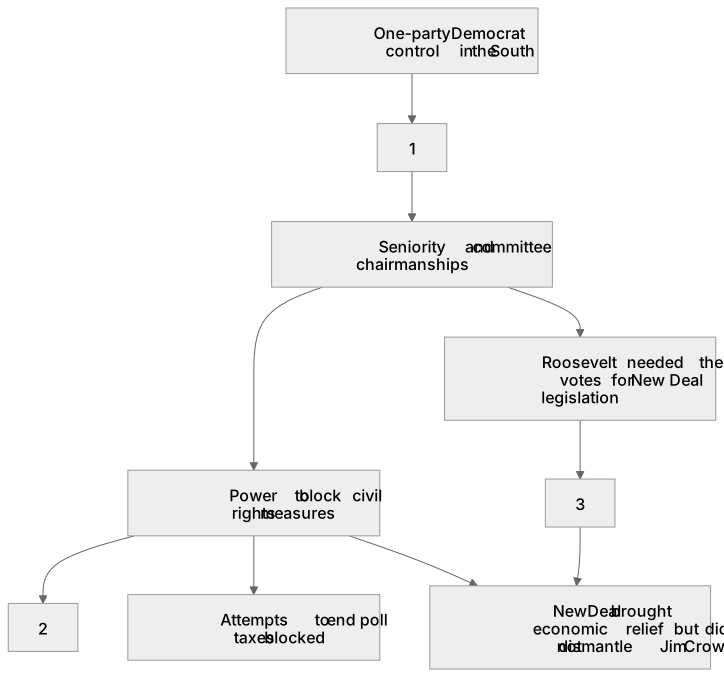
1Box 1
2Box 2
3Box 3
There is more to this lesson
The full lesson goes on to check your understanding and help you earn the marks. Create a free account to carry on, with your progress saved.
A week of Premium from your first lesson · Then the free plan continues · No card, no charge
Test your understanding of Paper 3, Option 39.1: Civil rights and race relations in the USA, 1850–2009 - 3 The New Deal and race relations, 1933–41: The influence of southern whites in the Democrat Party.
Active recall beats re-reading. Take an instant quiz now to test what you’ve learned and lock it into long-term memory.
A week of Premium from your first lesson · Then the free plan continues · No card, no charge