Pearson Edexcel · A-Level · History
Course version: 9HI0 · Version from Sept 2015
Civil rights and race relations in the USA, 1850–2009 - 5 Obama's campaign…
Full specification wording
Paper 3, Option 39.1: Civil rights and race relations in the USA, 1850–2009 - 5 Obama's campaign for the presidency, 2004–09: The reasons for victory in November 2008; the significance of his victory and the response to it of black Americans.
Obama's November 2008 victory rested on a coalition of African Americans, young voters, Latinos, women and independents, plus a well-funded grassroots campaign that exploited social media and…
Checked against the Pearson Edexcel 9HI0 specification (opens in a new tab) on .
- Point 3 of 3
Study notes
From the checked teaching notes for this specification point.
The idea
Obama's November 2008 victory rested on a coalition of African Americans, young voters, Latinos, women and independents, plus a well-funded grassroots campaign that exploited social media and small donations. He won key swing states such as Ohio, Florida and Virginia, benefiting from the Iraq War's unpopularity, the financial crisis and Bush's low approval. His victory was significant as the first Black president, a symbolic milestone in civil rights, yet it did not end racial inequality. Black American responses were largely celebratory, with high turnout and emotional scenes, but some expressed scepticism about whether his presidency would address systemic racism. Historians debate whether his win marked a post-racial era or masked persistent disparities.
What earns the marks
- Explains the reasons for Obama's victory: grassroots organisation, fundraising, social media, coalition-building, and the political context of the Iraq War and 2008 financial crisis.
- Assesses the significance of the victory: first African American president, symbolic breakthrough, impact on civil rights narratives, and limits in addressing structural racism.
- Analyses the response of black Americans: high voter turnout, emotional celebrations, pride, but also scepticism and debate over whether his presidency would tackle racial inequality.
- Uses specific evidence such as the 2008 election results, key swing states, and contemporary reactions from black communities and leaders.
- Evaluates different interpretations of the victory's significance, including post-racial claims versus persistent racial disparities.
Common mistakes and how to put them right
Treating Obama's victory as solely due to his race.
Put it right: Explain the multiple factors, including campaign strategy, economic context, and coalition politics.
Assuming all black Americans responded uniformly with celebration.
Put it right: Acknowledge diverse reactions, including scepticism and criticism.
Overstating the significance as the end of racism.
Put it right: Balance symbolic importance with evidence of ongoing inequality.
Exam tips
- Plan your answer to cover reasons, significance, and black American responses in separate paragraphs to ensure all parts of the question are addressed.
- Use precise evidence, such as specific swing states won or statistics on black voter turnout, to support your arguments.
- Engage with historical interpretations to show analysis, for example by contrasting views on whether the victory was a turning point.
Try the lesson
The start of the Paper 3, Option 39.1: Civil rights and race relations in the USA, 1850–2009 - 5 Obama's campaign for the presidency, 2004–09: The reasons for victory in November 2008; the significance of his victory and the response to it of black Americans. lesson, made from checked teaching notes for this specification point.
Have a go first
Which factor was a significant reason for Barack Obama's victory in the November 2008 presidential election?
Listen
Obama's November 2008 victory rested on a coalition of African Americans, young voters, Latinos, women and independents, plus a well-funded grassroots campaign that exploited social media and small donations. He won key swing states such as Ohio, Florida and Virginia, benefiting from the Iraq War's unpopularity, the financial crisis and Bush's low approval. His victory was significant as the first Black president, a symbolic milestone in civil rights, yet it did not end racial inequality. Black American responses were largely celebratory, with high turnout and emotional scenes, but some expressed scepticism about whether his presidency would address systemic racism. Historians debate whether his win marked a post-racial era or masked persistent disparities. A strong answer earns marks for these points. Explains the reasons for Obama's victory: grassroots organisation, fundraising, social media, coalition-building, and the political context of the Iraq War and 2008 financial crisis. Assesses the significance of the victory: first African American president, symbolic breakthrough, impact on civil rights narratives, and limits in addressing structural racism. Analyses the response of black Americans: high voter turnout, emotional celebrations, pride, but also scepticism and debate over whether his presidency would tackle racial inequality. Uses specific evidence such as the 2008 election results, key swing states, and contemporary reactions from black communities and leaders. A common slip: Treating Obama's victory as solely due to his race. Instead, Explain the multiple factors, including campaign strategy, economic context, and coalition politics. Exam tip: Plan your answer to cover reasons, significance, and black American responses in separate paragraphs to ensure all parts of the question are addressed.
See it
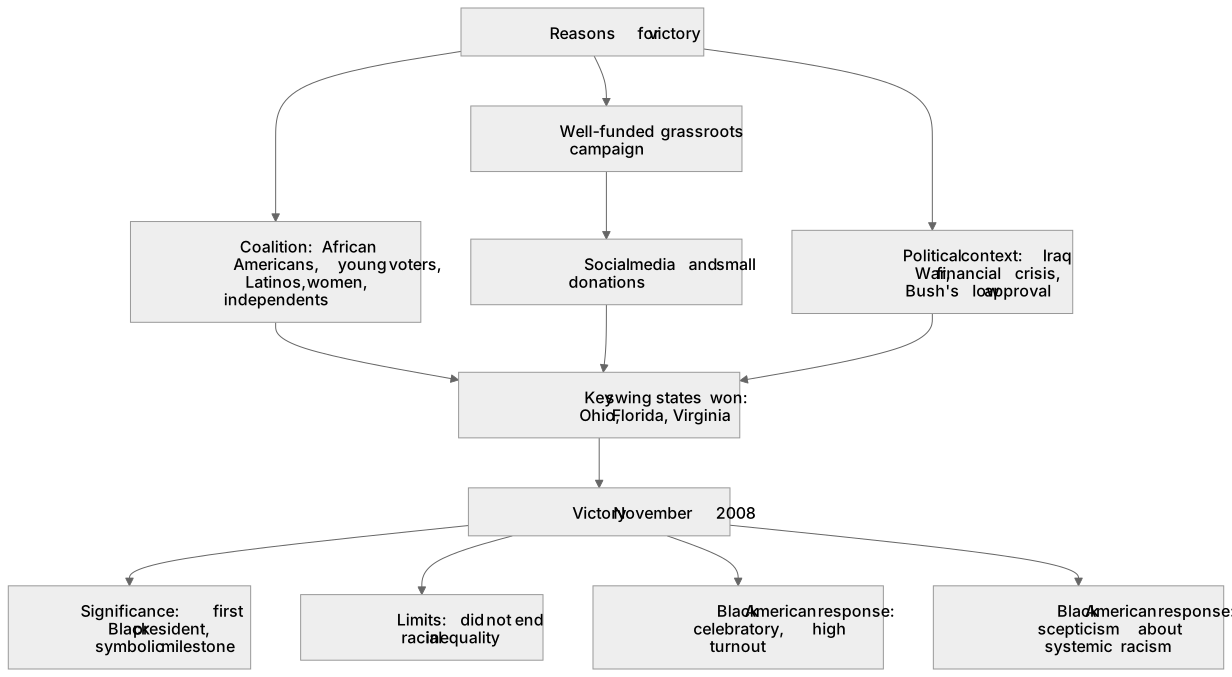
Label the diagram
Some boxes have lost their names. Pick the right name for each number.
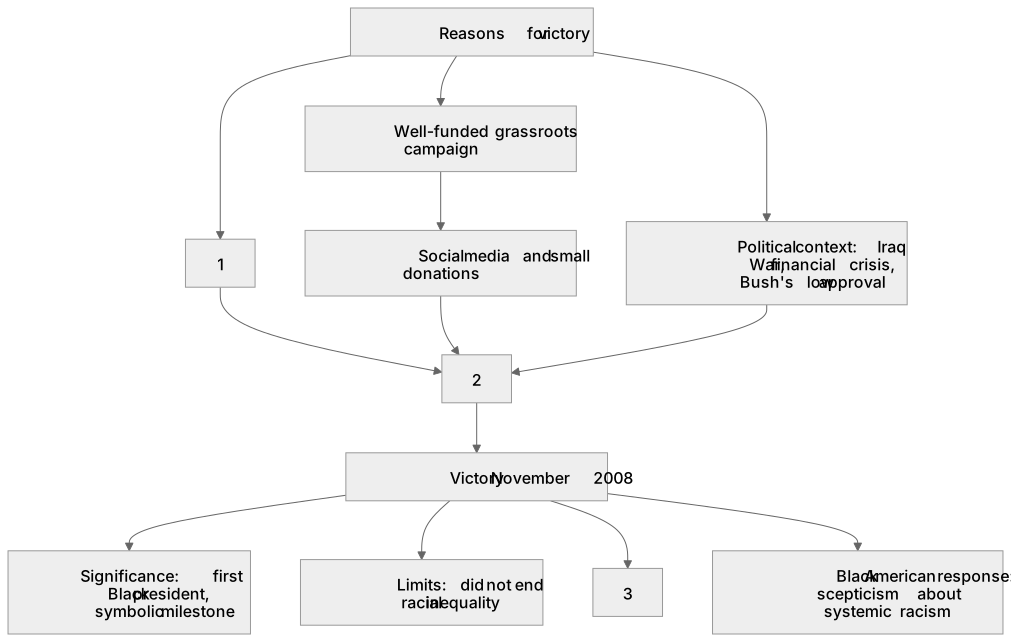
1Box 1
2Box 2
3Box 3
There is more to this lesson
The full lesson goes on to check your understanding and help you earn the marks. Create a free account to carry on, with your progress saved.
A week of Premium from your first lesson · Then the free plan continues · No card, no charge
Test your understanding of Paper 3, Option 39.1: Civil rights and race relations in the USA, 1850–2009 - 5 Obama's campaign for the presidency, 2004–09: The reasons for victory in November 2008; the significance of his victory and the response to it of black Americans.
Active recall beats re-reading. Take an instant quiz now to test what you’ve learned and lock it into long-term memory.
A week of Premium from your first lesson · Then the free plan continues · No card, no charge