Pearson Edexcel · A-Level · History
Course version: 9HI0 · Version from Sept 2015
Mass media and social change in Britain, 1882–2004 - 1 Changing patterns…
Full specification wording
Paper 3, Option 39.2: Mass media and social change in Britain, 1882–2004 - 1 Changing patterns of women’s lives within the family and in the world of work: Changes to women’s personal lives, 1882–2004 (key developments: the Married Women’s Property Act 1882, Marie Stopes’ family-planning clinics from 1921, the NHS 1948, the contraceptive pill from 1961, the Abortion Law Reform Act 1967, the end of the ‘composite tax system’ 1991, the first ‘Take our Daughters to Work’ day 1994); the reasons for, and impact of, government legislation and shifts in attitudes to women’s roles.
Between 1882 and 2004, women's personal lives were transformed by legal, medical and social changes.
Checked against the Pearson Edexcel 9HI0 specification (opens in a new tab) on .
- Point 1 of 2
- 4 key terms
Study notes
From the checked teaching notes for this specification point.
The idea
Between 1882 and 2004, women's personal lives were transformed by legal, medical and social changes. The Married Women's Property Act 1882 allowed women to own property separately. Marie Stopes opened family-planning clinics from 1921, aiding reproductive control. The NHS in 1948 provided free healthcare, improving maternal care. The contraceptive pill from 1961 enabled family planning. The Abortion Law Reform Act 1967 legalised abortion in certain cases. The end of the 'composite tax system' in 1991 allowed married women to receive savings interest without tax deducted at source, following 1990's independent taxation. The first 'Take our Daughters to Work' day in 1994 challenged gender stereotypes. These changes resulted from government legislation and shifting attitudes, impacting women's roles in family and work by increasing autonomy and workforce participation.
What earns the marks
- Analyses the reasons for these changes, including government legislation, medical advances, and shifts in public attitudes to women's roles.
- Assesses the impact of these changes on women's personal lives, such as increased control over property, reproduction, and taxation (e.g. receiving savings interest gross), and greater participation in work.
- Uses specific evidence and dates to support arguments about continuity and change over the period.
- Evaluates the extent to which legislation and attitudes interacted to change women's lives.
Common mistakes and how to put them right
Confusing the dates or details of key developments, such as the Abortion Law Reform Act 1967.
Put it right: Ensure accurate knowledge of each development and its significance.
Confusing the 1990 introduction of independent taxation with the 1991 end of the composite tax system.
Put it right: Note that the 1991 change specifically allowed married women to receive savings interest without tax deducted at source.
Overemphasising legislation without discussing shifts in attitudes.
Put it right: Integrate analysis of both government action and changing social attitudes.
Exam tips
- Create a timeline of the key developments to ensure chronological accuracy in your answer.
- For each development, note both the reasons for it and its impact on women's personal lives and roles.
- Use specific examples, such as the effect of the contraceptive pill on family planning, to illustrate broader changes.
Try the lesson
The start of the Paper 3, Option 39.2: Mass media and social change in Britain, 1882–2004 - 1 Changing patterns of women’s lives within the family and in the world of work: Changes to women’s personal lives, 1882–2004 (key developments: the Married Women’s Property Act 1882, Marie Stopes’ family-planning clinics from 1921, the NHS 1948, the contraceptive pill from 1961, the Abortion Law Reform Act 1967, the end of the ‘composite tax system’ 1991, the first ‘Take our Daughters to Work’ day 1994); the reasons for, and impact of, government legislation and shifts in attitudes to women’s roles. lesson, made from checked teaching notes for this specification point.
Have a go first
What was the primary legal impact of the 1882 legislation concerning the financial status of married women in Britain?
Listen
Between 1882 and 2004, women's personal lives were transformed by legal, medical and social changes. The Married Women's Property Act 1882 allowed women to own property separately. Marie Stopes opened family-planning clinics from 1921, aiding reproductive control. The NHS in 1948 provided free healthcare, improving maternal care. The contraceptive pill from 1961 enabled family planning. The Abortion Law Reform Act 1967 legalised abortion in certain cases. The end of the 'composite tax system' in 1991 allowed married women to receive savings interest without tax deducted at source, following 1990's independent taxation. The first 'Take our Daughters to Work' day in 1994 challenged gender stereotypes. These changes resulted from government legislation and shifting attitudes, impacting women's roles in family and work by increasing autonomy and workforce participation. A strong answer earns marks for these points. Explains the key developments: Married Women's Property Act 1882, Stopes' clinics from 1921, NHS 1948, contraceptive pill from 1961, Abortion Law Reform Act 1967, end of composite tax system 1991, and 'Take our Daughters to Work' day 1994. Analyses the reasons for these changes, including government legislation, medical advances, and shifts in public attitudes to women's roles. Assesses the impact of these changes on women's personal lives, such as increased control over property, reproduction, and taxation (e.g. receiving savings interest gross), and greater participation in work. Uses specific evidence and dates to support arguments about continuity and change over the period. A common slip: Confusing the dates or details of key developments, such as the Abortion Law Reform Act 1967. Instead, Ensure accurate knowledge of each development and its significance. Exam tip: Create a timeline of the key developments to ensure chronological accuracy in your answer.
See it
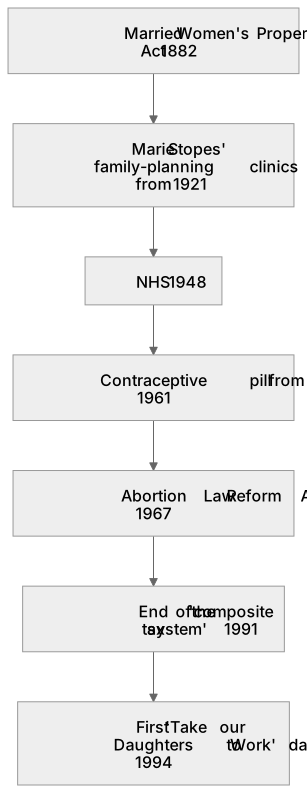
Put it in order
Put these steps in the order they happen.
- 1. First 'Take our Daughters to Work' day 1994
- 2. End of the 'composite tax system' 1991
- 3. NHS 1948
- 4. Abortion Law Reform Act 1967
- 5. Married Women's Property Act 1882
- 6. Marie Stopes' family-planning clinics from 1921
- 7. Contraceptive pill from 1961
Put the events in order
Put these events in the order they happened, earliest first.
- 1. The NHS provided free healthcare, improving maternal care
- 2. The contraceptive pill enabled family planning
- 3. The Abortion Law Reform Act legalised abortion in certain cases
- 4. Marie Stopes opened family-planning clinics
- 5. Married Women's Property Act allowed women to own property separately
- 6. The end of the composite tax system
Key words
Say what each word means before you turn the card.
Legal rights and property ownership
Try answering aloud or in your head before turning the card.
Reproductive rights and healthcare
Try answering aloud or in your head before turning the card.
Economic independence and taxation
Try answering aloud or in your head before turning the card.
Changing gender roles and workplace participation
Try answering aloud or in your head before turning the card.
See every definition
- Legal rights and property ownership
- The Married Women's Property Act 1882 allowed women to own property separately, increasing control over property.
- Reproductive rights and healthcare
- Marie Stopes opened family-planning clinics from 1921, the NHS in 1948 provided free healthcare, the contraceptive pill from 1961 enabled family planning and the Abortion Law Reform Act 1967 legalised abortion in certain cases.
- Economic independence and taxation
- The end of the 'composite tax system' in 1991 allowed married women to receive savings interest without tax deducted at source, following 1990's independent taxation.
- Changing gender roles and workplace participation
- The first 'Take our Daughters to Work' day in 1994 challenged gender stereotypes, and these changes increased autonomy and workforce participation.
Label the diagram
Some boxes have lost their names. Pick the right name for each number.
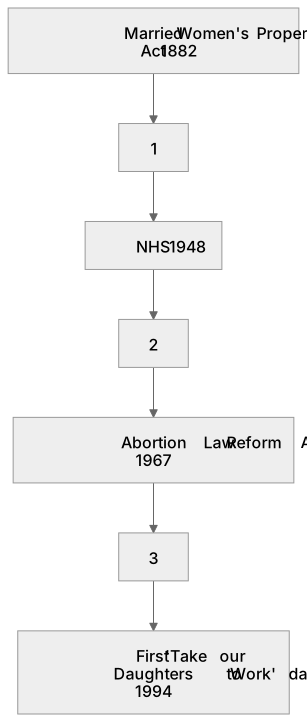
1Box 1
2Box 2
3Box 3
There is more to this lesson
The full lesson goes on to check your understanding and help you earn the marks. Create a free account to carry on, with your progress saved.
A week of Premium from your first lesson · Then the free plan continues · No card, no charge
Test your understanding of Paper 3, Option 39.2: Mass media and social change in Britain, 1882–2004 - 1 Changing patterns of women’s lives within the family and in the world of work: Changes to women’s personal lives, 1882–2004 (key developments: the Married Women’s Property Act 1882, Marie Stopes’ family-planning clinics from 1921, the NHS 1948, the contraceptive pill from 1961, the Abortion Law Reform Act 1967, the end of the ‘composite tax system’ 1991, the first ‘Take our Daughters to Work’ day 1994); the reasons for, and impact of, government legislation and shifts in attitudes to women’s roles.
Active recall beats re-reading. Take an instant quiz now to test what you’ve learned and lock it into long-term memory.
A week of Premium from your first lesson · Then the free plan continues · No card, no charge