Pearson Edexcel · A-Level · History
Course version: 9HI0 · Version from Sept 2015
Mass media and social change in Britain, 1882–2004 - 2 Changing patterns…
Full specification wording
Paper 3, Option 39.2: Mass media and social change in Britain, 1882–2004 - 2 Changing patterns of family leisure: Change and continuity in leisure, 1882–2004: entertainment in the home; changes in excursions and holidays (key developments: the first Butlin’s holiday camp 1936, Holiday Pay Act 1938, foreign package holidays from the 1950s).
Family leisure changed from mainly public, local and class-bound activities in 1882 to more commercial, home-based and global pastimes by 2004.
Checked against the Pearson Edexcel 9HI0 specification (opens in a new tab) on .
- Point 1 of 2
- 4 key terms
Study notes
From the checked teaching notes for this specification point.
The idea
Family leisure changed from mainly public, local and class-bound activities in 1882 to more commercial, home-based and global pastimes by 2004. Entertainment in the home shifted from reading, music-making and later radio to television, video and digital media, altering shared family routines. Excursions and holidays moved from day trips, seaside resorts and works outings towards paid holidays and mass tourism. Butlin’s first camp in 1936 offered affordable organised fun; the Holiday Pay Act 1938 gave many workers paid leave; foreign package holidays from the 1950s made overseas travel accessible. Continuity remained in class, income and regional limits.
What earns the marks
- Explains change in home entertainment: radio, cinema and television gradually replaced or reshaped reading, music-making and communal pastimes.
- Analyses the first Butlin’s holiday camp 1936 as commercial, affordable leisure with organised activities, appealing to working-class families.
- Explains the Holiday Pay Act 1938 as legislation giving many workers paid holidays, increasing demand for excursions and holidays.
- Analyses foreign package holidays from the 1950s: cheaper flights, tour operators and rising affluence made overseas travel more common.
- Assesses continuity: cost, class, gender, region and family duties still restricted leisure choices across the period.
Common mistakes and how to put them right
Assuming the Holiday Pay Act 1938 gave all workers paid holidays immediately.
Put it right by noting coverage varied and entitlement spread unevenly.
Treating television as instantly replacing all other home entertainment.
Put it right by explaining radio, cinema and reading coexisted for years.
Describing foreign package holidays as available to everyone from the 1950s.
Put it right by noting they were initially limited by cost and region.
Exam tips
- Organise answers around home entertainment and holidays, then trace change and continuity within each.
- Use the key developments as evidence of wider trends: commercialisation, affluence and legislation.
- Compare experiences by class, gender and region to show nuanced continuity.
Try the lesson
The start of the Paper 3, Option 39.2: Mass media and social change in Britain, 1882–2004 - 2 Changing patterns of family leisure: Change and continuity in leisure, 1882–2004: entertainment in the home; changes in excursions and holidays (key developments: the first Butlin’s holiday camp 1936, Holiday Pay Act 1938, foreign package holidays from the 1950s). lesson, made from checked teaching notes for this specification point.
Have a go first
In which year was the first Butlin's holiday camp opened?
Listen
Family leisure changed from mainly public, local and class-bound activities in 1882 to more commercial, home-based and global pastimes by 2004. Entertainment in the home shifted from reading, music-making and later radio to television, video and digital media, altering shared family routines. Excursions and holidays moved from day trips, seaside resorts and works outings towards paid holidays and mass tourism. Butlin’s first camp in 1936 offered affordable organised fun; the Holiday Pay Act 1938 gave many workers paid leave; foreign package holidays from the 1950s made overseas travel accessible. Continuity remained in class, income and regional limits. A strong answer earns marks for these points. Explains change in home entertainment: radio, cinema and television gradually replaced or reshaped reading, music-making and communal pastimes. Analyses the first Butlin’s holiday camp 1936 as commercial, affordable leisure with organised activities, appealing to working-class families. Explains the Holiday Pay Act 1938 as legislation giving many workers paid holidays, increasing demand for excursions and holidays. Analyses foreign package holidays from the 1950s: cheaper flights, tour operators and rising affluence made overseas travel more common. A common slip: Assuming the Holiday Pay Act 1938 gave all workers paid holidays immediately. Instead, noting coverage varied and entitlement spread unevenly. Exam tip: Organise answers around home entertainment and holidays, then trace change and continuity within each.
See it

Key words
Say what each word means before you turn the card.
Home entertainment
Try answering aloud or in your head before turning the card.
Paid holidays
Try answering aloud or in your head before turning the card.
Mass tourism
Try answering aloud or in your head before turning the card.
Continuity in leisure constraints
Try answering aloud or in your head before turning the card.
See every definition
- Home entertainment
- Pastimes enjoyed in the home shifted from reading, music-making and later radio to television, video and digital media, altering shared family routines.
- Paid holidays
- The Holiday Pay Act 1938 gave many workers paid leave, increasing demand for excursions and holidays.
- Mass tourism
- Excursions and holidays moved from day trips, seaside resorts and works outings towards paid holidays and mass tourism.
- Continuity in leisure constraints
- Cost, class, gender, region and family duties still restricted leisure choices across the period.
Label the diagram
Some boxes have lost their names. Pick the right name for each number.
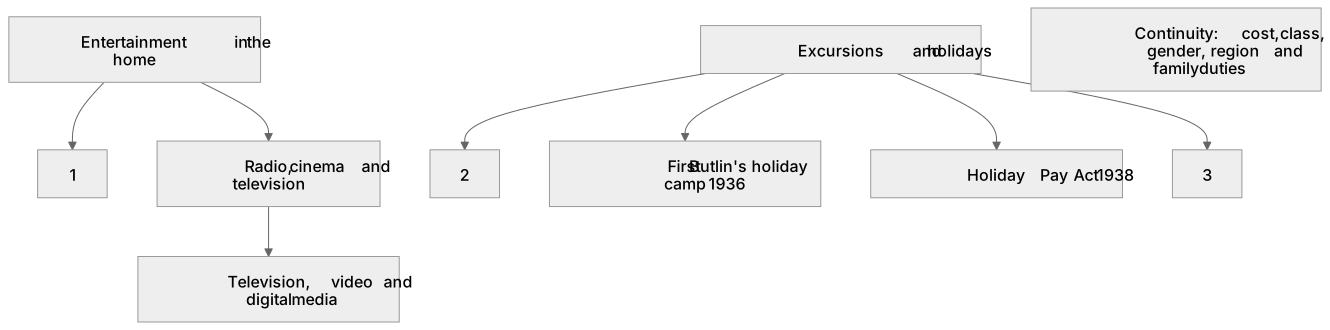
1Box 1
2Box 2
3Box 3
There is more to this lesson
The full lesson goes on to check your understanding and help you earn the marks. Create a free account to carry on, with your progress saved.
A week of Premium from your first lesson · Then the free plan continues · No card, no charge
Test your understanding of Paper 3, Option 39.2: Mass media and social change in Britain, 1882–2004 - 2 Changing patterns of family leisure: Change and continuity in leisure, 1882–2004: entertainment in the home; changes in excursions and holidays (key developments: the first Butlin’s holiday camp 1936, Holiday Pay Act 1938, foreign package holidays from the 1950s).
Active recall beats re-reading. Take an instant quiz now to test what you’ve learned and lock it into long-term memory.
A week of Premium from your first lesson · Then the free plan continues · No card, no charge