Pearson Edexcel · A-Level · History
Course version: 9HI0 · Version from Sept 2015
Mass media and social change in Britain, 1882–2004 - 2 Wireless and the…
Full specification wording
Paper 3, Option 39.2: Mass media and social change in Britain, 1882–2004 - 2 Wireless and the war: propaganda, information and entertainment, 1939-45: Reporting the war: the impact of broadcasts from the front; Churchill’s speeches on the BBC and his relationship with the Corporation; the nature of censorship.
This topic examines how the Second World War was reported to British listeners.
Checked against the Pearson Edexcel 9HI0 specification (opens in a new tab) on .
- Point 1 of 3
- 3 key terms
Study notes
From the checked teaching notes for this specification point.
The idea
This topic examines how the Second World War was reported to British listeners. Broadcasts from the front, using mobile recording units and correspondents such as Richard Dimbleby, brought battle sounds and eyewitness description into homes, making war immediate and shaping public feeling. Churchill used the BBC for major speeches, yet his relationship with the Corporation was wary: he wanted his voice heard but distrusted its independence and sometimes bypassed or pressured it. Censorship operated through government departments, voluntary agreements and the BBC’s own checks, delaying or removing details of operations, losses and locations. Study these three strands together, asking how each affected trust in wartime broadcasting.
What earns the marks
- Explains how front-line broadcasts changed reporting by adding immediacy, eyewitness testimony and actuality sound, and assesses their impact on listeners’ understanding and emotion.
- Analyses Churchill’s use of BBC broadcasts for major speeches and how this projected leadership, while noting his suspicion of the Corporation’s independence and his attempts to influence output.
- Examines the nature of censorship: who applied it, what was withheld or delayed, and how it balanced security against public information and morale.
- Evaluates the relationship between the BBC, government and public trust, using specific wartime examples and considering change over the course of the war.
Common mistakes and how to put them right
Treating all wartime reporting as simple propaganda.
Put it right: Distinguish censorship, which restricts information, from propaganda, which promotes a message, and show how the BBC combined both with factual reporting.
Assuming Churchill controlled the BBC directly.
Put it right: Explain that he could pressure and broadcast, but the Corporation retained editorial structures and negotiated with government ministries.
Describing censorship as only a BBC activity.
Put it right: Identify the roles of government departments, military authorities and voluntary press and broadcast agreements alongside the BBC’s own checks.
Exam tips
- Link each strand to the option’s theme of mass media and social change, not just to military history.
- Use named broadcasts, speeches or censorship episodes as evidence, and explain their significance rather than listing them.
- When discussing Churchill, separate his public broadcasts from his private dealings with the Corporation to show the relationship’s complexity.
Try the lesson
The start of the Paper 3, Option 39.2: Mass media and social change in Britain, 1882–2004 - 2 Wireless and the war: propaganda, information and entertainment, 1939-45: Reporting the war: the impact of broadcasts from the front; Churchill’s speeches on the BBC and his relationship with the Corporation; the nature of censorship. lesson, made from checked teaching notes for this specification point.
Have a go first
Which of the following best describes Winston Churchill's relationship with the BBC during the Second World War?
Listen
This topic examines how the Second World War was reported to British listeners. Broadcasts from the front, using mobile recording units and correspondents such as Richard Dimbleby, brought battle sounds and eyewitness description into homes, making war immediate and shaping public feeling. Churchill used the BBC for major speeches, yet his relationship with the Corporation was wary: he wanted his voice heard but distrusted its independence and sometimes bypassed or pressured it. Censorship operated through government departments, voluntary agreements and the BBC’s own checks, delaying or removing details of operations, losses and locations. Study these three strands together, asking how each affected trust in wartime broadcasting. A strong answer earns marks for these points. Explains how front-line broadcasts changed reporting by adding immediacy, eyewitness testimony and actuality sound, and assesses their impact on listeners’ understanding and emotion. Analyses Churchill’s use of BBC broadcasts for major speeches and how this projected leadership, while noting his suspicion of the Corporation’s independence and his attempts to influence output. Examines the nature of censorship: who applied it, what was withheld or delayed, and how it balanced security against public information and morale. Evaluates the relationship between the BBC, government and public trust, using specific wartime examples and considering change over the course of the war. A common slip: Treating all wartime reporting as simple propaganda. Instead, distinguish censorship, which restricts information, from propaganda, which promotes a message, and show how the BBC combined both with factual reporting. Exam tip: Link each strand to the option’s theme of mass media and social change, not just to military history.
See it
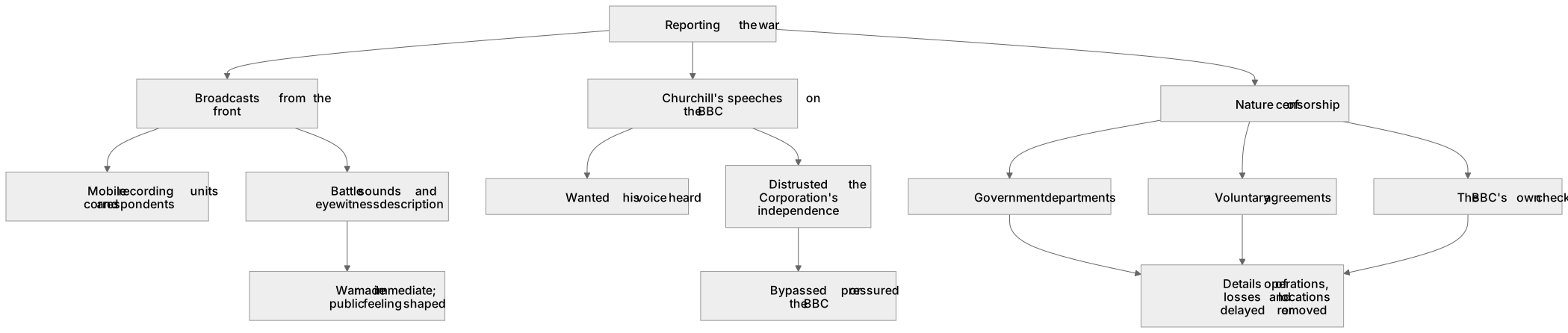
Key words
Say what each word means before you turn the card.
Broadcasts from the front
Try answering aloud or in your head before turning the card.
Churchill’s relationship with the BBC
Try answering aloud or in your head before turning the card.
Censorship
Try answering aloud or in your head before turning the card.
See every definition
- Broadcasts from the front
- Reporting that used mobile recording units and correspondents to bring battle sounds and eyewitness description into homes, making war immediate and shaping public feeling.
- Churchill’s relationship with the BBC
- A wary relationship in which he wanted his voice heard but distrusted the Corporation’s independence and sometimes bypassed or pressured it.
- Censorship
- Operated through government departments, voluntary agreements and the BBC’s own checks, delaying or removing details of operations, losses and locations.
Label the diagram
Some boxes have lost their names. Pick the right name for each number.
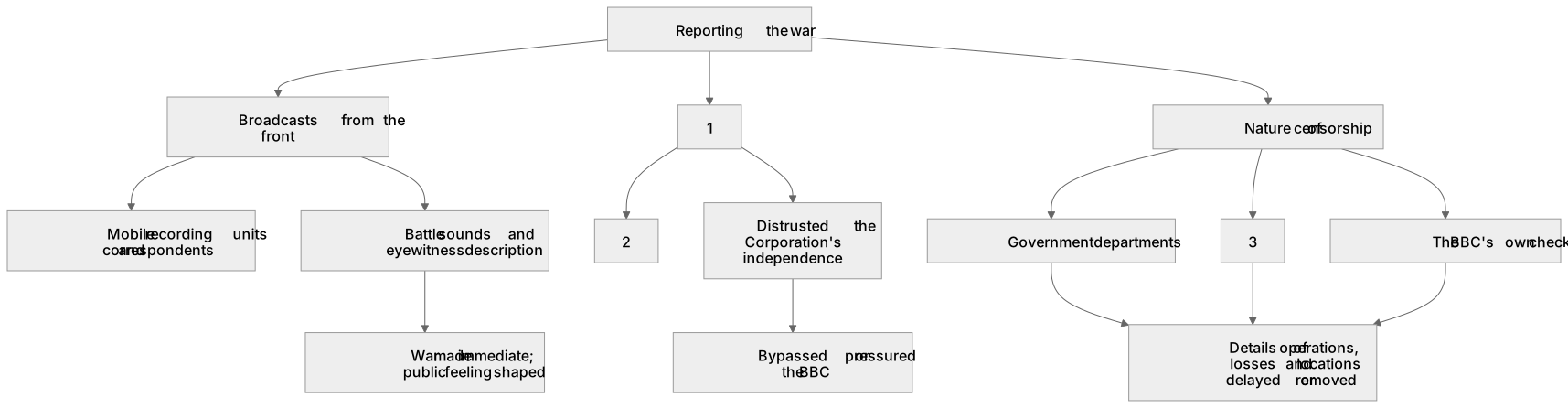
1Box 1
2Box 2
3Box 3
There is more to this lesson
The full lesson goes on to check your understanding and help you earn the marks. Create a free account to carry on, with your progress saved.
A week of Premium from your first lesson · Then the free plan continues · No card, no charge
Test your understanding of Paper 3, Option 39.2: Mass media and social change in Britain, 1882–2004 - 2 Wireless and the war: propaganda, information and entertainment, 1939-45: Reporting the war: the impact of broadcasts from the front; Churchill’s speeches on the BBC and his relationship with the Corporation; the nature of censorship.
Active recall beats re-reading. Take an instant quiz now to test what you’ve learned and lock it into long-term memory.
A week of Premium from your first lesson · Then the free plan continues · No card, no charge