Pearson Edexcel · A-Level · History
Course version: 9HI0 · Version from Sept 2015
Mass media and social change in Britain, 1882–2004 - 2 Wireless and the…
Full specification wording
Paper 3, Option 39.2: Mass media and social change in Britain, 1882–2004 - 2 Wireless and the war: propaganda, information and entertainment, 1939-45: The impact of propaganda broadcasts: the role of Lord Haw Haw and Sefton Delmer.
This topic examines how radio propaganda affected British audiences during the Second World War through two contrasting figures.
Checked against the Pearson Edexcel 9HI0 specification (opens in a new tab) on .
- Point 3 of 3
- 3 key terms
Study notes
From the checked teaching notes for this specification point.
The idea
This topic examines how radio propaganda affected British audiences during the Second World War through two contrasting figures. Lord Haw Haw, William Joyce, broadcast from Germany to Britain; his sneering, traitorous persona was designed to undermine morale, but many listeners tuned in for entertainment or curiosity, and his impact was arguably limited and sometimes counterproductive. Sefton Delmer, a British journalist, ran black propaganda for the Political Warfare Executive, creating stations such as Gustav Siegfried Eins and Soldatensender Calais that mimicked German radio to confuse and demoralise enemy troops. Studying their roles requires assessing intended and actual effects on both British and German audiences, using evidence of listening figures, contemporary reactions and official concerns. The key skill is evaluating impact rather than merely describing broadcasts.
What earns the marks
- Explains the nature and purpose of Lord Haw Haw's broadcasts from Germany to Britain, including their intended effect on British morale.
- Assesses the actual impact of Lord Haw Haw on British audiences, noting limited effect, curiosity value and possible counterproductive reactions.
- Explains Sefton Delmer's role in British black propaganda, including the creation of stations such as Gustav Siegfried Eins and Soldatensender Calais.
- Evaluates the impact of Delmer's broadcasts on German audiences and the extent to which they achieved their aims.
- Compares the two figures' approaches and effects, showing how each illustrates different uses and limitations of propaganda radio.
- Uses specific evidence, such as listener reactions, official records or broadcast content, to support judgements about impact.
Common mistakes and how to put them right
Treating Lord Haw Haw as uniformly effective in undermining British morale.
Put it right: Recognise that many listened for entertainment or curiosity and that his impact was limited and sometimes counterproductive.
Confusing Sefton Delmer's black propaganda with straightforward British government broadcasting.
Put it right: Explain that Delmer's stations posed as German outlets to deceive enemy listeners.
Describing broadcasts without evaluating their impact.
Put it right: Focus on intended versus actual effects and use evidence to judge significance.
Assuming all propaganda was aimed at the same audience.
Put it right: Distinguish between broadcasts to British civilians and those to German military or civilian audiences.
Exam tips
- Plan your answer around the concept of impact, ensuring each paragraph addresses effects on audiences rather than just describing broadcast content.
- Use precise examples, such as named stations or specific broadcast themes, to support your evaluation of Lord Haw Haw and Sefton Delmer.
- Compare the two figures explicitly to show how their roles illuminate different aspects of propaganda's effectiveness.
- Avoid unsupported generalisations; link claims about impact to evidence such as listener figures, contemporary reports or official responses.
Try the lesson
The start of the Paper 3, Option 39.2: Mass media and social change in Britain, 1882–2004 - 2 Wireless and the war: propaganda, information and entertainment, 1939-45: The impact of propaganda broadcasts: the role of Lord Haw Haw and Sefton Delmer. lesson, made from checked teaching notes for this specification point.
Have a go first
Which broadcaster became notorious in Britain for making propaganda broadcasts from Germany during the Second World War?
Listen
This topic examines how radio propaganda affected British audiences during the Second World War through two contrasting figures. Lord Haw Haw, William Joyce, broadcast from Germany to Britain; his sneering, traitorous persona was designed to undermine morale, but many listeners tuned in for entertainment or curiosity, and his impact was arguably limited and sometimes counterproductive. Sefton Delmer, a British journalist, ran black propaganda for the Political Warfare Executive, creating stations such as Gustav Siegfried Eins and Soldatensender Calais that mimicked German radio to confuse and demoralise enemy troops. Studying their roles requires assessing intended and actual effects on both British and German audiences, using evidence of listening figures, contemporary reactions and official concerns. The key skill is evaluating impact rather than merely describing broadcasts. A strong answer earns marks for these points. Explains the nature and purpose of Lord Haw Haw's broadcasts from Germany to Britain, including their intended effect on British morale. Assesses the actual impact of Lord Haw Haw on British audiences, noting limited effect, curiosity value and possible counterproductive reactions. Explains Sefton Delmer's role in British black propaganda, including the creation of stations such as Gustav Siegfried Eins and Soldatensender Calais. Evaluates the impact of Delmer's broadcasts on German audiences and the extent to which they achieved their aims. A common slip: Treating Lord Haw Haw as uniformly effective in undermining British morale. Instead, recognise that many listened for entertainment or curiosity and that his impact was limited and sometimes counterproductive. Exam tip: Plan your answer around the concept of impact, ensuring each paragraph addresses effects on audiences rather than just describing broadcast content.
See it
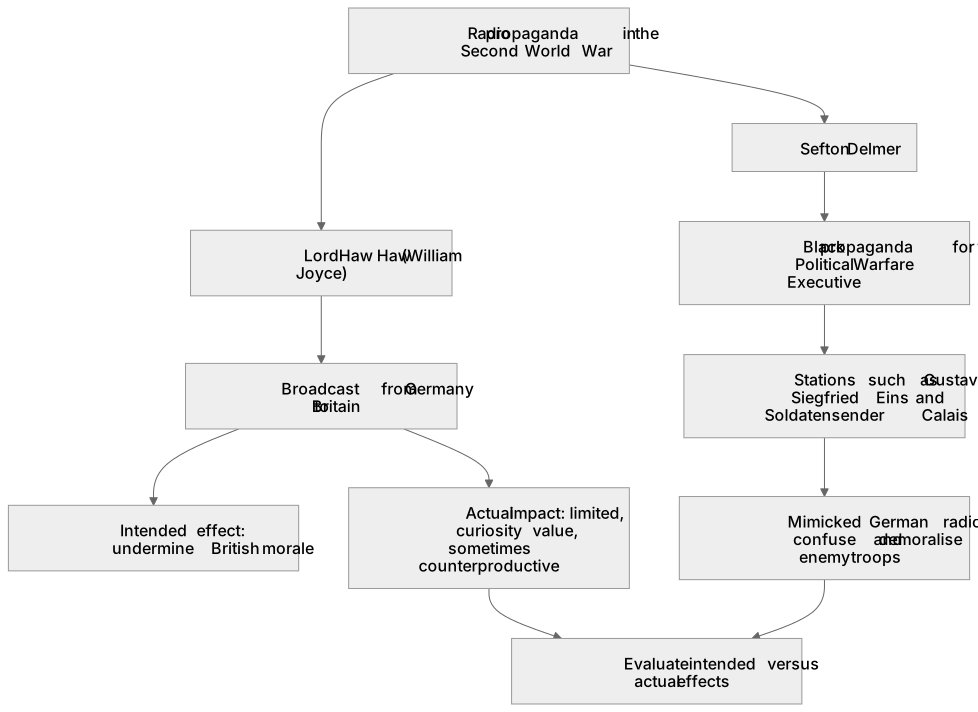
Key words
Say what each word means before you turn the card.
Black propaganda
Try answering aloud or in your head before turning the card.
Lord Haw Haw
Try answering aloud or in your head before turning the card.
Sefton Delmer
Try answering aloud or in your head before turning the card.
See every definition
- Black propaganda
- Propaganda that poses as an enemy outlet in order to deceive enemy listeners, as in the stations created by Sefton Delmer.
- Lord Haw Haw
- William Joyce, who broadcast from Germany to Britain with a sneering, traitorous persona designed to undermine morale.
- Sefton Delmer
- A British journalist who ran black propaganda for the Political Warfare Executive, creating stations that mimicked German radio.
Label the diagram
Some boxes have lost their names. Pick the right name for each number.
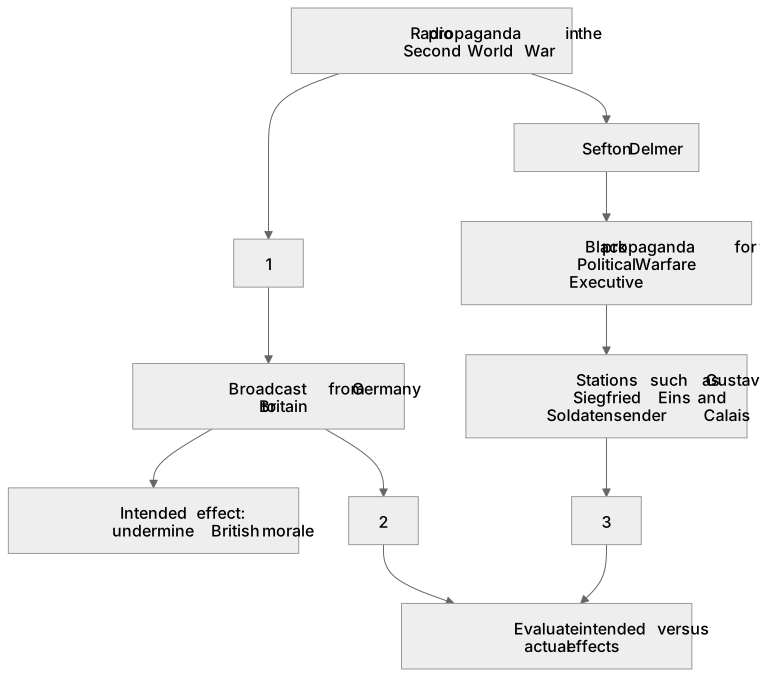
1Box 1
2Box 2
3Box 3
There is more to this lesson
The full lesson goes on to check your understanding and help you earn the marks. Create a free account to carry on, with your progress saved.
A week of Premium from your first lesson · Then the free plan continues · No card, no charge
Test your understanding of Paper 3, Option 39.2: Mass media and social change in Britain, 1882–2004 - 2 Wireless and the war: propaganda, information and entertainment, 1939-45: The impact of propaganda broadcasts: the role of Lord Haw Haw and Sefton Delmer.
Active recall beats re-reading. Take an instant quiz now to test what you’ve learned and lock it into long-term memory.
A week of Premium from your first lesson · Then the free plan continues · No card, no charge