Pearson Edexcel · A-Level · History
Course version: 9HI0 · Version from Sept 2015
Mass media and social change in Britain, 1882–2004 - 4 The Thatcher…
Full specification wording
Paper 3, Option 39.2: Mass media and social change in Britain, 1882–2004 - 4 The Thatcher governments and the media, 1979–90: The principles underpinning the Thatcher governments’ policies and their significance for the media industry.
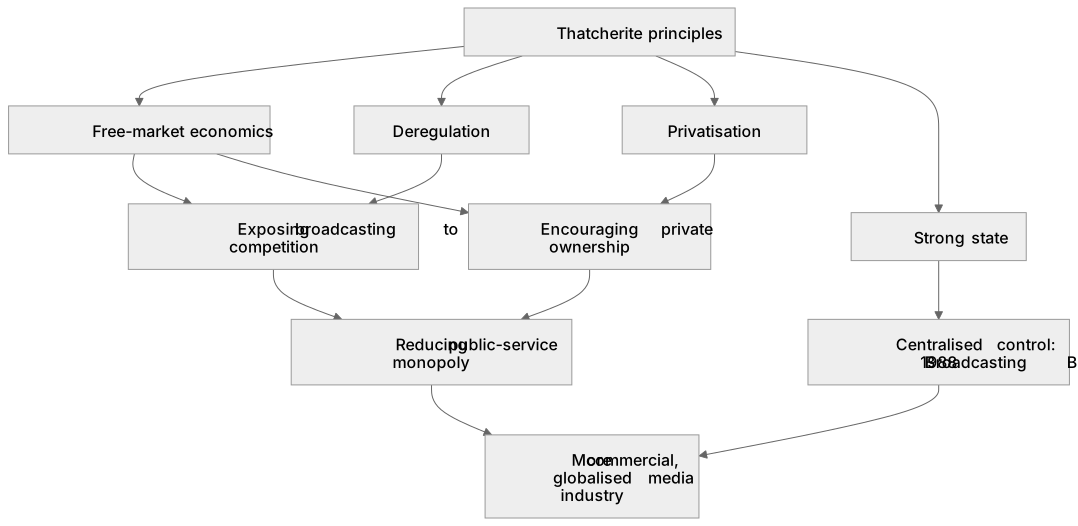
Thatcherism combined free-market economics, deregulation, privatisation, and a strong state.
Checked against the Pearson Edexcel 9HI0 specification (opens in a new tab) on .
- Point 1 of 3
- 4 key terms
Study notes
From the checked teaching notes for this specification point.
The idea
Thatcherism combined free-market economics, deregulation, privatisation, and a strong state. For media, these principles meant exposing broadcasting to competition, encouraging private ownership, and reducing public-service monopoly. Example: the 1984 Cable and Broadcasting Act and the Peacock Committee (1986) reflected faith in market forces. Significance: ITV franchises were auctioned, independent production grew, and satellite broadcasting expanded. Yet the state also centralised control, as seen in the 1988 Broadcasting Ban. Thus Thatcherism both liberalised and regulated the media, shaping a more commercial, globalised industry.
What earns the marks
- Explains core Thatcherite principles: free markets, deregulation, privatisation, and rollback of state ownership.
- Links these principles to specific media policies, such as the 1984 Cable and Broadcasting Act, the Peacock Committee, and the 1990 Broadcasting Act.
- Assesses significance for the media industry: increased competition, commercialisation, and the rise of satellite and cable services.
- Evaluates the paradox of deregulation alongside increased state control, for example the 1988 broadcasting ban on Sinn Féin and other organisations.
- Uses precise historical examples to support arguments about the impact on public-service broadcasting and press ownership.
Common mistakes and how to put them right
Treating Thatcherism as only about deregulation, ignoring its strong-state elements.
Put it right by noting both market liberalisation and centralised control.
Confusing the Peacock Committee with the Pilkington Committee.
Put it right by remembering Peacock reported in 1986 and favoured competition in broadcasting.
Assuming the 1990 Broadcasting Act was purely deregulatory.
Put it right by recognising it also tightened ownership rules and introduced a light-touch regulator, the ITC.
Exam tips
- Define Thatcherite principles briefly, then spend most of the essay analysing their consequences for media ownership, regulation, and content.
- Use specific legislation and reports as evidence, but always explain how they reflect or contradict Thatcherite principles.
- Address both the liberalising and controlling aspects of Thatcherite media policy to reach a balanced judgement.
Try the lesson
The start of the Paper 3, Option 39.2: Mass media and social change in Britain, 1882–2004 - 4 The Thatcher governments and the media, 1979–90: The principles underpinning the Thatcher governments’ policies and their significance for the media industry. lesson, made from checked teaching notes for this specification point.
Have a go first
Which principle is most closely associated with the Thatcher governments' approach to the media industry between 1979 and 1990?
Listen
Thatcherism combined free-market economics, deregulation, privatisation, and a strong state. For media, these principles meant exposing broadcasting to competition, encouraging private ownership, and reducing public-service monopoly. Example: the 1984 Cable and Broadcasting Act and the Peacock Committee (1986) reflected faith in market forces. Significance: ITV franchises were auctioned, independent production grew, and satellite broadcasting expanded. Yet the state also centralised control, as seen in the 1988 Broadcasting Ban. Thus Thatcherism both liberalised and regulated the media, shaping a more commercial, globalised industry. A strong answer earns marks for these points. Explains core Thatcherite principles: free markets, deregulation, privatisation, and rollback of state ownership. Links these principles to specific media policies, such as the 1984 Cable and Broadcasting Act, the Peacock Committee, and the 1990 Broadcasting Act. Assesses significance for the media industry: increased competition, commercialisation, and the rise of satellite and cable services. Evaluates the paradox of deregulation alongside increased state control, for example the 1988 broadcasting ban on Sinn Féin and other organisations. A common slip: Treating Thatcherism as only about deregulation, ignoring its strong-state elements. Instead, noting both market liberalisation and centralised control. Exam tip: Define Thatcherite principles briefly, then spend most of the essay analysing their consequences for media ownership, regulation, and content.
See it
Put the events in order
Put these events in the order they happened, earliest first.
- 1. Broadcasting Act tightened ownership rules and introduced light-touch regulator
- 2. Cable and Broadcasting Act reflected faith in market forces
- 3. Broadcasting Ban showed centralised state control
- 4. Peacock Committee favoured competition in broadcasting
Key words
Say what each word means before you turn the card.
Deregulation and market competition
Try answering aloud or in your head before turning the card.
Privatisation and private ownership
Try answering aloud or in your head before turning the card.
Public-service broadcasting under pressure
Try answering aloud or in your head before turning the card.
State control and censorship
Try answering aloud or in your head before turning the card.
See every definition
- Deregulation and market competition
- Exposing broadcasting to competition and reducing public-service monopoly, reflecting faith in market forces.
- Privatisation and private ownership
- Encouraging private ownership as part of Thatcherism's free-market economics and rollback of state ownership.
- Public-service broadcasting under pressure
- Reducing public-service monopoly by exposing broadcasting to competition and encouraging private ownership.
- State control and censorship
- A strong state centralising control, as seen in the 1988 Broadcasting Ban.
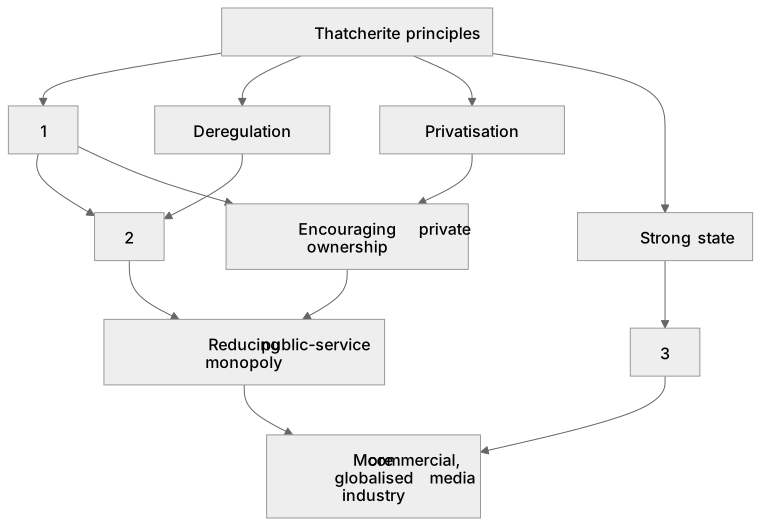
Label the diagram
Some boxes have lost their names. Pick the right name for each number.
1Box 1
2Box 2
3Box 3
There is more to this lesson
The full lesson goes on to check your understanding and help you earn the marks. Create a free account to carry on, with your progress saved.
A week of Premium from your first lesson · Then the free plan continues · No card, no charge
Test your understanding of Paper 3, Option 39.2: Mass media and social change in Britain, 1882–2004 - 4 The Thatcher governments and the media, 1979–90: The principles underpinning the Thatcher governments’ policies and their significance for the media industry.
Active recall beats re-reading. Take an instant quiz now to test what you’ve learned and lock it into long-term memory.
A week of Premium from your first lesson · Then the free plan continues · No card, no charge