Pearson Edexcel · A-Level · History
Course version: 9HI0 · Version from Sept 2015
Mass media and social change in Britain, 1882–2004 - 5 The Labour…
Full specification wording
Paper 3, Option 39.2: Mass media and social change in Britain, 1882–2004 - 5 The Labour government versus the media: the problem of the Iraq dossiers, 2002–04: The impact of dossier claims and the press briefing of February 2003; reportage in the media; the impact of the Channel 4 investigation into the accuracy of the dossiers.
This topic examines the impact of the Iraq dossiers, the February 2003 press briefing, media reportage, and the Channel 4 investigation.
Checked against the Pearson Edexcel 9HI0 specification (opens in a new tab) on .
- Point 1 of 3
- 4 key terms
Study notes
From the checked teaching notes for this specification point.
The idea
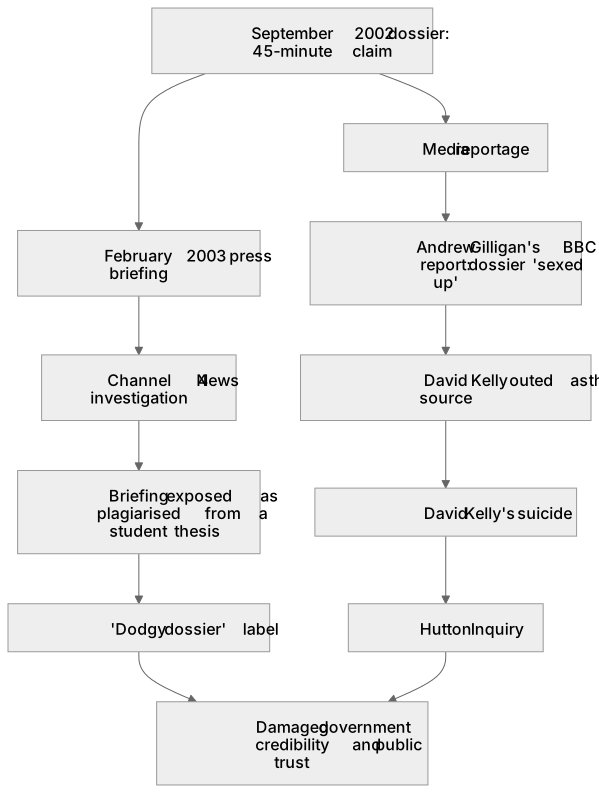
This topic examines the impact of the Iraq dossiers, the February 2003 press briefing, media reportage, and the Channel 4 investigation. The September 2002 dossier controversially claimed Iraq could deploy weapons of mass destruction within 45 minutes. In February 2003, a second dossier was issued. A Channel 4 News investigation quickly revealed this briefing was heavily plagiarised from a student thesis, severely damaging government credibility and earning it the 'dodgy dossier' label. Media reportage was intense; notably, Andrew Gilligan’s BBC report alleged the September dossier was 'sexed up'. This led to the outing of government scientist David Kelly as the source, his tragic suicide, and the Hutton Inquiry.
What earns the marks
- Explains the key claims of the September 2002 dossier, including the 45-minute claim regarding weapons of mass destruction.
- Analyses the February 2003 press briefing and the impact of the Channel 4 News investigation, which exposed the dossier as plagiarised from a student thesis.
- Evaluates media reportage, particularly the role of the BBC’s Andrew Gilligan in alleging the September dossier was 'sexed up'.
- Assesses the consequences of the media fallout, including the outing and suicide of David Kelly, and the subsequent Hutton Inquiry.
- Judges the long-term impact of these events on government-media relations and the decline in public trust regarding intelligence claims.
Common mistakes and how to put them right
Confusing the September 2002 dossier with the February 2003 briefing.
Put it right: The September dossier contained the 45-minute claim; the February briefing was the 'dodgy dossier' exposed for plagiarism.
Stating that the Channel 4 investigation led to the Hutton Inquiry.
Put it right: Channel 4 investigated the February 2003 dossier; the Hutton Inquiry was triggered by the death of David Kelly following the BBC's reporting on the September 2002 dossier.
Claiming David Kelly resigned over the dossier scandal.
Put it right: David Kelly did not resign; he was identified as the BBC's source and tragically died by suicide.
Exam tips
- Use precise dates and distinguish clearly between the September 2002 dossier and the February 2003 'dodgy dossier'.
- Link the Channel 4 investigation specifically to the exposure of plagiarism in the February 2003 briefing.
Try the lesson
The start of the Paper 3, Option 39.2: Mass media and social change in Britain, 1882–2004 - 5 The Labour government versus the media: the problem of the Iraq dossiers, 2002–04: The impact of dossier claims and the press briefing of February 2003; reportage in the media; the impact of the Channel 4 investigation into the accuracy of the dossiers. lesson, made from checked teaching notes for this specification point.
Have a go first
Which claim in the September 2002 Iraq dossier became the focus of the dispute between the government and the BBC?
Listen
This topic examines the impact of the Iraq dossiers, the February 2003 press briefing, media reportage, and the Channel 4 investigation. The September 2002 dossier controversially claimed Iraq could deploy weapons of mass destruction within 45 minutes. In February 2003, a second dossier was issued. A Channel 4 News investigation quickly revealed this briefing was heavily plagiarised from a student thesis, severely damaging government credibility and earning it the 'dodgy dossier' label. Media reportage was intense; notably, Andrew Gilligan’s BBC report alleged the September dossier was 'sexed up'. This led to the outing of government scientist David Kelly as the source, his tragic suicide, and the Hutton Inquiry. A strong answer earns marks for these points. Explains the key claims of the September 2002 dossier, including the 45-minute claim regarding weapons of mass destruction. Analyses the February 2003 press briefing and the impact of the Channel 4 News investigation, which exposed the dossier as plagiarised from a student thesis. Evaluates media reportage, particularly the role of the BBC’s Andrew Gilligan in alleging the September dossier was 'sexed up'. Assesses the consequences of the media fallout, including the outing and suicide of David Kelly, and the subsequent Hutton Inquiry. A common slip: confusing the September 2002 dossier with the February 2003 briefing. Instead, the September dossier contained the 45-minute claim; the February briefing was the 'dodgy dossier' exposed for plagiarism. Exam tip: Use precise dates and distinguish clearly between the September 2002 dossier and the February 2003 'dodgy dossier'.
See it
Key words
Say what each word means before you turn the card.
Government use of intelligence
Try answering aloud or in your head before turning the card.
Media scrutiny and investigative journalism
Try answering aloud or in your head before turning the card.
Public trust and credibility
Try answering aloud or in your head before turning the card.
Government-media relations
Try answering aloud or in your head before turning the card.
See every definition
- Government use of intelligence
- The September 2002 dossier controversially claimed Iraq could deploy weapons of mass destruction within 45 minutes.
- Media scrutiny and investigative journalism
- A Channel 4 News investigation quickly revealed the February 2003 briefing was heavily plagiarised from a student thesis.
- Public trust and credibility
- The plagiarism revelation severely damaged government credibility and eroded public trust.
- Government-media relations
- Media reportage, including the BBC's Andrew Gilligan alleging the September dossier was 'sexed up', fractured government-media relations.
Label the diagram
Some boxes have lost their names. Pick the right name for each number.
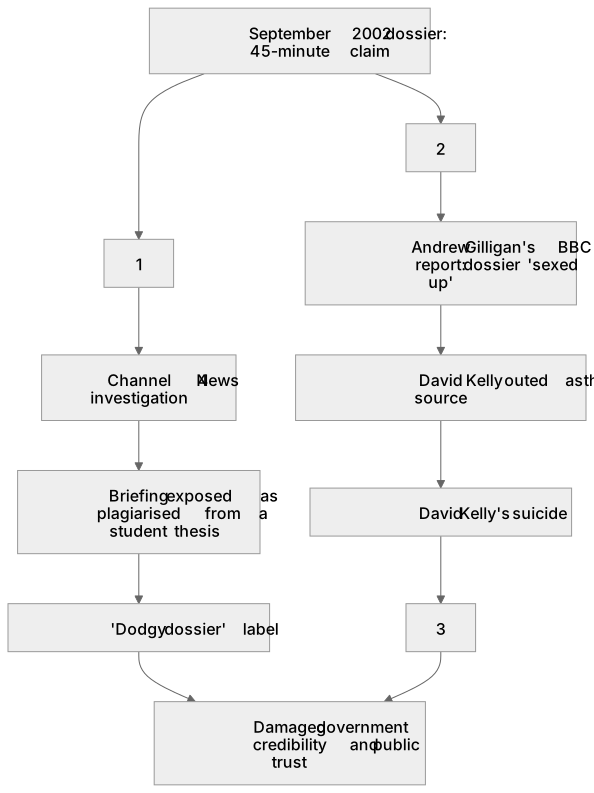
1Box 1
2Box 2
3Box 3
There is more to this lesson
The full lesson goes on to check your understanding and help you earn the marks. Create a free account to carry on, with your progress saved.
A week of Premium from your first lesson · Then the free plan continues · No card, no charge
Test your understanding of Paper 3, Option 39.2: Mass media and social change in Britain, 1882–2004 - 5 The Labour government versus the media: the problem of the Iraq dossiers, 2002–04: The impact of dossier claims and the press briefing of February 2003; reportage in the media; the impact of the Channel 4 investigation into the accuracy of the dossiers.
Active recall beats re-reading. Take an instant quiz now to test what you’ve learned and lock it into long-term memory.
A week of Premium from your first lesson · Then the free plan continues · No card, no charge