Pearson Edexcel · A-Level · History
Course version: 9HI0 · Version from Sept 2015
Reactions to the counter-culture, 1968–72: the rise of the ‘silent…
Full specification wording
Protest and reaction, 1963–72: Reactions to the counter-culture, 1968–72: the rise of the ‘silent majority’; the role of the media in influencing attitudes; the impact of events in Vietnam and at Kent State; Nixon’s appeal and his attack on the Great Society.
Reactions to the counter-culture, 1968–72, saw the rise of the ‘silent majority’—middle Americans who supported traditional values and Nixon.
Checked against the Pearson Edexcel 9HI0 specification (opens in a new tab) on .
- Point 4 of 4
Study notes
From the checked teaching notes for this specification point.
The idea
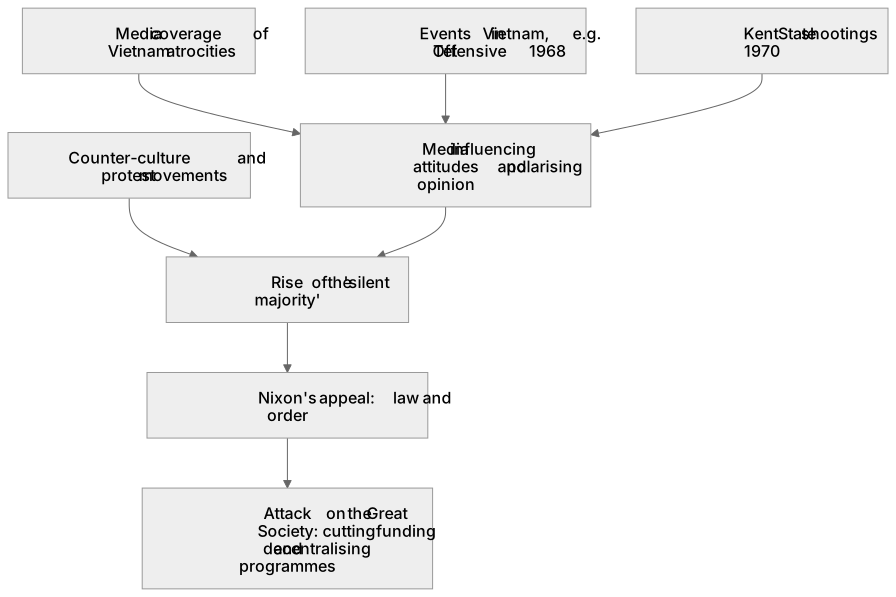
Reactions to the counter-culture, 1968–72, saw the rise of the ‘silent majority’—middle Americans who supported traditional values and Nixon. The media influenced attitudes by broadcasting Vietnam atrocities and Kent State shootings, polarising opinion. Events in Vietnam, like the Tet Offensive 1968, and Kent State 1970, fuelled protests and backlash. Nixon appealed to the silent majority with law and order, and attacked the Great Society by cutting funding and decentralising programmes. Assess how these reactions shaped American politics and society.
What earns the marks
- Explains the rise of the ‘silent majority’ as a reaction against counter-culture and protest movements.
- Analyses how the media influenced attitudes by reporting on Vietnam and Kent State.
- Assesses the impact of Vietnam and Kent State on public opinion and protest.
- Evaluates Nixon’s appeal to the silent majority and his attacks on the Great Society.
Common mistakes and how to put them right
Assuming all Americans supported the counter-culture.
Put it right: Many opposed it, forming the silent majority.
Error: overstating media influence; correction: media both reflected and shaped attitudes, but other factors mattered.
Claiming Nixon completely dismantled the Great Society.
Put it right: He reduced and restructured it but did not abolish it.
Exam tips
- Use specific examples like the 1968 Democratic Convention and Kent State shootings.
- Analyse the role of media with reference to television coverage.
- Link Nixon’s policies to the silent majority and Great Society.
Try the lesson
The start of the Protest and reaction, 1963–72: Reactions to the counter-culture, 1968–72: the rise of the ‘silent majority’; the role of the media in influencing attitudes; the impact of events in Vietnam and at Kent State; Nixon’s appeal and his attack on the Great Society. lesson, made from checked teaching notes for this specification point.
Have a go first
Which term did President Nixon use in 1969 to describe the Americans he claimed supported him against disruptive protest?
Listen
Reactions to the counter-culture, 1968–72, saw the rise of the ‘silent majority’—middle Americans who supported traditional values and Nixon. The media influenced attitudes by broadcasting Vietnam atrocities and Kent State shootings, polarising opinion. Events in Vietnam, like the Tet Offensive 1968, and Kent State 1970, fuelled protests and backlash. Nixon appealed to the silent majority with law and order, and attacked the Great Society by cutting funding and decentralising programmes. Assess how these reactions shaped American politics and society. A strong answer earns marks for these points. Explains the rise of the ‘silent majority’ as a reaction against counter-culture and protest movements. Analyses how the media influenced attitudes by reporting on Vietnam and Kent State. Assesses the impact of Vietnam and Kent State on public opinion and protest. Evaluates Nixon’s appeal to the silent majority and his attacks on the Great Society. A common slip: assuming all Americans supported the counter-culture. Instead, many opposed it, forming the silent majority. Exam tip: Use specific examples like the 1968 Democratic Convention and Kent State shootings.
See it
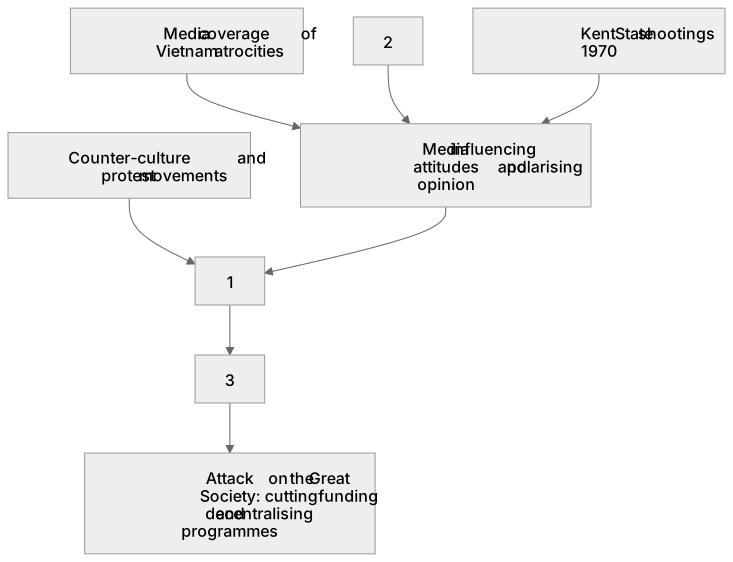
Label the diagram
Some boxes have lost their names. Pick the right name for each number.
1Box 1
2Box 2
3Box 3
There is more to this lesson
The full lesson goes on to check your understanding and help you earn the marks. Create a free account to carry on, with your progress saved.
A week of Premium from your first lesson · Then the free plan continues · No card, no charge
Test your understanding of Protest and reaction, 1963–72: Reactions to the counter-culture, 1968–72: the rise of the ‘silent majority’; the role of the media in influencing attitudes; the impact of events in Vietnam and at Kent State; Nixon’s appeal and his attack on the Great Society.
Active recall beats re-reading. Take an instant quiz now to test what you’ve learned and lock it into long-term memory.
A week of Premium from your first lesson · Then the free plan continues · No card, no charge