Pearson Edexcel · A-Level · History
Course version: 9HI0 · Version from Sept 2015
External pressures on National Party power, 1974–83, including political…
Full specification wording
Redefining resistance and challenges to National Party power, 1968–83: External pressures on National Party power, 1974–83, including political change in southern Africa, international condemnation and calls for economic sanctions, cultural and sporting boycotts.
Between 1974 and 1983, external pressures increasingly isolated the National Party.
Checked against the Pearson Edexcel 9HI0 specification (opens in a new tab) on .
- Point 4 of 4
Study notes
From the checked teaching notes for this specification point.
The idea
Between 1974 and 1983, external pressures increasingly isolated the National Party. Political change in southern Africa—Mozambique and Angola gaining independence in 1975, Zimbabwe in 1980—removed friendly buffer states and inspired resistance. International condemnation grew through UN resolutions and Commonwealth criticism. Calls for economic sanctions intensified, though major powers were slow to act. Cultural and sporting boycotts, such as the 1976 Montreal Olympics exclusion and the Gleneagles Agreement (1977), targeted apartheid's international image. These pressures did not force immediate change but raised the costs of maintaining apartheid and contributed to the NP's later reforms.
What earns the marks
- Explains how decolonisation in Mozambique, Angola and Zimbabwe altered the regional balance and threatened NP security.
- Analyses the role of international organisations (UN, Commonwealth) in condemning apartheid and promoting sanctions.
- Discusses the impact of economic sanctions calls, including disinvestment and trade restrictions, on the South African economy.
- Assesses the effectiveness of cultural and sporting boycotts in isolating South Africa and challenging NP legitimacy.
Common mistakes and how to put them right
Overstating the immediate economic impact of sanctions.
Put it right: Sanctions had gradual and uneven effects, with some states continuing trade.
Assuming all external pressure was coordinated.
Put it right: Actions varied by country and organisation, with mixed motives.
Ignoring the role of sporting boycotts in mobilising domestic and international opposition.
Put it right: They were highly visible and embarrassed the NP regime.
Exam tips
- Use specific examples (e.g., Gleneagles Agreement, 1976 Olympics) to illustrate external pressures.
- Link external pressures to domestic responses, such as NP reforms or increased repression.
- Consider the limitations of external pressure to avoid one-sided arguments.
Try the lesson
The start of the Redefining resistance and challenges to National Party power, 1968–83: External pressures on National Party power, 1974–83, including political change in southern Africa, international condemnation and calls for economic sanctions, cultural and sporting boycotts. lesson, made from checked teaching notes for this specification point.
Have a go first
Which southern African country gained independence from Portugal in 1975, bringing a Marxist government to power on South Africa's border?
Listen
Between 1974 and 1983, external pressures increasingly isolated the National Party. Political change in southern Africa—Mozambique and Angola gaining independence in 1975, Zimbabwe in 1980—removed friendly buffer states and inspired resistance. International condemnation grew through UN resolutions and Commonwealth criticism. Calls for economic sanctions intensified, though major powers were slow to act. Cultural and sporting boycotts, such as the 1976 Montreal Olympics exclusion and the Gleneagles Agreement (1977), targeted apartheid's international image. These pressures did not force immediate change but raised the costs of maintaining apartheid and contributed to the NP's later reforms. A strong answer earns marks for these points. Explains how decolonisation in Mozambique, Angola and Zimbabwe altered the regional balance and threatened NP security. Analyses the role of international organisations (UN, Commonwealth) in condemning apartheid and promoting sanctions. Discusses the impact of economic sanctions calls, including disinvestment and trade restrictions, on the South African economy. Assesses the effectiveness of cultural and sporting boycotts in isolating South Africa and challenging NP legitimacy. A common slip: Overstating the immediate economic impact of sanctions. Instead, sanctions had gradual and uneven effects, with some states continuing trade. Exam tip: Use specific examples (e.g., Gleneagles Agreement, 1976 Olympics) to illustrate external pressures.
See it
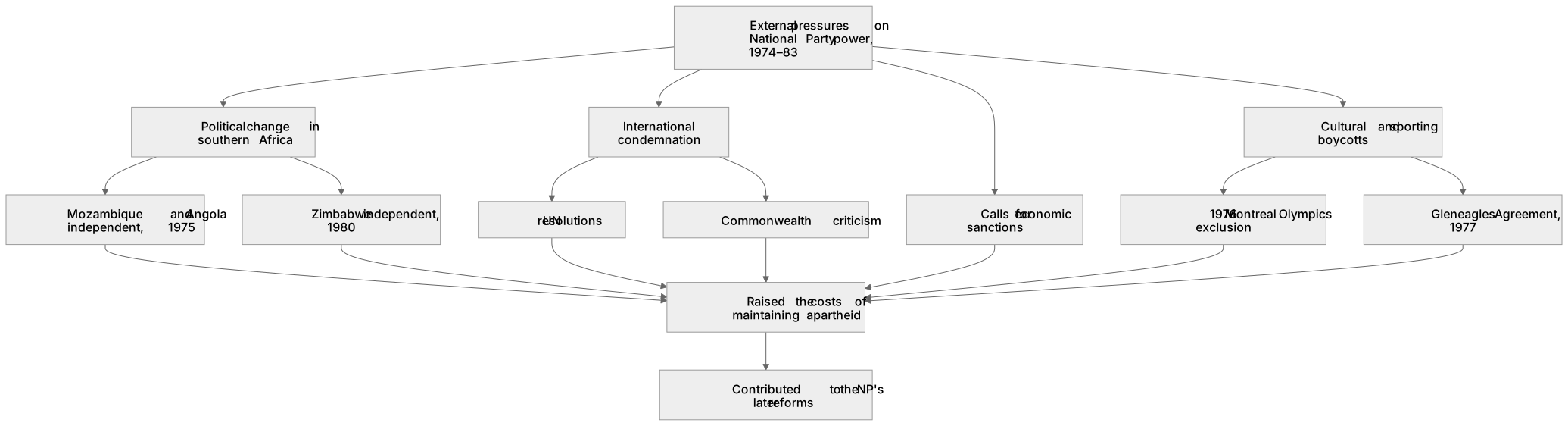
Put the events in order
Put these events in the order they happened, earliest first.
- 1. Mozambique and Angola gaining independence
- 2. Zimbabwe gaining independence
- 3. Montreal Olympics exclusion
Label the diagram
Some boxes have lost their names. Pick the right name for each number.
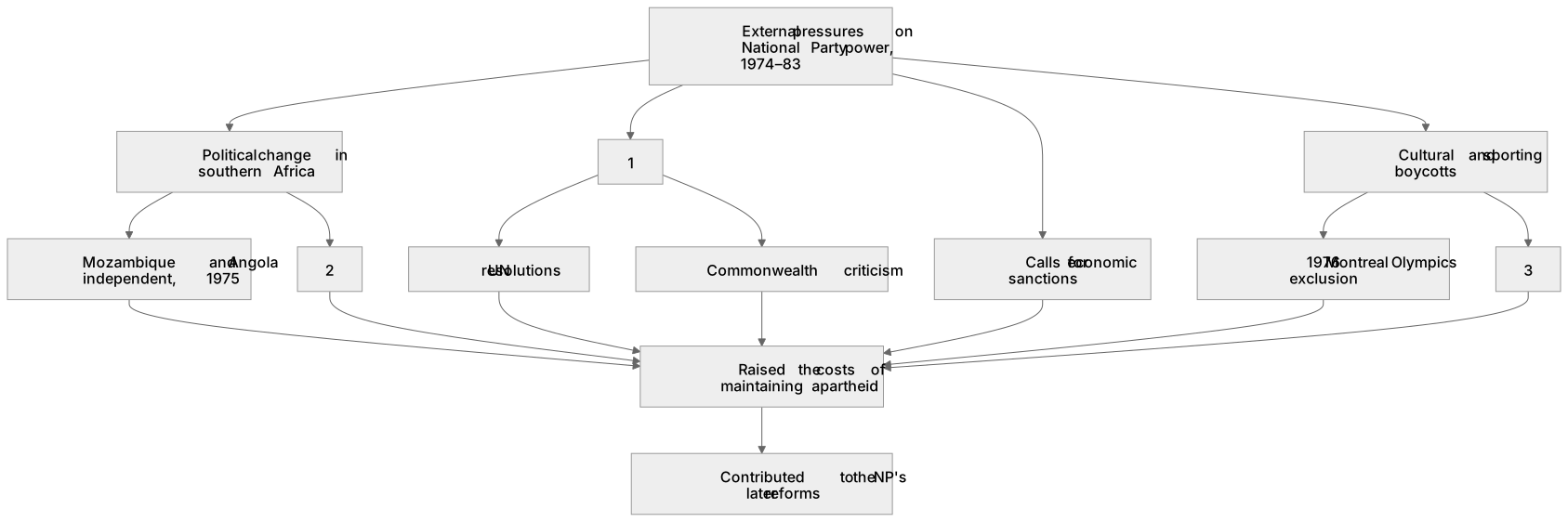
1Box 1
2Box 2
3Box 3
There is more to this lesson
The full lesson goes on to check your understanding and help you earn the marks. Create a free account to carry on, with your progress saved.
A week of Premium from your first lesson · Then the free plan continues · No card, no charge
Test your understanding of Redefining resistance and challenges to National Party power, 1968–83: External pressures on National Party power, 1974–83, including political change in southern Africa, international condemnation and calls for economic sanctions, cultural and sporting boycotts.
Active recall beats re-reading. Take an instant quiz now to test what you’ve learned and lock it into long-term memory.
A week of Premium from your first lesson · Then the free plan continues · No card, no charge