Pearson Edexcel · A-Level · History
Course version: 9HI0 · Version from Sept 2015
The ANC re-strengthened: decline in the early 70s; internal reorganisation…
Full specification wording
Redefining resistance and challenges to National Party power, 1968–83: The ANC re-strengthened: decline in the early 70s; internal reorganisation and external legitimacy; the role of Oliver Tambo; the global anti-apartheid movement.
After the banning of the ANC in 1960, the organisation declined in the early 1970s as leaders were imprisoned or exiled and internal structures were disrupted.
Checked against the Pearson Edexcel 9HI0 specification (opens in a new tab) on .
- Point 2 of 4
- 4 key terms
Study notes
From the checked teaching notes for this specification point.
The idea
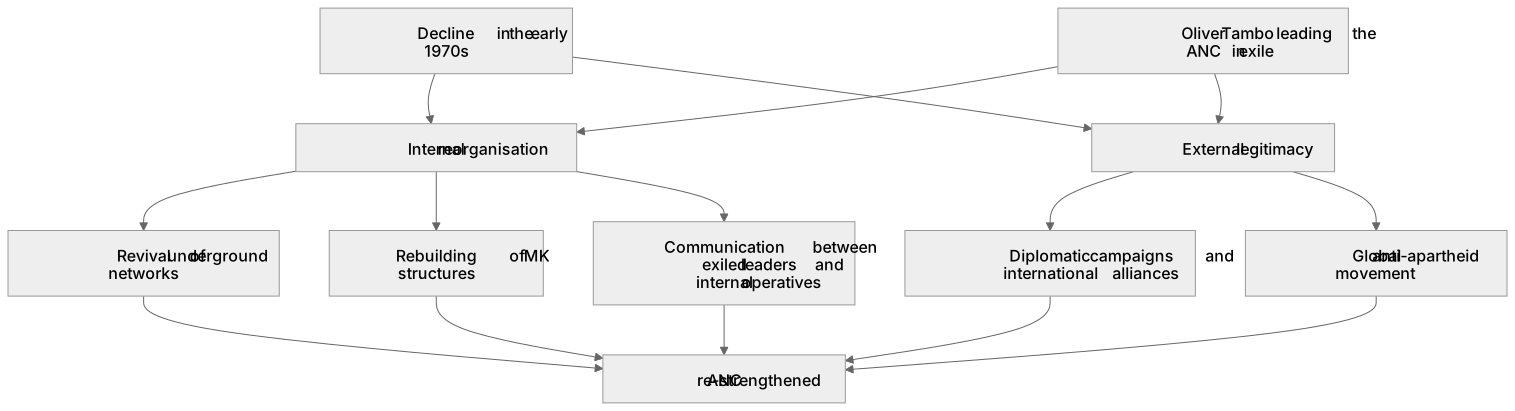
After the banning of the ANC in 1960, the organisation declined in the early 1970s as leaders were imprisoned or exiled and internal structures were disrupted. Recovery came through internal reorganisation, including the revival of underground networks and rebuilding of MK structures, and through external legitimacy gained via diplomatic campaigns and international alliances. Oliver Tambo, as acting president from 1967 and president from 1969 to 1991, was central to this revival, directing the ANC from exile and building support abroad. The global anti-apartheid movement, including the British AAM and the UN’s 1973 designation of apartheid as a crime against humanity, isolated the apartheid regime and strengthened the ANC’s cause.
What earns the marks
- Explains the decline of the ANC in the early 1970s: banning, imprisonment of leaders such as Mandela and Sisulu, and exile.
- Analyses internal reorganisation: rebuilding underground networks, the revival of the armed struggle (MK), and establishing communication between exiled leaders and internal operatives.
- Assesses external legitimacy: diplomatic recognition, UN resolutions and alliances with newly independent African states.
- Evaluates Oliver Tambo’s role: leading the ANC in exile (acting president from 1967, president 1969–1991), building international support and maintaining organisational unity.
- Explains the global anti-apartheid movement: consumer boycotts, sports boycotts and the role of organisations such as the British Anti-Apartheid Movement.
Common mistakes and how to put them right
Assuming the ANC was completely inactive in the early 1970s.
Put it right: It maintained underground structures and began rebuilding.
Confusing internal ANC reorganisation with the later UDF.
Put it right: Internal reorganisation refers to the ANC rebuilding its own underground and MK structures, whereas the UDF was a separate internal coalition launched later in 1983.
Overlooking Tambo’s diplomatic role.
Put it right: He was instrumental in securing international support and recognition for the ANC.
Exam tips
- Use specific examples of external legitimacy, such as UN resolutions or the 1981 sports boycott, to support arguments.
- Link internal reorganisation to external legitimacy to show how the ANC re-strengthened on multiple fronts.
- When discussing Tambo, refer to his long leadership in exile and his role in international diplomacy.
Try the lesson
The start of the Redefining resistance and challenges to National Party power, 1968–83: The ANC re-strengthened: decline in the early 70s; internal reorganisation and external legitimacy; the role of Oliver Tambo; the global anti-apartheid movement. lesson, made from checked teaching notes for this specification point.
Have a go first
Who served as acting president of the African National Congress for much of the period of its exile from the 1960s onwards?
Listen
After the banning of the ANC in 1960, the organisation declined in the early 1970s as leaders were imprisoned or exiled and internal structures were disrupted. Recovery came through internal reorganisation, including the revival of underground networks and rebuilding of MK structures, and through external legitimacy gained via diplomatic campaigns and international alliances. Oliver Tambo, as acting president from 1967 and president from 1969 to 1991, was central to this revival, directing the ANC from exile and building support abroad. The global anti-apartheid movement, including the British AAM and the UN’s 1973 designation of apartheid as a crime against humanity, isolated the apartheid regime and strengthened the ANC’s cause. A strong answer earns marks for these points. Explains the decline of the ANC in the early 1970s: banning, imprisonment of leaders such as Mandela and Sisulu, and exile. Analyses internal reorganisation: rebuilding underground networks, the revival of the armed struggle (MK), and establishing communication between exiled leaders and internal operatives. Assesses external legitimacy: diplomatic recognition, UN resolutions and alliances with newly independent African states. Evaluates Oliver Tambo’s role: leading the ANC in exile (acting president from 1967, president 1969–1991), building international support and maintaining organisational unity. A common slip: Assuming the ANC was completely inactive in the early 1970s. Instead, it maintained underground structures and began rebuilding. Exam tip: Use specific examples of external legitimacy, such as UN resolutions or the 1981 sports boycott, to support arguments.
See it
Put the events in order
Put these events in the order they happened, earliest first.
- 1. Oliver Tambo became president of the ANC
- 2. Oliver Tambo became acting president of the ANC
- 3. The UDF was launched
- 4. UN designated apartheid a crime against humanity
- 5. Sports boycott took place
Key words
Say what each word means before you turn the card.
Exile and internal resistance
Try answering aloud or in your head before turning the card.
Leadership and organisation
Try answering aloud or in your head before turning the card.
International solidarity and diplomacy
Try answering aloud or in your head before turning the card.
Isolation of the apartheid regime
Try answering aloud or in your head before turning the card.
See every definition
- Exile and internal resistance
- Leaders were imprisoned or exiled and internal structures disrupted, yet underground networks were revived and communication established between exiled leaders and internal operatives.
- Leadership and organisation
- Oliver Tambo, acting president from 1967 and president from 1969 to 1991, directed the ANC from exile, built international support and maintained organisational unity.
- International solidarity and diplomacy
- External legitimacy was gained through diplomatic campaigns and international alliances, including alliances with newly independent African states and UN resolutions.
- Isolation of the apartheid regime
- The global anti-apartheid movement, including the British AAM and the UN's 1973 designation of apartheid as a crime against humanity, isolated the apartheid regime and strengthened the ANC's cause.
Label the diagram
Some boxes have lost their names. Pick the right name for each number.
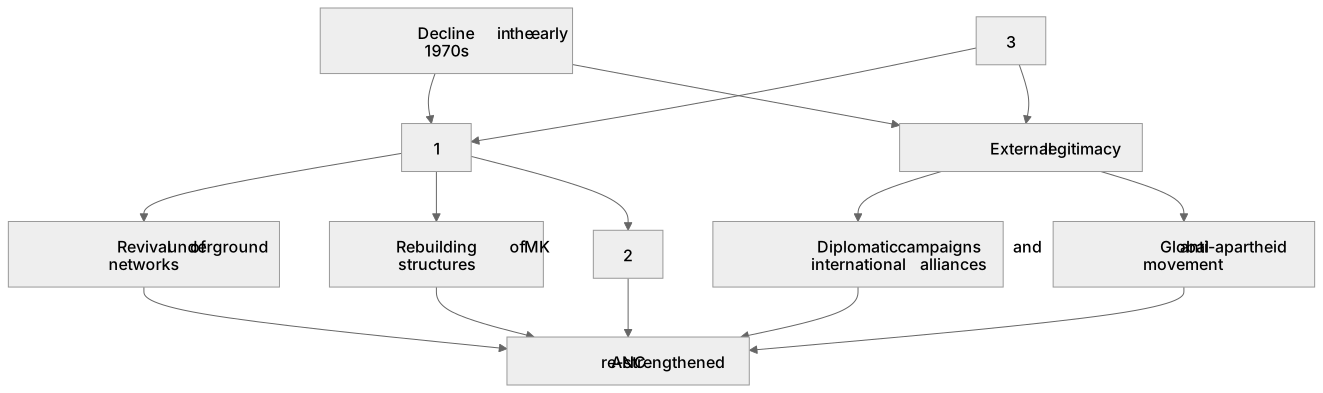
1Box 1
2Box 2
3Box 3
There is more to this lesson
The full lesson goes on to check your understanding and help you earn the marks. Create a free account to carry on, with your progress saved.
A week of Premium from your first lesson · Then the free plan continues · No card, no charge
Test your understanding of Redefining resistance and challenges to National Party power, 1968–83: The ANC re-strengthened: decline in the early 70s; internal reorganisation and external legitimacy; the role of Oliver Tambo; the global anti-apartheid movement.
Active recall beats re-reading. Take an instant quiz now to test what you’ve learned and lock it into long-term memory.
A week of Premium from your first lesson · Then the free plan continues · No card, no charge