Pearson Edexcel · A-Level · History
Course version: 9HI0 · Version from Sept 2015
Tudor monarchs and religious change; Henry VIII and the end of papal power…
Full specification wording
Religious changes, 1509–88: Tudor monarchs and religious change; Henry VIII and the end of papal power in England; religious changes under Edward and Mary; the Elizabethan compromise of 1558–63.
Henry VIII's break with Rome began with the annulment crisis and produced the Act of Supremacy in 1534, making the monarch head of the Church of England.
Checked against the Pearson Edexcel 9HI0 specification (opens in a new tab) on .
- Point 1 of 3
- 4 key terms
Study notes
From the checked teaching notes for this specification point.
The idea
Henry VIII's break with Rome began with the annulment crisis and produced the Act of Supremacy in 1534, making the monarch head of the Church of England. Doctrinal and liturgical change accelerated under Edward VI, with the Book of Common Prayer and the 1552 prayer book moving towards Protestantism. Mary I restored papal authority and Catholic practice, but her reign ended in 1558. Elizabeth I's settlement of 1558–63 combined the Act of Supremacy, the Act of Uniformity, the Royal Injunctions and the Thirty-Nine Articles, creating a via media that was Protestant in doctrine but retained some traditional ceremony. Assess how far each monarch imposed change from above and how far it was resisted or accepted.
What earns the marks
- Explains how Henry VIII's annulment crisis led to the break with Rome, including the Act of Supremacy and the royal supremacy over the Church.
- Analyses Edward VI's Protestant reforms, including the Book of Common Prayer and the 1552 prayer book, and how they advanced doctrinal change.
- Evaluates Mary I's restoration of Catholicism, including the return to papal authority and the reversal of Edwardian legislation, and the limits of that restoration.
- Assesses the Elizabethan settlement of 1558–63, covering the Act of Supremacy, Act of Uniformity, Royal Injunctions and Thirty-Nine Articles, and how it balanced Protestant doctrine with traditional practice.
- Judges the extent of popular acceptance or resistance to religious change across the period, using evidence such as the Pilgrimage of Grace or the Northern Rebellion.
Common mistakes and how to put them right
Describing the Elizabethan settlement as purely Protestant or purely Catholic.
Put it right by explaining its via media character, Protestant in doctrine yet retaining some ceremonial traditions.
Assuming Mary I's restoration was fully successful.
Put it right by noting that Protestantism survived and that her reign was short, leaving the settlement to Elizabeth.
Confusing the sequence of reforms under Edward VI.
Put it right by distinguishing the 1549 Book of Common Prayer from the more Protestant 1552 version.
Exam tips
- Link each religious change to the monarch who drove it, so that causation and chronology are clear.
- Use specific legislation and documents, such as the Act of Supremacy or the Thirty-Nine Articles, to support claims about doctrine and authority.
- When assessing acceptance or resistance, weigh evidence of compliance against evidence of rebellion or dissent rather than generalising.
Try the lesson
The start of the Religious changes, 1509–88: Tudor monarchs and religious change; Henry VIII and the end of papal power in England; religious changes under Edward and Mary; the Elizabethan compromise of 1558–63. lesson, made from checked teaching notes for this specification point.
Have a go first
Which Act of 1534 declared that the king was the supreme head of the Church of England?
Listen
Henry VIII's break with Rome began with the annulment crisis and produced the Act of Supremacy in 1534, making the monarch head of the Church of England. Doctrinal and liturgical change accelerated under Edward VI, with the Book of Common Prayer and the 1552 prayer book moving towards Protestantism. Mary I restored papal authority and Catholic practice, but her reign ended in 1558. Elizabeth I's settlement of 1558–63 combined the Act of Supremacy, the Act of Uniformity, the Royal Injunctions and the Thirty-Nine Articles, creating a via media that was Protestant in doctrine but retained some traditional ceremony. Assess how far each monarch imposed change from above and how far it was resisted or accepted. A strong answer earns marks for these points. Explains how Henry VIII's annulment crisis led to the break with Rome, including the Act of Supremacy and the royal supremacy over the Church. Analyses Edward VI's Protestant reforms, including the Book of Common Prayer and the 1552 prayer book, and how they advanced doctrinal change. Evaluates Mary I's restoration of Catholicism, including the return to papal authority and the reversal of Edwardian legislation, and the limits of that restoration. Assesses the Elizabethan settlement of 1558–63, covering the Act of Supremacy, Act of Uniformity, Royal Injunctions and Thirty-Nine Articles, and how it balanced Protestant doctrine with traditional practice. A common slip: Describing the Elizabethan settlement as purely Protestant or purely Catholic. Instead, explaining its via media character, Protestant in doctrine yet retaining some ceremonial traditions. Exam tip: Link each religious change to the monarch who drove it, so that causation and chronology are clear.
See it
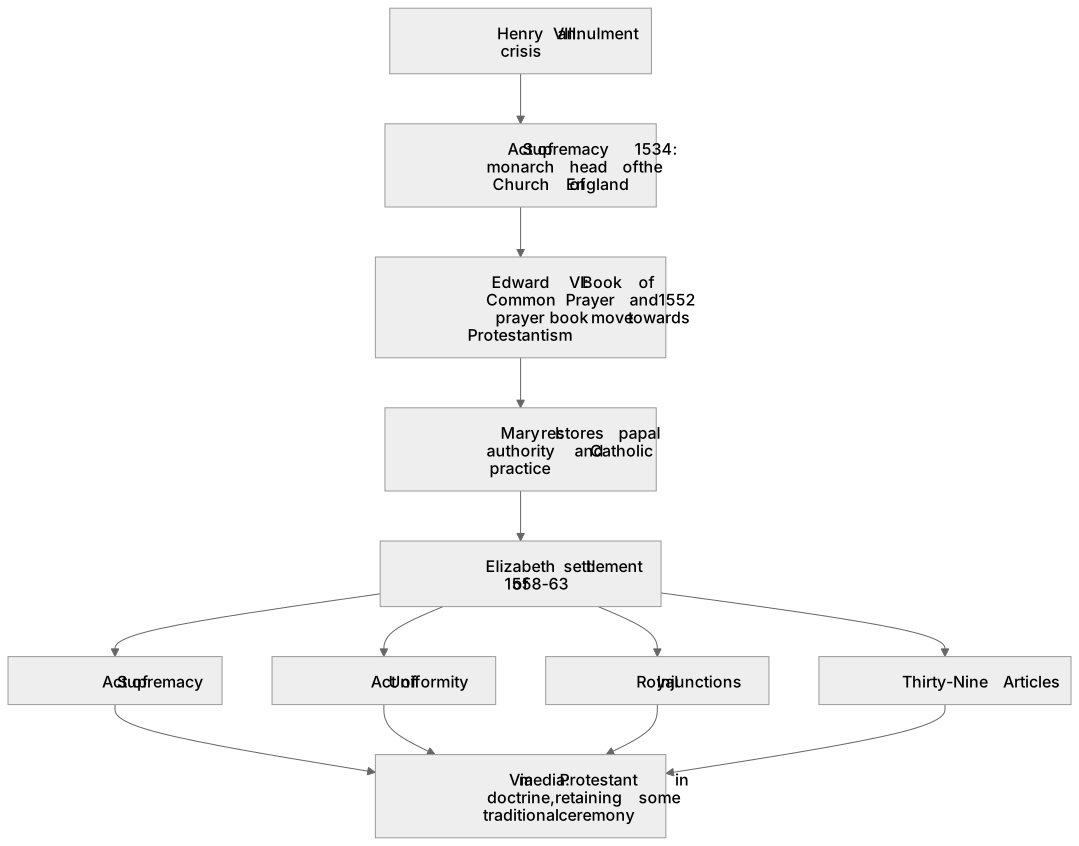
Put the events in order
Put these events in the order they happened, earliest first.
- 1. Mary I's reign ended
- 2. Act of Supremacy made the monarch head of the Church of England
- 3. More Protestant prayer book issued under Edward VI
- 4. Book of Common Prayer introduced under Edward VI
Key words
Say what each word means before you turn the card.
Royal supremacy
Try answering aloud or in your head before turning the card.
Protestant and Catholic reform
Try answering aloud or in your head before turning the card.
The Elizabethan via media
Try answering aloud or in your head before turning the card.
Popular response to religious change
Try answering aloud or in your head before turning the card.
See every definition
- Royal supremacy
- The monarch became head of the Church of England through the Act of Supremacy in 1534, following Henry VIII's annulment crisis and break with Rome.
- Protestant and Catholic reform
- Doctrinal and liturgical change advanced under Edward VI towards Protestantism, while Mary I restored papal authority and Catholic practice.
- The Elizabethan via media
- The settlement of 1558–63 combined the Act of Supremacy, Act of Uniformity, Royal Injunctions and Thirty-Nine Articles, being Protestant in doctrine but retaining some traditional ceremony.
- Popular response to religious change
- How far each monarch imposed change from above and how far it was resisted or accepted, judged using evidence such as the Pilgrimage of Grace or the Northern Rebellion.
Label the diagram
Some boxes have lost their names. Pick the right name for each number.
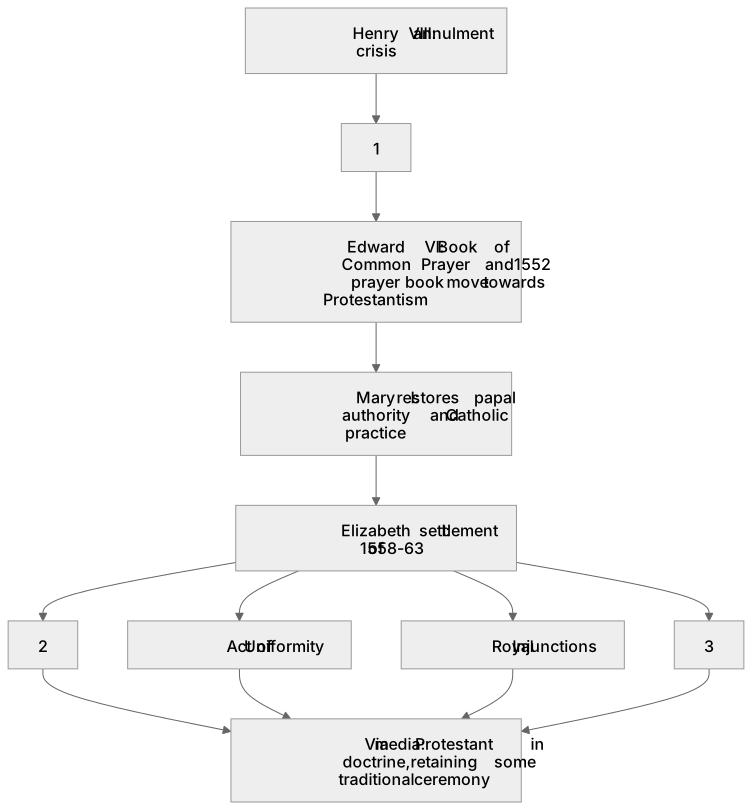
1Box 1
2Box 2
3Box 3
There is more to this lesson
The full lesson goes on to check your understanding and help you earn the marks. Create a free account to carry on, with your progress saved.
A week of Premium from your first lesson · Then the free plan continues · No card, no charge
Test your understanding of Religious changes, 1509–88: Tudor monarchs and religious change; Henry VIII and the end of papal power in England; religious changes under Edward and Mary; the Elizabethan compromise of 1558–63.
Active recall beats re-reading. Take an instant quiz now to test what you’ve learned and lock it into long-term memory.
A week of Premium from your first lesson · Then the free plan continues · No card, no charge