Pearson Edexcel · A-Level · History
Course version: 9HI0 · Version from Sept 2015
Cultural challenge: trends in youth culture; the impact of technology on…
Full specification wording
Republican dominance and its opponents, 1981–92: Cultural challenge: trends in youth culture; the impact of technology on popular culture; the growth of cable television and the influence of MTV; the impact of the AIDS crisis; controversial social issues in film and television.
This topic examines how cultural developments challenged established norms in the USA during 1981–92.
Checked against the Pearson Edexcel 9HI0 specification (opens in a new tab) on .
- Point 3 of 4
- 4 key terms
Study notes
From the checked teaching notes for this specification point.
The idea
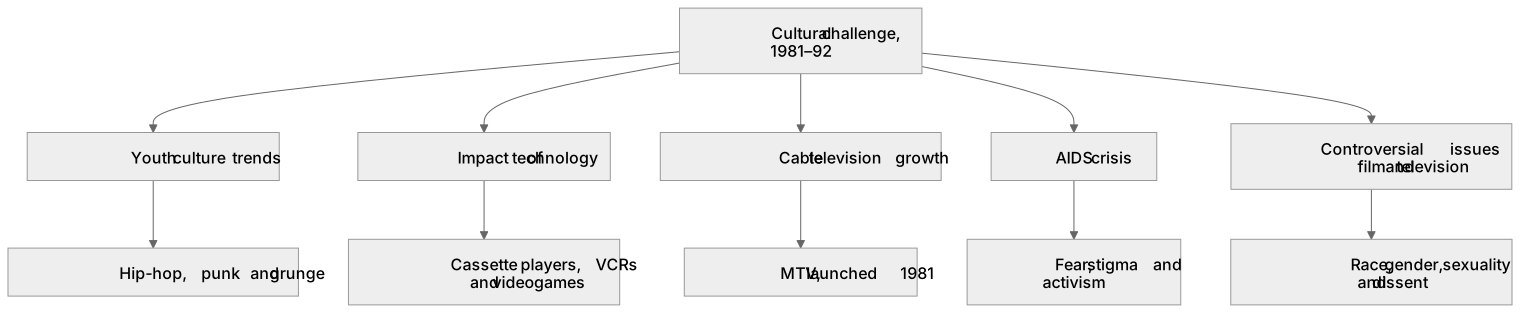
This topic examines how cultural developments challenged established norms in the USA during 1981–92. Youth culture saw the rise of hip-hop, punk and grunge, expressing alienation and political critique. Technology transformed popular culture: portable cassette players, video recorders and early video games allowed personalised consumption. Cable television expanded rapidly, and MTV, launched in 1981, revolutionised music promotion and youth identity. The AIDS crisis from the early 1980s provoked fear and activism, exposing discrimination and reshaping public health. Film and television tackled controversial issues such as racism, sexism and homosexuality, often sparking debate. Together these trends illustrate cultural conflict and the changing role of media in American society.
What earns the marks
- Youth culture trends: emergence of hip-hop, punk, grunge and their expression of generational dissent.
- Technological impact: personal cassette players, VCRs and video games enabling individualised cultural consumption.
- Cable television growth: expansion of channels and niche broadcasting, fragmenting the mass audience.
- MTV influence: launched 1981, transformed music promotion, created visual stars and shaped youth fashion and attitudes.
- AIDS crisis impact: public fear, stigmatisation of gay men and intravenous drug users, activism by groups such as ACT UP, and shifts in public health policy.
- Controversial social issues in film and television: portrayal of race, gender, sexuality and political dissent, provoking censorship debates and advertiser pressure.
Common mistakes and how to put them right
Treating youth culture as a single, unified movement.
Put it right: Recognise diverse and often conflicting trends such as hip-hop, punk and grunge, each with distinct audiences and messages.
Overstating MTV's immediate reach, ignoring that many households lacked cable in the early 1980s.
Put it right: Note the gradual growth of cable and MTV's evolving influence across the decade.
Presenting the AIDS crisis solely as a medical issue, overlooking its cultural and political dimensions.
Put it right: Include the role of activism, stigma and the epidemic's impact on popular culture and public attitudes.
Exam tips
- Use specific examples, such as the launch of MTV in 1981 or the activism of ACT UP, to support arguments about cultural challenge.
- Analyse how technology and cable television changed the production and consumption of popular culture, rather than just listing innovations.
- When discussing controversial issues, link film and television content to broader social debates and audience reactions.
Try the lesson
The start of the Republican dominance and its opponents, 1981–92: Cultural challenge: trends in youth culture; the impact of technology on popular culture; the growth of cable television and the influence of MTV; the impact of the AIDS crisis; controversial social issues in film and television. lesson, made from checked teaching notes for this specification point.
Have a go first
Which music television channel, launched in 1981, became a major influence on American popular culture during the 1980s?
Listen
This topic examines how cultural developments challenged established norms in the USA during 1981–92. Youth culture saw the rise of hip-hop, punk and grunge, expressing alienation and political critique. Technology transformed popular culture: portable cassette players, video recorders and early video games allowed personalised consumption. Cable television expanded rapidly, and MTV, launched in 1981, revolutionised music promotion and youth identity. The AIDS crisis from the early 1980s provoked fear and activism, exposing discrimination and reshaping public health. Film and television tackled controversial issues such as racism, sexism and homosexuality, often sparking debate. Together these trends illustrate cultural conflict and the changing role of media in American society. A strong answer earns marks for these points. Youth culture trends: emergence of hip-hop, punk, grunge and their expression of generational dissent. Technological impact: personal cassette players, VCRs and video games enabling individualised cultural consumption. Cable television growth: expansion of channels and niche broadcasting, fragmenting the mass audience. MTV influence: launched 1981, transformed music promotion, created visual stars and shaped youth fashion and attitudes. A common slip: treating youth culture as a single, unified movement. Instead, recognise diverse and often conflicting trends such as hip-hop, punk and grunge, each with distinct audiences and messages. Exam tip: Use specific examples, such as the launch of MTV in 1981 or the activism of ACT UP, to support arguments about cultural challenge.
See it
Key words
Say what each word means before you turn the card.
Youth culture and generational identity
Try answering aloud or in your head before turning the card.
Technology and cultural change
Try answering aloud or in your head before turning the card.
Media influence and fragmentation
Try answering aloud or in your head before turning the card.
AIDS crisis and social activism
Try answering aloud or in your head before turning the card.
See every definition
- Youth culture and generational identity
- Trends such as hip-hop, punk and grunge expressed alienation and political critique, showing diverse and often conflicting generational dissent.
- Technology and cultural change
- Portable cassette players, video recorders and early video games allowed personalised consumption, transforming popular culture.
- Media influence and fragmentation
- Cable television expanded rapidly and MTV, launched in 1981, revolutionised music promotion and youth identity, fragmenting the mass audience.
- AIDS crisis and social activism
- From the early 1980s the crisis provoked fear and activism, exposing discrimination and reshaping public health.
Label the diagram
Some boxes have lost their names. Pick the right name for each number.
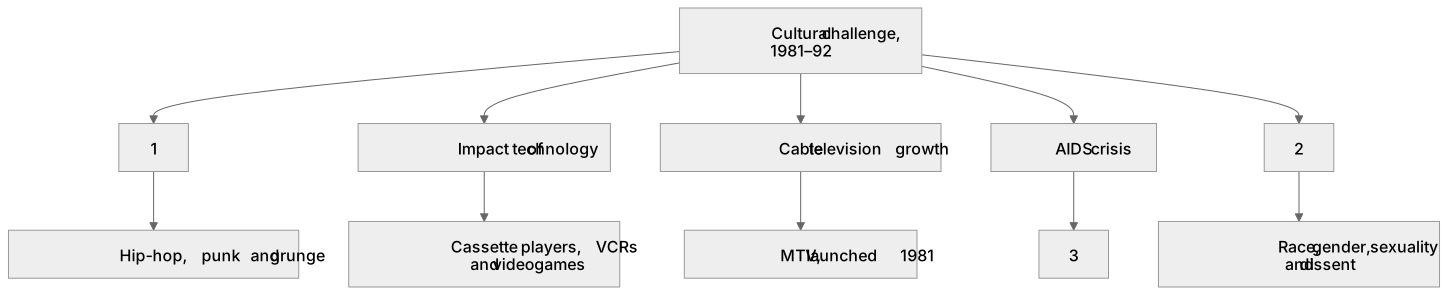
1Box 1
2Box 2
3Box 3
There is more to this lesson
The full lesson goes on to check your understanding and help you earn the marks. Create a free account to carry on, with your progress saved.
A week of Premium from your first lesson · Then the free plan continues · No card, no charge
Test your understanding of Republican dominance and its opponents, 1981–92: Cultural challenge: trends in youth culture; the impact of technology on popular culture; the growth of cable television and the influence of MTV; the impact of the AIDS crisis; controversial social issues in film and television.
Active recall beats re-reading. Take an instant quiz now to test what you’ve learned and lock it into long-term memory.
A week of Premium from your first lesson · Then the free plan continues · No card, no charge