Pearson Edexcel · A-Level · History
Course version: 9HI0 · Version from Sept 2015
The impact of economic change on society: the effects of inflation on…
Full specification wording
Social and political change, 1973–80: The impact of economic change on society: the effects of inflation on family incomes; the growth of homelessness; the oil crisis and the end of cheap energy; the impact of foreign competition; the response of the government.
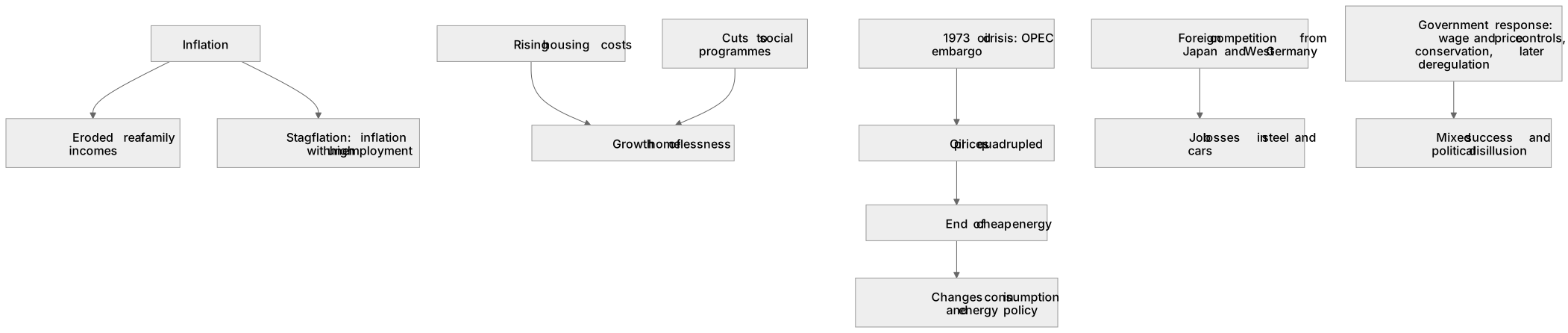
Inflation eroded real family incomes, especially for those on fixed incomes, while unemployment and stagnant growth created stagflation.
Checked against the Pearson Edexcel 9HI0 specification (opens in a new tab) on .
- Point 2 of 4
- 4 key terms
Study notes
From the checked teaching notes for this specification point.
The idea
Inflation eroded real family incomes, especially for those on fixed incomes, while unemployment and stagnant growth created stagflation. Homelessness grew as housing costs rose and cuts to social programmes took effect. The 1973 oil crisis, triggered by the OPEC embargo, quadrupled oil prices and ended the era of cheap energy, forcing changes in consumption and energy policy. Foreign competition, particularly from Japan and West Germany, hit American manufacturing, causing job losses in industries like steel and cars. The government responded with wage and price controls, energy conservation measures, and later deregulation, but these had mixed success and contributed to political disillusion.
What earns the marks
- Explains how inflation reduced purchasing power and affected family budgets.
- Describes the growth of homelessness and its links to economic and policy factors.
- Analyses the oil crisis as a turning point that ended cheap energy and prompted government action.
- Assesses the impact of foreign competition on American jobs and industries.
- Evaluates the effectiveness of government responses such as controls, conservation and deregulation.
Common mistakes and how to put them right
Confusing inflation with recession.
Put it right: Define inflation as rising prices and explain stagflation as the combination of inflation and high unemployment.
Assuming homelessness was only caused by personal failings.
Put it right: Link it to structural factors like housing costs and cuts.
Treating the oil crisis as only an energy issue.
Put it right: Show its wider economic and social consequences.
Exam tips
- Use data such as the 1973 oil price rise or inflation rates to illustrate arguments.
- Connect economic changes to social effects like family stress and homelessness.
- Assess government responses by weighing their aims against outcomes.
Try the lesson
The start of the Social and political change, 1973–80: The impact of economic change on society: the effects of inflation on family incomes; the growth of homelessness; the oil crisis and the end of cheap energy; the impact of foreign competition; the response of the government. lesson, made from checked teaching notes for this specification point.
Have a go first
How did inflation most significantly affect the real incomes of American families during the 1970s?
Listen
Inflation eroded real family incomes, especially for those on fixed incomes, while unemployment and stagnant growth created stagflation. Homelessness grew as housing costs rose and cuts to social programmes took effect. The 1973 oil crisis, triggered by the OPEC embargo, quadrupled oil prices and ended the era of cheap energy, forcing changes in consumption and energy policy. Foreign competition, particularly from Japan and West Germany, hit American manufacturing, causing job losses in industries like steel and cars. The government responded with wage and price controls, energy conservation measures, and later deregulation, but these had mixed success and contributed to political disillusion. A strong answer earns marks for these points. Explains how inflation reduced purchasing power and affected family budgets. Describes the growth of homelessness and its links to economic and policy factors. Analyses the oil crisis as a turning point that ended cheap energy and prompted government action. Assesses the impact of foreign competition on American jobs and industries. A common slip: Confusing inflation with recession. Instead, define inflation as rising prices and explain stagflation as the combination of inflation and high unemployment. Exam tip: Use data such as the 1973 oil price rise or inflation rates to illustrate arguments.
See it
Key words
Say what each word means before you turn the card.
Economic instability and stagflation
Try answering aloud or in your head before turning the card.
Social consequences of economic change
Try answering aloud or in your head before turning the card.
Energy policy and dependence
Try answering aloud or in your head before turning the card.
Government intervention and its limits
Try answering aloud or in your head before turning the card.
See every definition
- Economic instability and stagflation
- Inflation eroded real family incomes, while unemployment and stagnant growth together created stagflation.
- Social consequences of economic change
- Homelessness grew as housing costs rose and cuts to social programmes took effect.
- Energy policy and dependence
- The oil crisis ended the era of cheap energy and forced changes in consumption and energy policy.
- Government intervention and its limits
- Wage and price controls, energy conservation measures and later deregulation had mixed success and contributed to political disillusion.
Label the diagram
Some boxes have lost their names. Pick the right name for each number.
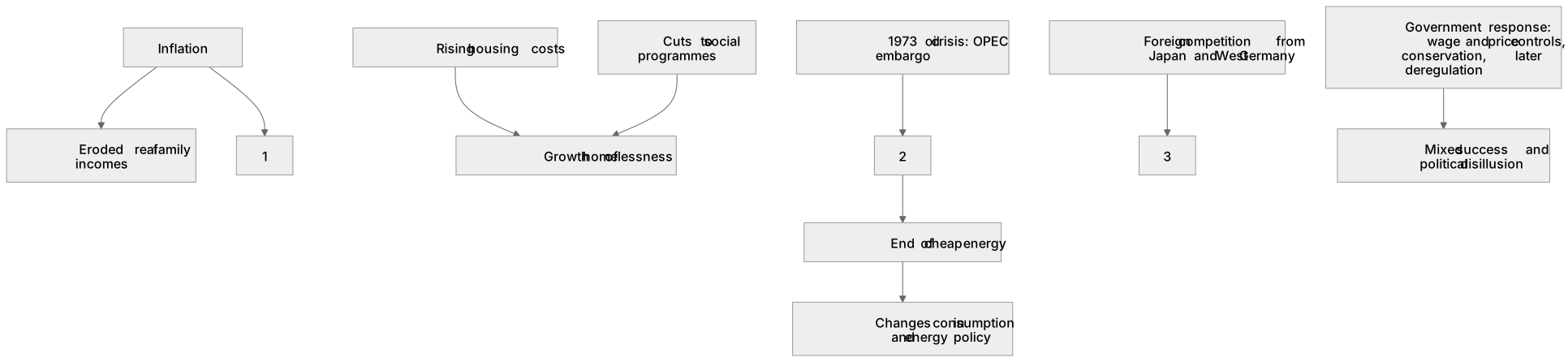
1Box 1
2Box 2
3Box 3
There is more to this lesson
The full lesson goes on to check your understanding and help you earn the marks. Create a free account to carry on, with your progress saved.
A week of Premium from your first lesson · Then the free plan continues · No card, no charge
Test your understanding of Social and political change, 1973–80: The impact of economic change on society: the effects of inflation on family incomes; the growth of homelessness; the oil crisis and the end of cheap energy; the impact of foreign competition; the response of the government.
Active recall beats re-reading. Take an instant quiz now to test what you’ve learned and lock it into long-term memory.
A week of Premium from your first lesson · Then the free plan continues · No card, no charge