Pearson Edexcel · A-Level · History
Course version: 9HI0 · Version from Sept 2015
The changing position of women, 1917–80: impact of the Roaring Twenties,…
Full specification wording
Society and culture in change, 1917–80: The changing position of women, 1917–80: impact of the Roaring Twenties, Great Depression and New Deal on women; impact of the Second World War and suburban life, 1941–60; emergence of the women’s liberation movement and its achievements; extent of women’s advancement, 1961–80.
This topic examines how women’s economic, social and political position altered between 1917 and 1980.
Checked against the Pearson Edexcel 9HI0 specification (opens in a new tab) on .
- Point 1 of 3
- 3 key terms
Study notes
From the checked teaching notes for this specification point.
The idea
This topic examines how women’s economic, social and political position altered between 1917 and 1980. The Roaring Twenties brought new consumer goods and some urban employment, yet domestic expectations persisted. The Great Depression pushed married women out of work and the New Deal created mainly male schemes. The Second World War drew women into factories and services, but post-war suburban life (1941–60) often reinforced domestic roles. The Equal Pay Act 1963 stemmed from earlier labour activism. From the late 1960s, the women’s liberation movement emerged, campaigning for reproductive rights and workplace equality, achieving successes like Title IX (1972) and Roe v. Wade (1973). By 1980, women’s advancement was uneven: more entered higher education and professions, but pay gaps and unequal domestic burdens remained.
What earns the marks
- Explains how the Roaring Twenties affected women through consumer culture, changing fashion and some expansion of white-collar work, while noting that domestic roles and unequal pay persisted.
- Assesses the impact of the Second World War on women’s work, including the recruitment of married women into war industries and the later post-war expectation that they should return to domestic roles.
- Evaluates how suburban life between 1941 and 1960 shaped women’s experiences, with the growth of home ownership, consumer durables and domestic ideology often reinforcing separate spheres.
- Explains the emergence of the women’s liberation movement, including its key demands for equal opportunities and reproductive rights, and assesses its achievements such as Title IX (1972) and Roe v. Wade (1973).
Common mistakes and how to put them right
Treating the Roaring Twenties as uniformly liberating for all women.
Put it right: Recognise that gains were uneven and many women, especially working-class and minority ethnic women, saw little change.
Assuming the Second World War permanently transformed women’s employment.
Put it right: Explain that many women were dismissed or encouraged to leave work after 1945, and the post-war period saw a return to domestic ideals.
Claiming the women’s liberation movement achieved the Equal Pay Act 1963.
Put it right: Acknowledge that this Act was the product of earlier labour and women's rights activism, whereas the liberation movement achieved later successes like Title IX.
Exam tips
- Plan essays around the specified periods and themes, ensuring each phase (1920s, 1930s, 1941–60, 1961–80) is addressed with specific evidence.
- Use precise examples, such as the impact of the Great Depression on married women’s employment or Title IX, to support arguments about change and continuity.
- When assessing extent of advancement, weigh progress in law and education against social and economic realities, and consider differences among women by class, race and region.
Try the lesson
The start of the Society and culture in change, 1917–80: The changing position of women, 1917–80: impact of the Roaring Twenties, Great Depression and New Deal on women; impact of the Second World War and suburban life, 1941–60; emergence of the women’s liberation movement and its achievements; extent of women’s advancement, 1961–80. lesson, made from checked teaching notes for this specification point.
Have a go first
Which of the following best describes the general impact of the Second World War on female employment in the United States?
Listen
This topic examines how women’s economic, social and political position altered between 1917 and 1980. The Roaring Twenties brought new consumer goods and some urban employment, yet domestic expectations persisted. The Great Depression pushed married women out of work and the New Deal created mainly male schemes. The Second World War drew women into factories and services, but post-war suburban life (1941–60) often reinforced domestic roles. The Equal Pay Act 1963 stemmed from earlier labour activism. From the late 1960s, the women’s liberation movement emerged, campaigning for reproductive rights and workplace equality, achieving successes like Title IX (1972) and Roe v. Wade (1973). By 1980, women’s advancement was uneven: more entered higher education and professions, but pay gaps and unequal domestic burdens remained. A strong answer earns marks for these points. Explains how the Roaring Twenties affected women through consumer culture, changing fashion and some expansion of white-collar work, while noting that domestic roles and unequal pay persisted. Analyses the impact of the Great Depression and New Deal on women, including pressure on married women’s employment, the marginalisation of women in many New Deal programmes, and the particular difficulties faced by Black and minority ethnic women. Assesses the impact of the Second World War on women’s work, including the recruitment of married women into war industries and the later post-war expectation that they should return to domestic roles. Evaluates how suburban life between 1941 and 1960 shaped women’s experiences, with the growth of home ownership, consumer durables and domestic ideology often reinforcing separate spheres. A common slip: Treating the Roaring Twenties as uniformly liberating for all women. Instead, recognise that gains were uneven and many women, especially working-class and minority ethnic women, saw little change. Exam tip: Plan essays around the specified periods and themes, ensuring each phase (1920s, 1930s, 1941–60, 1961–80) is addressed with specific evidence.
See it
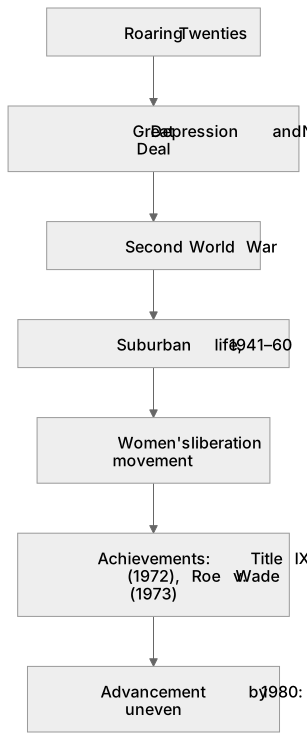
Put it in order
Put these steps in the order they happen.
- 1. Advancement by 1980: uneven
- 2. Achievements: Title IX (1972), Roe v. Wade (1973)
- 3. Second World War
- 4. Women's liberation movement
- 5. Roaring Twenties
- 6. Great Depression and New Deal
- 7. Suburban life, 1941–60
Put the events in order
Put these events in the order they happened, earliest first.
- 1. The Equal Pay Act stemmed from earlier labour activism
- 2. The women's liberation movement achieved Roe v. Wade
- 3. The women's liberation movement achieved Title IX
Key words
Say what each word means before you turn the card.
Government policy and legal reform
Try answering aloud or in your head before turning the card.
Social and cultural expectations of women
Try answering aloud or in your head before turning the card.
Activism and the women’s liberation movement
Try answering aloud or in your head before turning the card.
See every definition
- Government policy and legal reform
- The note cites the Equal Pay Act 1963 as stemming from earlier labour activism, and the women’s liberation movement’s later successes such as Title IX (1972) and Roe v. Wade (1973).
- Social and cultural expectations of women
- The note describes domestic expectations persisting in the Roaring Twenties and post-war suburban life often reinforcing domestic roles and separate spheres.
- Activism and the women’s liberation movement
- Emerging from the late 1960s, it campaigned for reproductive rights and workplace equality, achieving successes like Title IX (1972) and Roe v. Wade (1973).
Label the diagram
Some boxes have lost their names. Pick the right name for each number.
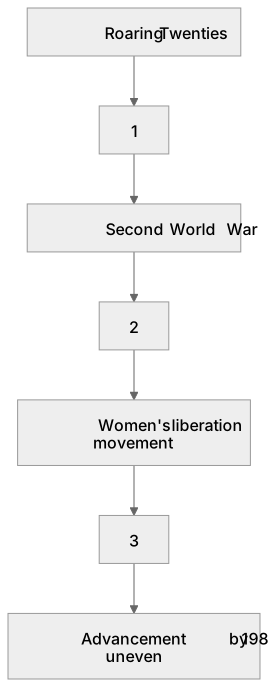
1Box 1
2Box 2
3Box 3
There is more to this lesson
The full lesson goes on to check your understanding and help you earn the marks. Create a free account to carry on, with your progress saved.
A week of Premium from your first lesson · Then the free plan continues · No card, no charge
Test your understanding of Society and culture in change, 1917–80: The changing position of women, 1917–80: impact of the Roaring Twenties, Great Depression and New Deal on women; impact of the Second World War and suburban life, 1941–60; emergence of the women’s liberation movement and its achievements; extent of women’s advancement, 1961–80.
Active recall beats re-reading. Take an instant quiz now to test what you’ve learned and lock it into long-term memory.
A week of Premium from your first lesson · Then the free plan continues · No card, no charge