Pearson Edexcel · A-Level · History
Course version: 9HI0 · Version from Sept 2015
Class and social values: class, social change and the impact of wars,…
Full specification wording
Society in transition, 1918–79: Class and social values: class, social change and the impact of wars, 1918–51; the emergence of the ‘liberal society’, and its opponents, 1951–79.
This topic examines how class and social values changed in Britain from 1918 to 1979.
Checked against the Pearson Edexcel 9HI0 specification (opens in a new tab) on .
- Point 1 of 3
- 3 key terms
Study notes
From the checked teaching notes for this specification point.
The idea
This topic examines how class and social values changed in Britain from 1918 to 1979. From 1918 to 1951, the two world wars disrupted class structures: conscription and labour shortages drew women into industry, while evacuation and rationing exposed poverty. The interwar years saw limited social mobility, but the Second World War led to the 1942 Beveridge Report and the 1945 Labour government’s welfare state, including the NHS. After 1951, affluence, consumerism and youth culture produced a ‘liberal society’ – permissive legislation on abortion, homosexuality and divorce – but this was contested by moral conservatives, religious groups and those who felt traditional values were under threat.
What earns the marks
- Analyses the impact of the Second World War on class and social values, including evacuation, the Blitz, rationing and the Beveridge Report, which increased support for collective welfare provision.
- Assesses the extent to which the post-1945 welfare state and full employment reduced class divisions, for example through the NHS, council housing and secondary education for all.
- Explains the emergence of the ‘liberal society’ after 1951, including permissive legislation such as the 1967 Abortion Act and the 1967 Sexual Offences Act, and changing attitudes to authority and tradition.
- Evaluates the opponents of the ‘liberal society’, such as Mary Whitehouse and the National Viewers’ and Listeners’ Association, religious leaders, and conservative politicians who campaigned against permissiveness.
- Judges how far social change 1918–79 was driven by war, affluence, or government action, and reaches a substantiated overall judgement on the nature and extent of change.
Common mistakes and how to put them right
Treating the ‘liberal society’ as universally accepted.
Put it right: Recognise that permissive reforms often passed with significant opposition and that attitudes varied by region, generation and class.
Assuming that the Second World War alone caused the welfare state.
Put it right: Explain that the Beveridge Report, wartime collectivism and the 1945 Labour victory were all important, and that pre-war poverty surveys also shaped policy.
Confusing class change with social change.
Put it right: Define class in terms of occupation, income and status, and distinguish it from broader social values such as attitudes to marriage, religion and authority.
Overstating the impact of permissive legislation on everyday behaviour.
Put it right: Note that laws such as the 1967 Abortion Act and 1967 Sexual Offences Act changed legal rights but did not immediately transform social attitudes across all groups.
Exam tips
- Plan essays around clear criteria for measuring change, such as legislation, public opinion, class mobility and regional variation, and use them consistently to reach a judgement.
- Use specific evidence with dates and names, for example the 1942 Beveridge Report, the 1948 NHS, the 1967 Abortion Act, and the 1967 Sexual Offences Act, to support each argument.
- Address both parts of the chronology – 1918–51 and 1951–79 – and explicitly compare the impact of wars with other factors such as affluence and government policy.
- When discussing opponents of the ‘liberal society’, explain their arguments and assess their effectiveness rather than simply listing them.
Try the lesson
The start of the Society in transition, 1918–79: Class and social values: class, social change and the impact of wars, 1918–51; the emergence of the ‘liberal society’, and its opponents, 1951–79. lesson, made from checked teaching notes for this specification point.
Have a go first
Which piece of legislation, passed in 1944, is most closely associated with the wartime origins of the post-1945 welfare settlement in Britain?
Listen
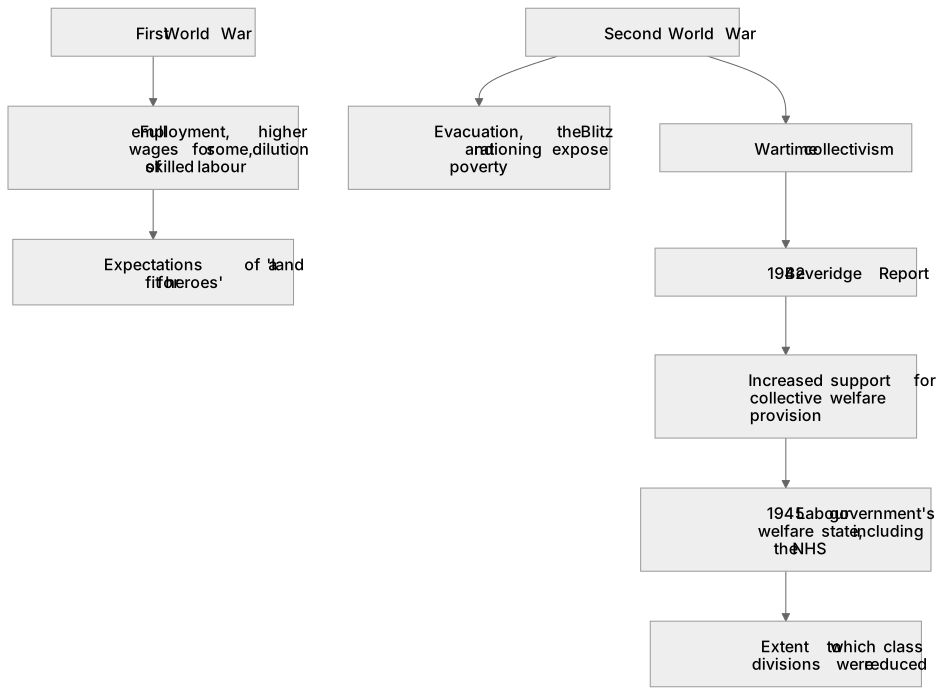
This topic examines how class and social values changed in Britain from 1918 to 1979. From 1918 to 1951, the two world wars disrupted class structures: conscription and labour shortages drew women into industry, while evacuation and rationing exposed poverty. The interwar years saw limited social mobility, but the Second World War led to the 1942 Beveridge Report and the 1945 Labour government’s welfare state, including the NHS. After 1951, affluence, consumerism and youth culture produced a ‘liberal society’ – permissive legislation on abortion, homosexuality and divorce – but this was contested by moral conservatives, religious groups and those who felt traditional values were under threat. A strong answer earns marks for these points. Explains how the First World War affected class and social values, for example through full employment, higher wages for some workers, and the dilution of skilled labour, leading to expectations of a ‘land fit for heroes’. Analyses the impact of the Second World War on class and social values, including evacuation, the Blitz, rationing and the Beveridge Report, which increased support for collective welfare provision. Assesses the extent to which the post-1945 welfare state and full employment reduced class divisions, for example through the NHS, council housing and secondary education for all. Explains the emergence of the ‘liberal society’ after 1951, including permissive legislation such as the 1967 Abortion Act and the 1967 Sexual Offences Act, and changing attitudes to authority and tradition. A common slip: Treating the ‘liberal society’ as universally accepted. Instead, recognise that permissive reforms often passed with significant opposition and that attitudes varied by region, generation and class. Exam tip: Plan essays around clear criteria for measuring change, such as legislation, public opinion, class mobility and regional variation, and use them consistently to reach a judgement.
See it
Put the events in order
Put these events in the order they happened, earliest first.
- 1. The Abortion Act and the Sexual Offences Act were passed
- 2. The Beveridge Report increased support for collective welfare provision
- 3. The NHS was created
- 4. The Labour government established the welfare state
Watch it explained
What is the one idea the video explains? Say it in a sentence.
Read the described scene instead
This lesson examines how class and social values changed in Britain between 1918 and 1979. We will compare two periods: 1918 to 1951, when two world wars disrupted class structures, and 1951 to 1979, when affluence and permissive legislation produced a so-called liberal society. Throughout, ask how far war, government policy and affluence reshaped class and social values. The First World War affected class and social values through full employment, higher wages for some workers, and the dilution of skilled labour. These changes raised expectations of a land fit for heroes. In the interwar years, however, social mobility remained limited. So the war changed experience and expectation more than it immediately transformed the class structure. The Second World War had a broader impact. Evacuation, the Blitz and rationing exposed poverty and increased support for collective welfare provision. The 1942 Beveridge Report and the 1945 Labour government's welfare state, including the NHS, were central. But the welfare state was not caused by the war alone: wartime collectivism, Beveridge and Labour's victory all mattered, and pre-war poverty surveys also shaped policy. After 1945, the welfare state and full employment were meant to reduce class divisions. The NHS, council housing and secondary education for all are key examples. Yet historians must assess how far these measures actually reduced class divisions, rather than assume they did. Class should be defined by occupation, income and status, and distinguished from broader social values. After 1951, affluence, consumerism and youth culture produced what is often called a liberal society. Permissive legislation on abortion, homosexuality and divorce changed legal rights, alongside changing attitudes to authority and tradition. The 1967 Abortion Act and the 1967 Sexual Offences Act are key examples. But these laws did not immediately transform social attitudes across all groups. The liberal society was contested. Moral conservatives, religious groups and conservative politicians campaigned against permissiveness. Mary Whitehouse and the National Viewers' and Listeners' Association are important opponents. Do not treat permissive reforms as universally accepted: they often passed with significant opposition, and attitudes varied by region, generation and class. Explain opponents' arguments and assess their effectiveness rather than simply listing them. To judge change, compare the impact of war, affluence and government action. Wars disrupted class structures and increased support for collective welfare. Affluence and government policy helped produce liberal reforms, but opposition and continuity persisted. A substantiated overall judgement should address the nature and extent of change, using dates and names as evidence.
Key words
Say what each word means before you turn the card.
Class structure and social mobility
Try answering aloud or in your head before turning the card.
Impact of the two world wars on society
Try answering aloud or in your head before turning the card.
The ‘liberal society’ and permissive legislation
Try answering aloud or in your head before turning the card.
See every definition
- Class structure and social mobility
- The note defines class in terms of occupation, income and status, and examines how far class divisions were reduced and social mobility limited across the period.
- Impact of the two world wars on society
- Conscription and labour shortages drew women into industry, while evacuation and rationing exposed poverty, and the Second World War led to the Beveridge Report and collective welfare provision.
- The ‘liberal society’ and permissive legislation
- After 1951, affluence, consumerism and youth culture produced permissive legislation on abortion, homosexuality and divorce, alongside changing attitudes to authority and tradition.
Label the diagram
Some boxes have lost their names. Pick the right name for each number.
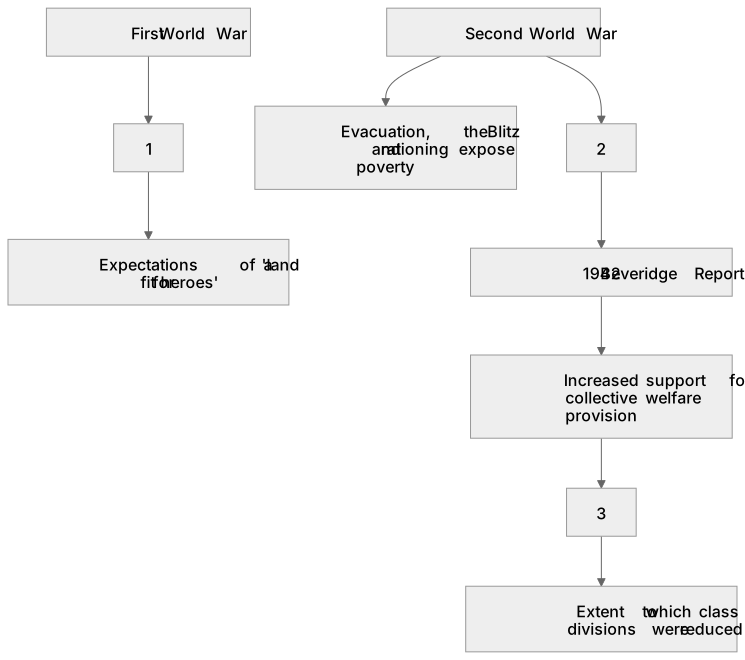
1Box 1
2Box 2
3Box 3
There is more to this lesson
The full lesson goes on to check your understanding and help you earn the marks. Create a free account to carry on, with your progress saved.
A week of Premium from your first lesson · Then the free plan continues · No card, no charge
Test your understanding of Society in transition, 1918–79: Class and social values: class, social change and the impact of wars, 1918–51; the emergence of the ‘liberal society’, and its opponents, 1951–79.
Active recall beats re-reading. Take an instant quiz now to test what you’ve learned and lock it into long-term memory.
A week of Premium from your first lesson · Then the free plan continues · No card, no charge