Pearson Edexcel · A-Level · History
Course version: 9HI0 · Version from Sept 2015
Economic influences: impact of boom, bust and recovery, 1917–41; the…
Full specification wording
The changing quality of life, 1917–80: Economic influences: impact of boom, bust and recovery, 1917–41; the impact of the Second World War, post-war affluence and growth, 1941–69; the challenges of the 1970s.
This topic examines how economic change shaped the quality of life in the USA from 1917 to 1980.
Checked against the Pearson Edexcel 9HI0 specification (opens in a new tab) on .
- Point 1 of 3
Study notes
From the checked teaching notes for this specification point.
The idea
This topic examines how economic change shaped the quality of life in the USA from 1917 to 1980. The 1920s boom brought mass consumption and new consumer goods, but the 1929 crash and Depression caused mass unemployment and hardship, with recovery under the New Deal and wartime mobilisation. The Second World War ended the Depression and expanded industrial output, leading to post-war affluence, suburbanisation and rising living standards to 1969. The 1970s brought stagflation, oil shocks, deindustrialisation and unemployment, challenging assumptions of continuous growth.
What earns the marks
- Explains the impact of the 1920s boom, the Depression and recovery to 1941 on living standards and employment.
- Analyses how the Second World War and post-war affluence to 1969 changed consumption, work and housing.
- Assesses the challenges of the 1970s, including inflation, unemployment and energy crises, on the quality of life.
- Evaluates the uneven impact of economic change on different social groups, regions and ethnicities.
- Draws supported judgements about the extent to which economic change improved the quality of life across the period.
Common mistakes and how to put them right
Treating the 1920s boom as universal prosperity.
Put it right: Recognise that farmers, older industries and many minority groups did not share in the boom.
Assuming post-war affluence benefited everyone equally.
Put it right: Consider persistent poverty, racial discrimination and regional decline.
Describing the 1970s only as a period of decline.
Put it right: Note continuing technological and social change alongside economic problems.
Exam tips
- Use specific economic indicators and events, such as the 1929 Wall Street Crash, wartime production or the 1973 oil crisis.
- Link economic changes directly to effects on housing, health, work and leisure.
- Compare the experiences of different groups to show the uneven impact of economic change.
Try the lesson
The start of the The changing quality of life, 1917–80: Economic influences: impact of boom, bust and recovery, 1917–41; the impact of the Second World War, post-war affluence and growth, 1941–69; the challenges of the 1970s. lesson, made from checked teaching notes for this specification point.
Have a go first
Which of the following was a major impact of the Second World War on the United States economy between 1941 and 1945?
Listen
This topic examines how economic change shaped the quality of life in the USA from 1917 to 1980. The 1920s boom brought mass consumption and new consumer goods, but the 1929 crash and Depression caused mass unemployment and hardship, with recovery under the New Deal and wartime mobilisation. The Second World War ended the Depression and expanded industrial output, leading to post-war affluence, suburbanisation and rising living standards to 1969. The 1970s brought stagflation, oil shocks, deindustrialisation and unemployment, challenging assumptions of continuous growth. A strong answer earns marks for these points. Explains the impact of the 1920s boom, the Depression and recovery to 1941 on living standards and employment. Analyses how the Second World War and post-war affluence to 1969 changed consumption, work and housing. Assesses the challenges of the 1970s, including inflation, unemployment and energy crises, on the quality of life. Evaluates the uneven impact of economic change on different social groups, regions and ethnicities. A common slip: Treating the 1920s boom as universal prosperity. Instead, recognise that farmers, older industries and many minority groups did not share in the boom. Exam tip: Use specific economic indicators and events, such as the 1929 Wall Street Crash, wartime production or the 1973 oil crisis.
See it
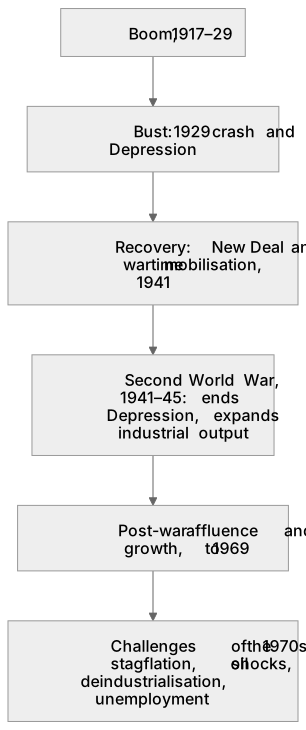
Put it in order
Put these steps in the order they happen.
- 1. Recovery: New Deal and wartime mobilisation, to 1941
- 2. Bust: 1929 crash and Depression
- 3. Boom, 1917–29
- 4. Challenges of the 1970s: stagflation, oil shocks, deindustrialisation, unemployment
- 5. Post-war affluence and growth, to 1969
- 6. Second World War, 1941–45: ends Depression, expands industrial output
Label the diagram
Some boxes have lost their names. Pick the right name for each number.
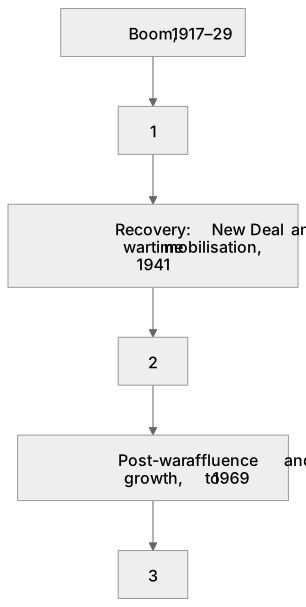
1Box 1
2Box 2
3Box 3
There is more to this lesson
The full lesson goes on to check your understanding and help you earn the marks. Create a free account to carry on, with your progress saved.
A week of Premium from your first lesson · Then the free plan continues · No card, no charge
Test your understanding of The changing quality of life, 1917–80: Economic influences: impact of boom, bust and recovery, 1917–41; the impact of the Second World War, post-war affluence and growth, 1941–69; the challenges of the 1970s.
Active recall beats re-reading. Take an instant quiz now to test what you’ve learned and lock it into long-term memory.
A week of Premium from your first lesson · Then the free plan continues · No card, no charge