Pearson Edexcel · A-Level · History
Course version: 9HI0 · Version from Sept 2015
Defence: Baldwin I’s consolidation of territory, 1100–18; adoption of…
Full specification wording
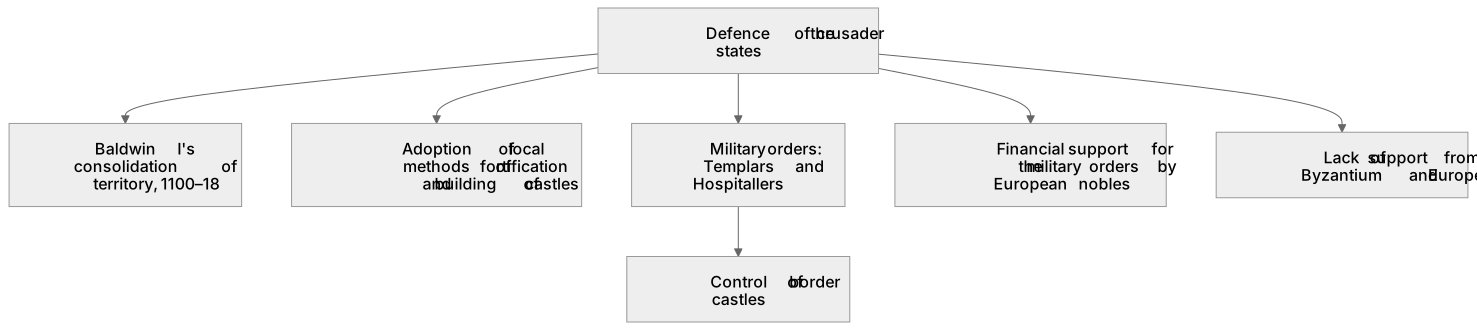
The crusader states of Outremer, 1100–92: Defence: Baldwin I’s consolidation of territory, 1100–18; adoption of local methods of fortification and the building of castles; the protection of the military orders of Templars and Hospitallers, including their control of border castles; financial support for the military orders by European nobles; lack of support for the states from Byzantium and Europe.
Defence of the crusader states relied on Baldwin I's consolidation of territory from 1100 to 1118, securing key strongholds.
Checked against the Pearson Edexcel 9HI0 specification (opens in a new tab) on .
- Point 2 of 3
- 3 key terms
Study notes
From the checked teaching notes for this specification point.
The idea
Defence of the crusader states relied on Baldwin I's consolidation of territory from 1100 to 1118, securing key strongholds. The Franks adopted local methods of fortification, building castles like Krak des Chevaliers. Military orders, Templars and Hospitallers, protected the states, controlling border castles. European nobles provided financial support, but support from Byzantium and Europe was lacking. This mix of local adaptation and external aid was crucial for survival. The military orders became a permanent defensive force, but reliance on Europe was inconsistent. Overall, defence was a constant challenge due to limited resources and external threats.
What earns the marks
- Explains Baldwin I's consolidation of territory from 1100 to 1118, including key campaigns and acquisitions.
- Describes the adoption of local methods of fortification and the building of castles, such as Krak des Chevaliers.
- Analyses the role of the military orders (Templars and Hospitallers) in protecting the states, including their control of border castles.
- Discusses financial support for the military orders by European nobles and its impact.
- Evaluates the lack of support from Byzantium and Europe, and its consequences for the defence of the crusader states.
Common mistakes and how to put them right
Confusing the roles of Templars and Hospitallers.
Put it right: Both were military orders, but they had different origins and sometimes rivalries; both controlled border castles.
Assuming that European support was constant.
Put it right: Support was sporadic and often insufficient, leading to reliance on local resources.
Overlooking Baldwin I's achievements.
Put it right: Baldwin I expanded and secured the kingdom, setting foundations for defence.
Exam tips
- Use specific examples of castles and their locations to show understanding of fortification.
- Explain how the military orders were funded and what that meant for their effectiveness.
- Contrast the support from Byzantium and Europe with the needs of the states.
Try the lesson
The start of the The crusader states of Outremer, 1100–92: Defence: Baldwin I’s consolidation of territory, 1100–18; adoption of local methods of fortification and the building of castles; the protection of the military orders of Templars and Hospitallers, including their control of border castles; financial support for the military orders by European nobles; lack of support for the states from Byzantium and Europe. lesson, made from checked teaching notes for this specification point.
Have a go first
Which two military orders played a crucial role in protecting the crusader states and controlling border castles?
Listen
Defence of the crusader states relied on Baldwin I's consolidation of territory from 1100 to 1118, securing key strongholds. The Franks adopted local methods of fortification, building castles like Krak des Chevaliers. Military orders, Templars and Hospitallers, protected the states, controlling border castles. European nobles provided financial support, but support from Byzantium and Europe was lacking. This mix of local adaptation and external aid was crucial for survival. The military orders became a permanent defensive force, but reliance on Europe was inconsistent. Overall, defence was a constant challenge due to limited resources and external threats. A strong answer earns marks for these points. Explains Baldwin I's consolidation of territory from 1100 to 1118, including key campaigns and acquisitions. Describes the adoption of local methods of fortification and the building of castles, such as Krak des Chevaliers. Analyses the role of the military orders (Templars and Hospitallers) in protecting the states, including their control of border castles. Discusses financial support for the military orders by European nobles and its impact. A common slip: Confusing the roles of Templars and Hospitallers. Instead, Both were military orders, but they had different origins and sometimes rivalries; both controlled border castles. Exam tip: Use specific examples of castles and their locations to show understanding of fortification.
See it
Key words
Say what each word means before you turn the card.
Fortification
Try answering aloud or in your head before turning the card.
External support
Try answering aloud or in your head before turning the card.
Military defence
Try answering aloud or in your head before turning the card.
See every definition
- Fortification
- The adoption of local methods of fortification and the building of castles helped to defend the territory.
- External support
- Financial support came from European nobles, but support from Byzantium and Europe was lacking.
- Military defence
- Defence relied on Baldwin I's consolidation of territory, castles and the military orders.
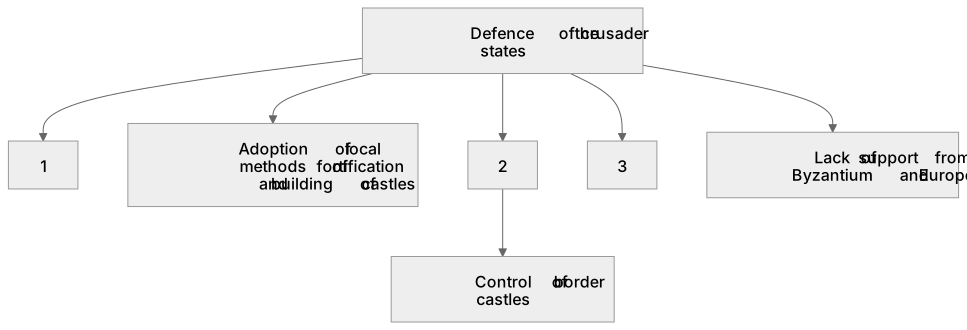
Label the diagram
Some boxes have lost their names. Pick the right name for each number.
1Box 1
2Box 2
3Box 3
There is more to this lesson
The full lesson goes on to check your understanding and help you earn the marks. Create a free account to carry on, with your progress saved.
A week of Premium from your first lesson · Then the free plan continues · No card, no charge
Test your understanding of The crusader states of Outremer, 1100–92: Defence: Baldwin I’s consolidation of territory, 1100–18; adoption of local methods of fortification and the building of castles; the protection of the military orders of Templars and Hospitallers, including their control of border castles; financial support for the military orders by European nobles; lack of support for the states from Byzantium and Europe.
Active recall beats re-reading. Take an instant quiz now to test what you’ve learned and lock it into long-term memory.
A week of Premium from your first lesson · Then the free plan continues · No card, no charge