Pearson Edexcel · A-Level · History
Course version: 9HI0 · Version from Sept 2015
Lutheran beliefs and their influence: the importance of justification; the…
Full specification wording
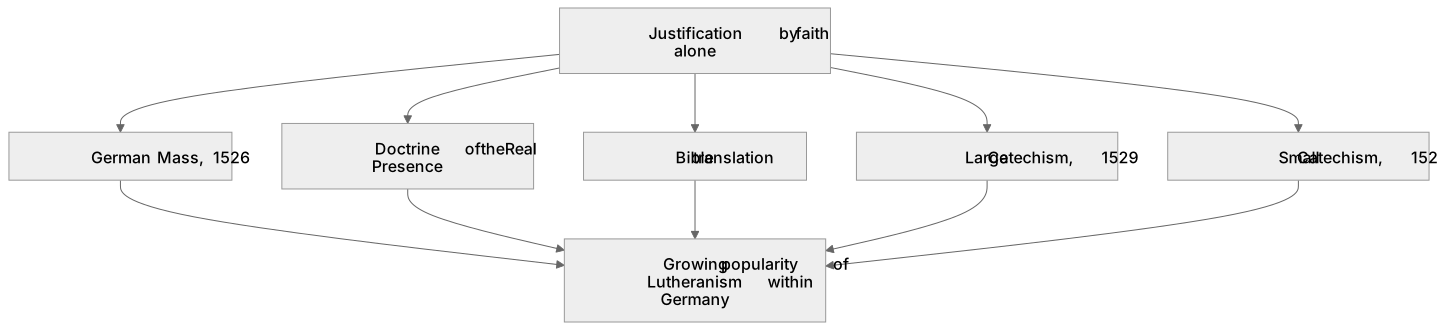
The development of Lutheranism, 1521–46: Lutheran beliefs and their influence: the importance of justification; the German Mass; the doctrine of the Real Presence; Luther’s translation of the Bible; the Large Catechism and Small Catechism; the growing popularity of Lutheranism within Germany.
Lutheran beliefs centred on justification by faith alone: humans are saved by God’s grace through faith in Christ, not by works.
Checked against the Pearson Edexcel 9HI0 specification (opens in a new tab) on .
- Point 3 of 4
- 4 key terms
Study notes
From the checked teaching notes for this specification point.
The idea
Lutheran beliefs centred on justification by faith alone: humans are saved by God’s grace through faith in Christ, not by works. This shaped worship: Luther’s German Mass (1526) replaced Latin with German, included hymns and preaching, and allowed communion in both kinds. On the Real Presence, Luther rejected transubstantiation but taught that Christ’s body and blood are truly present ‘in, with and under’ bread and wine. His Bible translation (New Testament 1522, complete Bible 1534) gave Germans Scripture in their own language, standardising written German. The Large Catechism (1529) taught clergy and adults; the Small Catechism (1529) taught children and households. These ideas spread through printing, schools and princely support, making Lutheranism increasingly popular in many German territories by the 1540s.
What earns the marks
- Explains justification by faith alone as the central Lutheran belief: salvation is God’s gift received through faith, not earned by good works or sacraments.
- Describes the German Mass as a vernacular liturgy that replaced Latin, emphasised preaching and congregational singing, and often gave communion in both kinds.
- Distinguishes Luther’s doctrine of the Real Presence from transubstantiation: Christ is truly present in the elements but the bread and wine remain.
- Shows how Luther’s Bible translation made Scripture accessible to ordinary Germans and helped standardise the German language.
- Compares the purpose of the Large Catechism (teaching clergy and adults) with the Small Catechism (teaching children and households).
- Assesses reasons for the growing popularity of Lutheranism, such as printing, political protection, urban support and the appeal of justification by faith.
Common mistakes and how to put them right
Treating justification by faith as meaning that good works are unimportant.
Put it right: Luther taught that faith produces good works, but works do not earn salvation.
Confusing the Real Presence with transubstantiation.
Put it right: Luther denied that the bread and wine change substance, while affirming Christ’s true presence.
Assuming the German Mass was written in 1517 or that it immediately replaced all Latin services.
Put it right: It was published in 1526 and was adopted gradually, with Latin retained in some places.
Believing the Bible translation was the work of Luther alone.
Put it right: He led a team of scholars, and the complete Bible appeared in 1534.
Exam tips
- When explaining influence, link each belief or text to a concrete effect: for example, the Small Catechism’s question-and-answer format made doctrine memorable for households.
- Use precise dates and terms (1526, 1529, 1534; justification; Real Presence) to show secure knowledge.
- For ‘importance’ questions, prioritise justification by faith as the core doctrine and explain how other beliefs and texts depended on it.
Try the lesson
The start of the The development of Lutheranism, 1521–46: Lutheran beliefs and their influence: the importance of justification; the German Mass; the doctrine of the Real Presence; Luther’s translation of the Bible; the Large Catechism and Small Catechism; the growing popularity of Lutheranism within Germany. lesson, made from checked teaching notes for this specification point.
Have a go first
Which doctrine did Luther regard as the central teaching of the Christian faith?
Listen
Lutheran beliefs centred on justification by faith alone: humans are saved by God’s grace through faith in Christ, not by works. This shaped worship: Luther’s German Mass (1526) replaced Latin with German, included hymns and preaching, and allowed communion in both kinds. On the Real Presence, Luther rejected transubstantiation but taught that Christ’s body and blood are truly present ‘in, with and under’ bread and wine. His Bible translation (New Testament 1522, complete Bible 1534) gave Germans Scripture in their own language, standardising written German. The Large Catechism (1529) taught clergy and adults; the Small Catechism (1529) taught children and households. These ideas spread through printing, schools and princely support, making Lutheranism increasingly popular in many German territories by the 1540s. A strong answer earns marks for these points. Explains justification by faith alone as the central Lutheran belief: salvation is God’s gift received through faith, not earned by good works or sacraments. Describes the German Mass as a vernacular liturgy that replaced Latin, emphasised preaching and congregational singing, and often gave communion in both kinds. Distinguishes Luther’s doctrine of the Real Presence from transubstantiation: Christ is truly present in the elements but the bread and wine remain. Shows how Luther’s Bible translation made Scripture accessible to ordinary Germans and helped standardise the German language. A common slip: Treating justification by faith as meaning that good works are unimportant. Instead, Luther taught that faith produces good works, but works do not earn salvation. Exam tip: When explaining influence, link each belief or text to a concrete effect: for example, the Small Catechism’s question-and-answer format made doctrine memorable for households.
See it
Put the events in order
Put these events in the order they happened, earliest first.
- 1. Complete Bible translation appeared
- 2. Luther's New Testament translation published
- 3. Large Catechism and Small Catechism produced
- 4. Luther's German Mass replaced Latin in worship
Key words
Say what each word means before you turn the card.
Justification
Try answering aloud or in your head before turning the card.
German Mass
Try answering aloud or in your head before turning the card.
Real Presence
Try answering aloud or in your head before turning the card.
Catechism
Try answering aloud or in your head before turning the card.
See every definition
- Justification
- The central Lutheran belief that humans are saved by God’s grace through faith in Christ, not by works.
- German Mass
- A vernacular liturgy published in 1526 that replaced Latin, emphasised preaching and congregational singing, and allowed communion in both kinds.
- Real Presence
- Luther’s doctrine that Christ’s body and blood are truly present ‘in, with and under’ bread and wine, while the bread and wine remain.
- Catechism
- A teaching text, the Large Catechism for clergy and adults and the Small Catechism for children and households, both of 1529.
Label the diagram
Some boxes have lost their names. Pick the right name for each number.
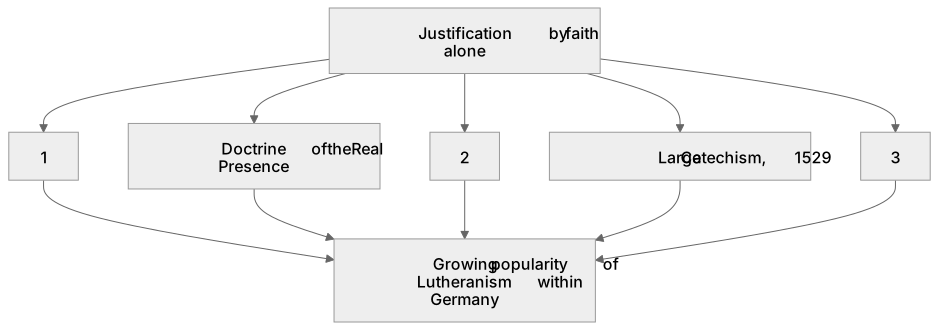
1Box 1
2Box 2
3Box 3
There is more to this lesson
The full lesson goes on to check your understanding and help you earn the marks. Create a free account to carry on, with your progress saved.
A week of Premium from your first lesson · Then the free plan continues · No card, no charge
Test your understanding of The development of Lutheranism, 1521–46: Lutheran beliefs and their influence: the importance of justification; the German Mass; the doctrine of the Real Presence; Luther’s translation of the Bible; the Large Catechism and Small Catechism; the growing popularity of Lutheranism within Germany.
Active recall beats re-reading. Take an instant quiz now to test what you’ve learned and lock it into long-term memory.
A week of Premium from your first lesson · Then the free plan continues · No card, no charge