Pearson Edexcel · A-Level · History
Course version: 9HI0 · Version from Sept 2015
The February Revolution: growth of unrest in towns and countryside;…
Full specification wording
The end of Romanov rule, 1906–17: The February Revolution: growth of unrest in towns and countryside; International Women’s Day and the Petrograd general strike; the creation of the Provisional Committee and the Petrograd Soviet; the abdication of Nicholas II.
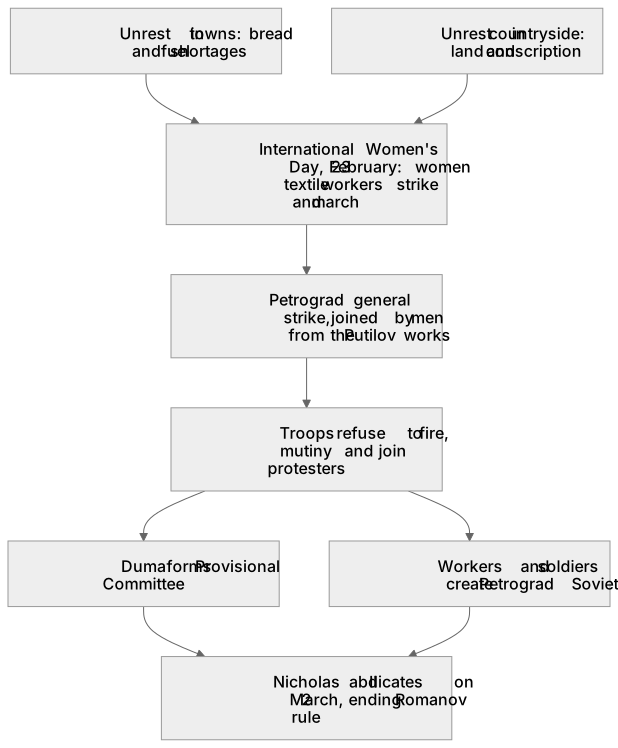
By early 1917 unrest grew in towns over bread and fuel shortages, and in the countryside over land and conscription.
Checked against the Pearson Edexcel 9HI0 specification (opens in a new tab) on .
- Point 4 of 4
- 4 key terms
Study notes
From the checked teaching notes for this specification point.
The idea
By early 1917 unrest grew in towns over bread and fuel shortages, and in the countryside over land and conscription. On International Women's Day, 23 February, women textile workers in Petrograd struck and marched, sparking a general strike joined by men from the Putilov works. Troops refused to fire on protesters, mutinied and joined them. The Duma formed a Provisional Committee, while workers and soldiers created the Petrograd Soviet. Facing loss of all support, Nicholas II abdicated on 2 March, ending Romanov rule.
What earns the marks
- Explains how food and fuel shortages in towns and rural discontent over land and conscription created a revolutionary situation by early 1917.
- Describes the events of International Women's Day, including the strike by women textile workers and the spread to a general strike in Petrograd.
- Analyses the significance of the mutiny of Petrograd garrison troops and their support for the protesters.
- Compares the creation and aims of the Provisional Committee of the Duma with the Petrograd Soviet of Workers' and Soldiers' Deputies.
- Assesses the reasons for and consequences of Nicholas II's abdication on 2 March 1917.
Common mistakes and how to put them right
Saying the February Revolution was planned by Bolsheviks.
Put it right: It began spontaneously from bread riots and strikes, though socialists later influenced the Soviet.
Confusing the Provisional Committee with the Petrograd Soviet.
Put it right: The Committee was formed by Duma politicians, while the Soviet represented workers and soldiers.
Claiming Nicholas abdicated immediately on 23 February.
Put it right: He abdicated on 2 March after losing army and Duma support.
Exam tips
- Use precise dates, such as 23 February for International Women's Day and 2 March for the abdication.
- Explain the dual power situation by contrasting the Provisional Committee and the Petrograd Soviet.
- Show how the mutiny of troops was a turning point that made the regime's collapse irreversible.
Try the lesson
The start of the The end of Romanov rule, 1906–17: The February Revolution: growth of unrest in towns and countryside; International Women’s Day and the Petrograd general strike; the creation of the Provisional Committee and the Petrograd Soviet; the abdication of Nicholas II. lesson, made from checked teaching notes for this specification point.
Have a go first
On which date in 1917 did crowds in Petrograd mark International Women's Day with strikes and demonstrations that helped to trigger the February Revolution?
Listen
By early 1917 unrest grew in towns over bread and fuel shortages, and in the countryside over land and conscription. On International Women's Day, 23 February, women textile workers in Petrograd struck and marched, sparking a general strike joined by men from the Putilov works. Troops refused to fire on protesters, mutinied and joined them. The Duma formed a Provisional Committee, while workers and soldiers created the Petrograd Soviet. Facing loss of all support, Nicholas II abdicated on 2 March, ending Romanov rule. A strong answer earns marks for these points. Explains how food and fuel shortages in towns and rural discontent over land and conscription created a revolutionary situation by early 1917. Describes the events of International Women's Day, including the strike by women textile workers and the spread to a general strike in Petrograd. Analyses the significance of the mutiny of Petrograd garrison troops and their support for the protesters. Compares the creation and aims of the Provisional Committee of the Duma with the Petrograd Soviet of Workers' and Soldiers' Deputies. A common slip: saying the February Revolution was planned by Bolsheviks. Instead, it began spontaneously from bread riots and strikes, though socialists later influenced the Soviet. Exam tip: Use precise dates, such as 23 February for International Women's Day and 2 March for the abdication.
See it
Key words
Say what each word means before you turn the card.
International Women's Day
Try answering aloud or in your head before turning the card.
Provisional Committee
Try answering aloud or in your head before turning the card.
Petrograd Soviet
Try answering aloud or in your head before turning the card.
Abdication of Nicholas II
Try answering aloud or in your head before turning the card.
See every definition
- International Women's Day
- On 23 February, women textile workers in Petrograd struck and marched, sparking a general strike joined by men from the Putilov works.
- Provisional Committee
- Formed by Duma politicians, it was created alongside the Petrograd Soviet of Workers' and Soldiers' Deputies.
- Petrograd Soviet
- Created by workers and soldiers, it represented them while the Provisional Committee was formed by Duma politicians.
- Abdication of Nicholas II
- Facing loss of all support, he abdicated on 2 March, ending Romanov rule.
Label the diagram
Some boxes have lost their names. Pick the right name for each number.
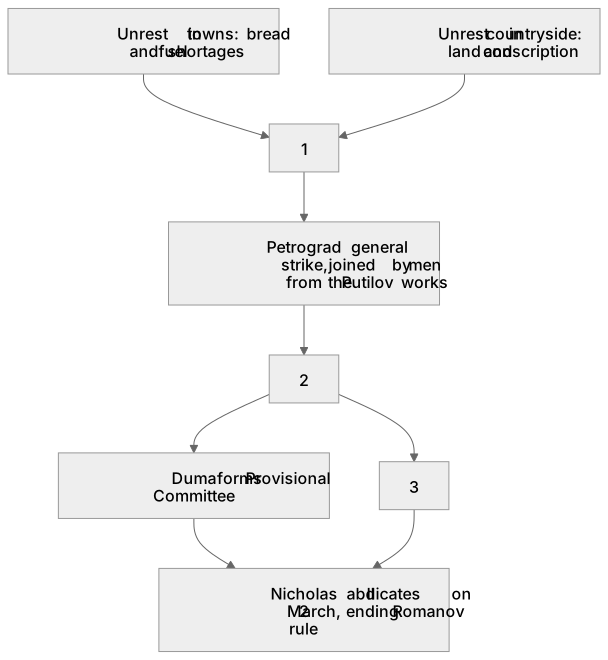
1Box 1
2Box 2
3Box 3
There is more to this lesson
The full lesson goes on to check your understanding and help you earn the marks. Create a free account to carry on, with your progress saved.
A week of Premium from your first lesson · Then the free plan continues · No card, no charge
Test your understanding of The end of Romanov rule, 1906–17: The February Revolution: growth of unrest in towns and countryside; International Women’s Day and the Petrograd general strike; the creation of the Provisional Committee and the Petrograd Soviet; the abdication of Nicholas II.
Active recall beats re-reading. Take an instant quiz now to test what you’ve learned and lock it into long-term memory.
A week of Premium from your first lesson · Then the free plan continues · No card, no charge